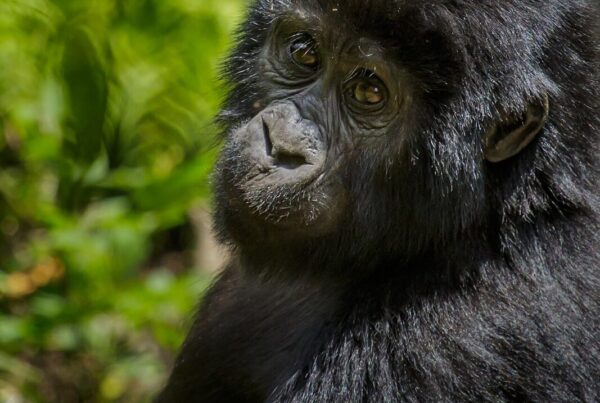
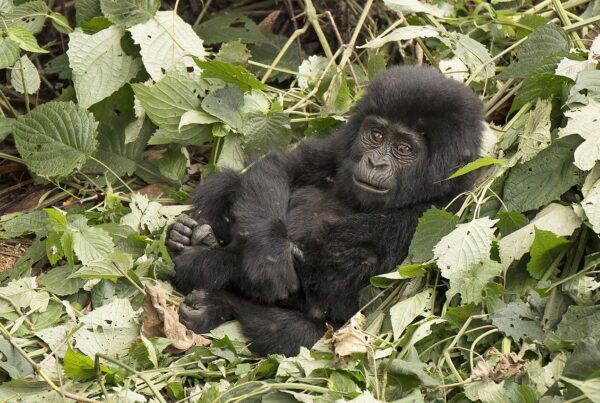
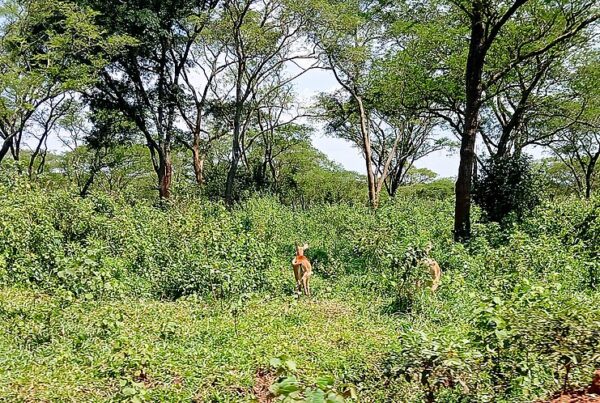
In 2018, the IUCN — the International Union for Conservation of Nature, which maintains the Red List of Threatened Species used as the global standard for conservation status — announced a reassessment of the mountain gorilla: the subspecies was downlisted from Critically Endangered to Endangered, the first positive movement in the mountain gorilla’s conservation status in recorded history and a direct result of the 2018 census confirming a population of at least 1,004 individuals, surpassing the threshold that triggers reassessment. Endangered still means a very high risk of extinction in the wild — the downlisting reflects progress, not safety — but it represents a genuine conservation milestone that Bwindi gorilla trekking revenue has directly funded. See Uganda safari packages.
- Previous status: Critically Endangered (highest risk category before Extinct in the Wild)
- New status: Endangered (2018) — still a very high risk of extinction
- Trigger: 2018 census confirmed population over 1,000 individuals; Critically Endangered threshold is under 250 mature individuals
- Population at lowest point: estimated 254 individuals in the early 1980s
- 2018 census figure: 1,004 mountain gorillas confirmed; subsequent surveys put the number above 1,063
In 2018, the International Union for Conservation of Nature announced a reassessment of the mountain gorilla’s conservation status: the subspecies was downlisted from Critically Endangered to Endangered. This change — the first positive movement in the mountain gorilla’s IUCN Red List status since systematic assessment began — represented one of the most significant conservation milestones in African wildlife history. Understanding what the change means, what it does not mean, and what produced it tells the story of one of conservation’s genuine successes.
What Critically Endangered means
The IUCN Red List assesses species against criteria relating to population size, rate of population change, geographic range, and the probability of extinction over defined time periods. Critically Endangered is the highest-risk category before Extinct in the Wild — a species listed as Critically Endangered faces an extremely high risk of extinction in the wild. The assessment is based on quantitative thresholds: a population under 250 mature individuals, or a 80+ percent reduction in population over three generations, qualifies automatically.
Mountain gorillas were first scientifically assessed as Critically Endangered in the 1990s when the global population had fallen to an estimated 250–300 individuals — a number so low that any single catastrophic event (epidemic disease, volcanic eruption, armed conflict affecting key habitat) could have triggered population collapse. At that population level, the subspecies was genuinely at imminent risk of extinction.
The population recovery
The 2018 reassessment reflected the results of a census conducted across the full range of mountain gorilla habitat in 2016–2018: Bwindi Impenetrable National Park, Mgahinga Gorilla National Park, and the Virunga Massif spanning Rwanda, DRC, and Uganda. The census counted approximately 1,004 individuals at that time; subsequent monitoring and births have taken the estimated total above 1,100.
This growth — from under 300 to over 1,100 in roughly three decades — represents a population increase of over 350 percent. By any measure, this is a remarkable conservation outcome. The criteria for downlisting from Critically Endangered to Endangered include population exceeding 250 mature individuals and demonstrating a stable or growing trend. The mountain gorilla met both criteria clearly.
The recovery has not been uniform across the two populations (Bwindi and the Virunga Massif). The Virunga population has grown faster in percentage terms, benefiting from a more compact and intensively monitored habitat. The Bwindi population’s growth has been slower but consistent. Both populations are now larger than they were at any point in the past 50 years, which is the relevant benchmark for assessing conservation success.
What drove the recovery
Multiple factors contributed to the population recovery, and researchers who have studied it emphasise that no single intervention explains the outcome — it was a system-level success.
Anti-poaching enforcement: The deployment of trained rangers who conduct daily patrols, remove snares, and investigate poaching incidents has dramatically reduced gorilla mortality from hunting. The Virunga ranger programme, which includes hundreds of rangers and has suffered significant casualties from conflict with armed groups, represents a sustained and costly commitment to field protection.
Tourism revenue and community benefit-sharing: The gorilla trekking permit system generates millions of dollars annually, a portion of which is shared with communities surrounding the parks. This revenue sharing creates economic interest in conservation outcomes at the community level. Communities who receive school buildings, health clinics, and water infrastructure from park tourism revenue have stronger incentives to support conservation and report poaching than communities who receive nothing.
Veterinary intervention: The Gorilla Doctors programme has conducted hundreds of medical interventions — treating snare injuries, respiratory infections, and other conditions that would likely have been fatal without treatment. At population sizes as small as those of mountain gorillas, individual deaths have demographic significance, and the prevention of avoidable deaths has contributed measurably to population growth.
Habitat protection: The legal protection of the national parks, combined with enforcement of park boundaries, has maintained the habitat that sustains the gorilla population. Despite significant agricultural pressure around park boundaries, the core forest habitats have remained intact — a consequence of the political commitment and institutional capacity of Uganda, Rwanda, and (to a more contested extent) DRC to maintain protected area status.
Habituation and research: The habituation of gorilla groups for research and tourism has not only enabled the tourism that funds conservation — it has also provided monitoring capacity. Habituated gorillas are observed daily, and any health or behavioural concerns are identified and reported rapidly. This surveillance function means that health crises are caught early and mortality from preventable causes is reduced.
Why Endangered is not a reason for complacency
The downlisting from Critically Endangered to Endangered is a conservation success, but it does not mean mountain gorillas are safe. Endangered is still a high-risk category: a species listed as Endangered faces a very high risk of extinction in the wild. The total population of 1,100 individuals is still extraordinarily small — smaller than many single herds of buffalo in East Africa’s savannah parks. The entire global population of mountain gorillas would fit comfortably in a single sports stadium.
The threats that drove the original decline have not been eliminated; they have been managed. Poaching pressure continues, requiring sustained anti-poaching effort. Disease risk from human pathogens is an ongoing threat that requires continued management of tourist protocols and veterinary preparedness. Climate change is beginning to affect the montane forest habitats that gorillas depend on. Political instability in DRC — where roughly half the total gorilla population lives — remains a constant background risk. And the dependency of the conservation system on tourism revenue makes it vulnerable to the kind of disruption that COVID-19 caused, when park closures temporarily eliminated the income that funds conservation operations.
A model for conservation
The mountain gorilla recovery is now studied internationally as one of the few examples of a critically endangered large mammal population being brought back from the edge of extinction through active conservation management. The model — intensive protection, tourism financing, community benefit-sharing, veterinary care, and sustained research — has been applied or adapted for other species and other contexts. The lessons are not always transferable directly (the gorilla model depends on tourism revenue that not all species can generate), but the demonstration that deliberate, well-funded, community-engaged conservation can reverse population decline in a critically threatened species is one of the most important facts in the conservation field.
Visitors who come to Uganda for gorilla trekking are participating in the financing system that makes this recovery possible. The USD 800 permit that seems expensive in isolation is, in context, a direct contribution to one of conservation’s most important ongoing achievements. Understanding that context changes the meaning of the encounter: you are not simply a tourist; you are a stakeholder in a conservation success that took three decades and many lives to achieve.
What does the IUCN Red List classification system mean?
The IUCN Red List of Threatened Species is the global standard for assessing the conservation status of species and subspecies. It uses quantitative criteria — population size, rate of decline, geographic range, probability of extinction modelling — to assign species to categories. From most to least severe, the threatened categories are: Critically Endangered (CR), Endangered (EN), and Vulnerable (VU). Critically Endangered indicates an extremely high risk of extinction in the wild; the criteria triggering CR status include a population of fewer than 250 mature individuals, or a population decline of 80% or more over three generations. Endangered indicates a very high risk of extinction; the EN criteria include fewer than 2,500 mature individuals or a decline of 50% or more over three generations. Mountain gorillas moved from CR to EN when the 2018 census confirmed a population exceeding the CR threshold — but they remain well within the EN criteria given their restricted range and ongoing vulnerability.
How was the 2018 mountain gorilla census conducted?
Mountain gorilla censuses use DNA analysis of faecal samples collected systematically across the gorilla range — the most reliable method for a forest-dwelling primate in terrain where direct visual counts are impossible for non-habituated individuals. Field teams from Uganda Wildlife Authority, Rwanda Development Board, the Institut Congolais pour la Conservation de la Nature, and partner research organisations collected faecal samples across Bwindi, Mgahinga, and the Virungas. DNA extracted from these samples allows individual identification (each gorilla has a unique DNA profile), building a population estimate from the number of distinct individuals detected. The 2018 Bwindi census was conducted separately from the Virunga census; combined, they confirmed at least 1,004 individuals. Habituated family members are additionally monitored through direct daily observation, providing a precise known population as a baseline for the wider census estimates.
What drove the mountain gorilla population recovery?
The mountain gorilla population recovery from under 300 in the early 1980s to over 1,100 today is the result of several converging factors rather than a single intervention. Anti-poaching: the systematic snare removal and boundary patrol programmes at Bwindi and the Virungas dramatically reduced gorilla mortality from incidental snaring and direct poaching. Veterinary care: the Gorilla Doctors programme, established in 1986, provides medical intervention when habituated gorillas develop treatable conditions — snare injuries, respiratory infections, and other survivable threats that would otherwise cause death. Tourism revenue sustainability: the gorilla permit system created a large, reliable revenue stream for conservation operations that donor grants alone could not provide. Community engagement: revenue sharing and employment programmes reduced the economic incentive for communities to support poaching. Habitat protection: maintaining the forest integrity of Bwindi and the Virungas through sustained political commitment from Uganda, Rwanda, and DRC governments.
Does the downlisting mean gorilla conservation is less urgent?
No — and this is a point conservation organisations were careful to communicate when the 2018 downlisting was announced. Endangered still represents a very high risk of extinction in the wild. Mountain gorillas remain one of the world’s most threatened mammals: with a total population of approximately 1,100 individuals confined to roughly 780 square kilometres of fragmented mountain forest, surrounded by densely populated farmland, the species is acutely vulnerable to any significant disturbance — a disease outbreak, a period of civil conflict disrupting ranger operations, or a further reduction in tourism revenue cutting conservation funding. The IUCN’s own announcement of the 2018 downlisting explicitly stated that the status change did not mean conservation efforts could be relaxed, and that Endangered status still requires the same level of focused conservation investment that drove the population growth.
Could mountain gorillas ever be fully removed from the threatened list?
In theory, mountain gorillas could eventually be downlisted further to Vulnerable and eventually Near Threatened if the population continued to grow and the geographic range expanded — but the structural constraints on this are severe. The entire mountain gorilla range is limited by geography: suitable montane forest habitat at the required elevations exists only in the Albertine Rift, and the areas immediately surrounding Bwindi and the Virungas are among the most densely populated agricultural landscapes in Africa. Expanding gorilla range into new areas would require forest restoration, community land-use changes, and political agreements across three countries. The more realistic scenario is a continued slow population increase within the current range, stabilising at a size determined by the carrying capacity of the protected forest area. A population of 1,000-1,500 in a 780 square kilometre range will remain conservation-dependent for the foreseeable future regardless of Red List category.
- Gorilla Conservation Success: How Mountain Gorillas Were Saved
- Meet the conservationist protecting mountain gorillas in the heart of the impenetrable forest.
- Gorilla Conservation Success Story: How Tourism Saved Mountain Gorillas
- Dian Fossey and Mountain Gorillas: Her Legacy in Conservation
- Mountain Gorilla Conservation Challenges Today
- Mountain Gorilla Conservation Organisations: Who Is Doing the Work
- How to Support Mountain Gorilla Conservation From Home
- Gorilla Conservation History: 60 Years of Protecting Mountain Gorillas
- Before and After: How Conservation Saved the Mountain Gorilla in Pictures
- What 30 Years of Mountain Gorilla Conservation Looked Like on the Ground