Updated
gorilla trekking Uganda lifetime memory is one of Africa’s most extraordinary wildlife experiences, connecting travellers with mountain gorillas in their natural forest habitat. The phrase is deliberately extreme, and it is used deliberately. Most travel writing describes destinations as “unforgettable” or “life-changing” with a looseness that has made both words functionally meaningless. The gorilla encounter in Uganda is not unforgettable in that loose sense. It is specifically, durably memorable in a way that the testimony of people who experienced it decades ago confirms without exception.
Deathbed is the extreme version of a more modest and verifiable claim: that the gorilla encounter in Bwindi is among the memories that people rank highest in their long-term experiential inventory — that when asked, years or decades later, to name the experiences that mattered most, the gorilla trekking trip appears with striking regularity and with striking vividness. This is not universal — there will always be people for whom an experience does not land as it does for others. But the pattern is consistent enough to be treated as a reliable prediction rather than an aspiration.
Gorilla Trekking Uganda: The Trip You Will Remember on Your Deathbed
What the Research Says About Memorable Experiences
The psychology of memory has identified several reliable predictors of long-term memory quality. Emotional intensity at the time of experience is the strongest predictor — experiences that produce intense emotional responses create stronger, more stable long-term memories. Novelty is the second strongest — experiences that are genuinely unlike prior experience require the formation of new memory frameworks, which produces deeper encoding. And meaning — the sense that the experience is connected to things that matter deeply — appears to strengthen the memory’s resistance to fading over time.
The gorilla encounter scores at the high end on all three dimensions. The emotional response is intense for virtually all visitors — a combination of awe, recognition, and what can only be described as a form of love or tenderness toward the gorilla family that most people do not anticipate and cannot quite explain. The novelty is absolute: nothing in ordinary experience prepares you for it. And the meaning — the awareness of conservation, of shared ancestry, of the extraordinary improbability of this moment in ecological history — is dense and immediate.
The Deathbed Test in Practice
The deathbed test is a thought experiment sometimes used in ethics and in life-choice frameworks: what will you wish you had done, seen, experienced, when you are at the end of your life and reviewing what it contained? The test is not about comfort or safety — those are often better served by not doing extraordinary things. It is about the experiences that constitute a life of depth and richness, the ones that gave you something to carry and to pass on.
In that framework, the gorilla trekking trip in Uganda scores well by almost any measure. It is the kind of experience that belongs in a life’s inventory not because it is prestigious or photogenic but because it provides something genuinely irreplaceable: a direct encounter with another kind of intelligence in a wild forest, on their terms, for an hour that will remain specific and vivid in memory for as long as you are able to remember anything.
The Accessible Extraordinary
The deathbed-memorable experiences most people imagine are either physically extreme (climbing Everest, crossing a desert) or financially extreme (private island, expedition to Antarctica). Gorilla trekking in Uganda is neither. It requires a level of physical fitness that most people over forty with some hiking experience can manage. It costs $800 for the permit and $2,500-$3,500 total from Europe — significant but not extraordinary by the standards of major travel expenditure.
It sits in a category that deserves its own name: accessible extraordinary. The experiences that produce deathbed-worthy memories without requiring you to be either an elite athlete or a billionaire. Uganda’s gorillas are the best example of this category that currently exists. The forest is there. The gorillas are there. The conservation system is there. The $800 permit is available. Contact us to book yours for 2027.
Frequently Asked Questions
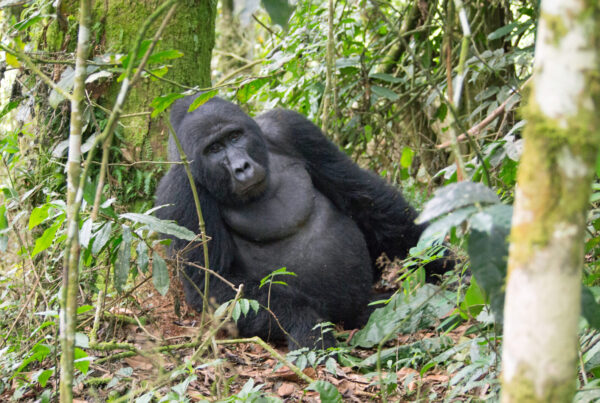
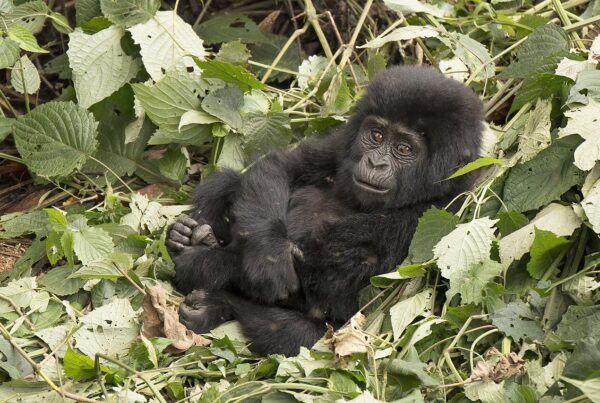
Uganda is home to the mountain gorilla (Gorilla beringei beringei), one of two subspecies of eastern gorilla. They live exclusively in the Virunga volcanic highlands (Uganda/Rwanda/DRC) and Bwindi Impenetrable Forest (Uganda only). Mountain gorillas are the only gorilla subspecies that cannot survive in captivity — every individual you can trek is a wild animal.
The standard gorilla trekking permit gives you exactly 1 hour with the gorilla family. This time begins when you make first contact with the family — the ranger signals the start. The Gorilla Habituation Experience gives 4 hours with a semi-wild family. The walk to find the gorillas can take 30 minutes to 5 hours depending on where the family has moved.
Stay calm, crouch down slowly, avoid direct eye contact, and remain quiet. Do not run — running triggers a chase response. Rangers accompanying your group manage close approaches. Habituated gorillas are accustomed to humans and almost never make contact, but a charging silverback is managed by staying still and following ranger instructions immediately.
A maximum of 8 visitors per habituated gorilla family per day for standard trekking. The Gorilla Habituation Experience has a maximum of 4 visitors per family per day. These limits are set by UWA to minimise stress on the gorilla families and maintain the quality of the experience.
Uganda is home to the mountain gorilla (Gorilla beringei beringei), one of two subspecies of eastern gorilla. They live exclusively in the Virunga volcanic highlands (Uganda/Rwanda/DRC) and Bwindi Impenetrable Forest (Uganda only). Mountain gorillas are the only gorilla subspecies that cannot survive in captivity — every individual you can trek is a wild animal.