Updated
gorilla trekking Uganda no experience needed is one of Africa’s most extraordinary wildlife experiences, connecting travellers with mountain gorillas in their natural forest habitat. Most great adventures demand preparation — you train for the marathon, you study for the expedition, you gear up, skill up, plan extensively, and arrive at the start line having earned your place through months of work; gorilla trekking in Uganda is different — it requires nothing from you but your presence, a willingness to walk through extraordinary mountain forest, and the capacity to be moved by an encounter with another intelligent being looking back at you from ten feet away. Everything you need to know before your first Bwindi gorilla trek on a Uganda safari.
- Permit cost: USD 800 per person per trek; booked through Uganda Wildlife Authority (UWA); non-refundable but transferable
- Success rate: historically 95%+ — gorilla groups are monitored daily and found every day; trekking time varies 1-8 hours depending on gorilla location
- Physical requirement: moderate fitness; no technical skill required; the ability to walk on uneven terrain for 2-8 hours; a walking stick is provided
- Best sites: Bwindi Impenetrable Forest (most groups; 4 sectors: Buhoma, Ruhija, Rushaga, Nkuringo); Mgahinga Gorilla NP (one group, Nyakagezi)
Most great adventures demand preparation. You train for the marathon. You study for the expedition. You gear up, skill up, plan extensively, and arrive at the start line having earned your place through months of work. Gorilla trekking in Uganda is different. It requires nothing from you but your presence — your willingness to show up, to walk into the forest, to pay attention, and to receive what the experience offers. The gorillas do not care about your fitness level or your gear or your preparation. They care about nothing at all, and that is part of the gift.
The Adventure That Requires Nothing From You But Your Presence: Gorilla Trekking
The Unusual Democracy of the Forest
Gorilla trekking in Bwindi Impenetrable Forest is accessible to a wider range of people than most great wilderness experiences. You do not need to be an athlete. Treks range from one hour to five hours depending on where the gorilla family has moved overnight, but the terrain — while steep in places and genuinely dense — is navigated at a pace set by the group. Rangers adjust routes based on group ability. Porters are available to carry bags and assist on difficult sections. If you can walk on uneven ground for a few hours, you can do this.
The $800 permit for international tourists in 2027 is the same price regardless of your fitness, your experience, or your preparation level. The silverback at the end of the trail does not grade trekkers. He simply continues being what he is — ancient, enormous, entirely present — while you are allowed to be present in return. The equity of that is unusual and wonderful.
What Presence Actually Means
The one thing gorilla trekking demands — full presence — turns out to be the thing it most reliably delivers. Not because you decide to be present, but because the gorillas make it impossible to be anywhere else. You cannot be thinking about work email when a 200-kilogram silverback is two meters away. You cannot be planning next week when a juvenile gorilla is studying your boot with solemn curiosity. The forest and its inhabitants pull you into the now with a force that ordinary mindfulness practice spends years trying to approximate.
Your permitted hour with the gorilla family — eight trekkers maximum, one family, sixty minutes — is one of the rare contexts in modern life where the present moment is the only moment available. No past, no future, no elsewhere. The gorillas inhabit the present completely, and their presence is contagious. Most trekkers report that the hour passes in what feels like minutes and also like an eternity — the paradox of time experienced without distraction.
The Gorillas Themselves
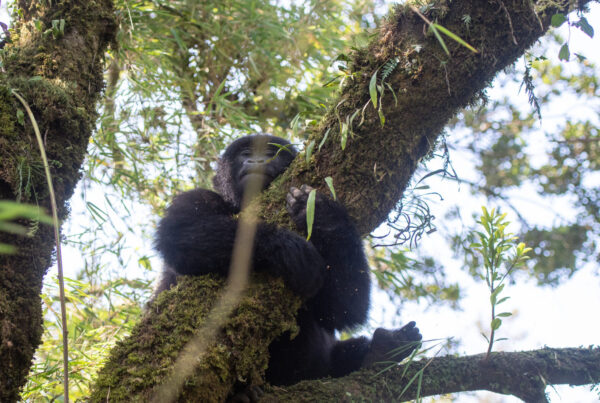
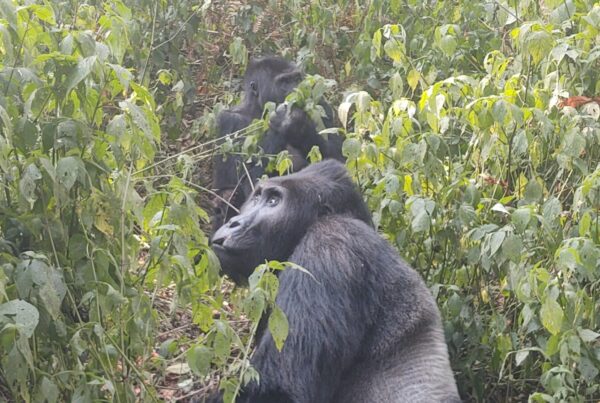
Mountain gorillas live in extended family groups led by a dominant silverback — named for the silver saddle of fur that develops on mature males. These families have distinct personalities, known histories, and complex social structures that rangers and researchers have documented over decades. The habituated families that trekkers visit have been gradually accustomed to human presence over years — a careful process that allows close observation without stress to the animals.
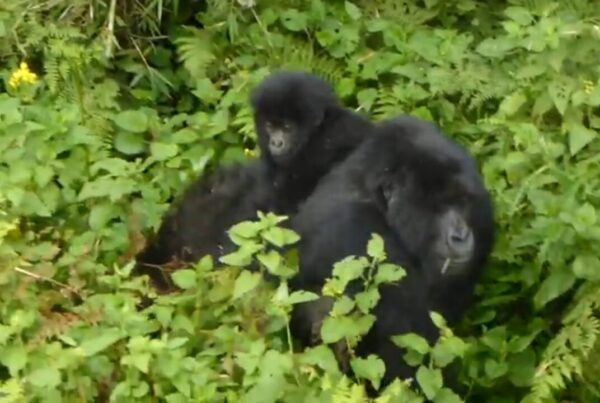
What habituated means, in practice, is that the gorillas largely ignore you. They continue their morning routines — feeding, resting, nursing young, playing — while you watch from the regulation distance of seven meters, a rule that exists to protect the gorillas’ health rather than your safety. The silverback may approach closer on his own. Juveniles frequently ignore the seven-meter rule entirely, approaching out of curiosity. These are the moments that dissolve into pure experience — the moments trekkers describe with the helpless expression of people trying to convey something language cannot quite hold.
Uganda as the Container
The gorillas are the center of the experience. Uganda is the container that holds it. And Uganda as a container is extraordinary. This small landlocked country in East Africa holds more biodiversity per square kilometer than almost anywhere on the planet. It has 1,066 bird species — more than the entire continent of North America. It has tree-climbing lions, chimpanzees, hippos, elephants, shoebill storks, and landscapes ranging from savanna to montane forest to the shores of the world’s second-largest lake.
The western highlands where Bwindi sits — the Kigezi region, sometimes called the Switzerland of Africa — are among the most beautiful landscapes in Africa. Green hills fold into each other under a sky that seems closer to the equatorial sun than it should. The air at altitude is cool and clear. Villages perch on hillsides surrounded by terraced fields. The whole drive from Kampala to Bwindi, eight hours through this landscape, is part of the experience — not just the transit to it.
The Night Before the Trek
There is a particular quality to the night before a gorilla trek that frequent travelers describe as unlike the anticipation before any other experience. You are at a lodge on the forest edge. The forest sounds come through the window — insects, nightjars, the rustle of things moving in the undergrowth. Somewhere in there, a family of mountain gorillas is building their night nests, settling in for sleep. Tomorrow, rangers will find them from the previous evening’s nest site and lead your group to where they are. You do not know exactly what will happen. You only know it will be extraordinary. That unknowing is part of the gift.
Nothing Required But You
Bring good boots. Bring a rain jacket — Bwindi is a rainforest and it does what rainforests do. Bring a light daypack with water and a snack. Leave your expectations at the forest edge, because the gorillas will not meet them — they will exceed them in ways you did not predict, and the gap between expectation and reality will be one of the most pleasant surprises of your life.
You do not need to be an expert on gorillas. You do not need to have read everything about Uganda or Bwindi or conservation. You do not need to be fit in any particular way or prepared in any particular direction. You need to show up, walk into the forest, and pay attention. The rest happens to you.
This is the adventure that requires nothing from you but your presence. And your presence is available right now. Book your 2027 permit and bring it to Bwindi. That is all the preparation the gorillas require of you — and the experience will take care of everything else.
What actually happens during a Uganda gorilla trek?
The trek unfolds in distinct phases each with its own character. Briefing: at 7:30am (typical start) all permit-holders gather at the ranger station; a ranger explains the rules (7-metre distance, no flash photography, no eating, no trekking if ill); permits are checked; groups of maximum 8 visitors are assigned to each habituated family. The walk in: duration varies from 30 minutes to 5+ hours depending on where the gorillas slept; rangers who tracked the gorillas the previous afternoon radio their position to the lead ranger; the group follows trails and sometimes cuts through forest off-trail. The encounter: when you reach the gorillas a timer starts; you have exactly 60 minutes with the family; the gorillas move and feed around you; you move with them maintaining 7m; it is not a zoo experience — the gorillas choose their direction and you follow. The walk out: often faster than the walk in; you are typically elated and walking is effortless; allow 30-90 minutes back to vehicles.
How physically demanding is gorilla trekking at Bwindi?
The difficulty varies significantly by sector and day. The range: on some days the gorillas are close to the trailhead and trekking takes 1.5-2 hours round trip; on other days the gorillas have moved deep into the forest and trekking takes 6-8 hours; you cannot know in advance. The terrain: Bwindi’s forest is steep and wet; roots, mud, and inclines of 40-60 degrees are normal; the “impenetrable” in the name reflects the dense undergrowth; rangers cut a path with pangas; even in this you are mostly on a path. Who can do it: the vast majority of visitors of all ages complete the trek successfully; rangers have carried elderly or mobility-impaired visitors on stretcher-chairs (available for hire); the minimum age is 15. Preparation advice: waterproof boots; long trousers against nettles; light waterproof jacket; walking poles are very helpful on steep sections and provided by rangers; a small day pack with water and snacks is all you need.
What is the most meaningful part of a gorilla trek for most visitors?
The encounter consistently produces an emotional response that visitors describe as unlike any other wildlife experience. The eye contact: mountain gorillas regularly make direct eye contact with visitors; unlike most wild animals they do not look away; the intelligence in that direct gaze — from an animal that shares 97% of your DNA and lives in complex family groups with lifelong relationships — is what most people describe as the defining moment. The silverback: the dominant male is usually 50-200kg of relaxed power; he typically ignores visitors completely or moves around them with casual indifference; occasionally he will make a short display charge (staying in place and beating his chest); rangers will signal you to hold ground and look down; it is not dangerous but it is breathtaking. The young gorillas: infants and juveniles often approach visitors with playful curiosity; a young gorilla rolling down a muddy slope or wrestling with a sibling five metres away is the most joyful sight in Uganda’s wildlife.
How far in advance do you need to book a gorilla permit?
Booking timing is critical for a successful trip. Peak season (July-August, December-January): book 6-12 months in advance; gorilla permits for peak dates sell out this far ahead; attempting to book for August in May is likely to result in no available permits. Shoulder season (June, September, October, November): book 3-6 months ahead; permits are more available but still sell; do not leave it to the last month. Off-peak (February-May): permits are more available; 1-3 months is often enough; last-minute permits are possible though not guaranteed. How to book: through Uganda Wildlife Authority directly at ugandawildlife.org; or through a registered Uganda tour operator who manages the booking process for you; the operator route is more reliable for international visitors unfamiliar with the UWA system. Permit transfer: permits can be transferred to another date or person with reasonable notice to UWA; they are non-refundable but can be re-used on a new date.
Which Bwindi sector is best for first-time gorilla trekkers?
Each of Bwindi’s four sectors has different characteristics. Buhoma: the original and most established sector; northern Bwindi; most facilities and lodge options; first-time visitors often start here; 4 habituated groups; the Buhoma community walk and waterfall trail are popular add-ons. Rushaga: southern Bwindi; largest number of habituated groups (approximately 8); this sector also offers the gorilla habituation experience; accessed via Kabale; newer lodges of high quality available. Ruhija: eastern Bwindi; higher altitude; best birding sector (Shelley’s crimsonwing, African green broadbill); 2 habituated groups; a good choice for birder-trekker combination. Nkuringo: southwest Bwindi; dramatic views toward DRC; adjacent to Mgahinga; 2 habituated groups; the hike from the park boundary to the gorillas is considered among the more challenging in Uganda. Recommendation for first-timers: Buhoma or Rushaga for the widest range of lodge options and multiple group choices if one permit is unavailable.
- Why Gorilla Trekking in Uganda Is Africa’s Most Unforgettable Wildlife Adventure
- Gorilla Trekking with Kids: Tips for Family-Friendly Adventures in Uganda
- Unforgettable One-Day Rhino Trekking Safari Adventure
- Why Travelers Fear Congo, But Marines Know the Thrill of This 5-Day Congo Gorilla Trekking and Nyiragongo Hike Adventure
- Adrenaline, Enjoyment & Adventure: 4-Day Cycling and Gorilla Safari in Uganda
- The Towering Presence of a King: How Tall Is a Silverback Gorilla?
- The Gorilla and Chimpanzee Trekking Adventure in Uganda
- Africa Adventure Safaris and Tours
- Jinja Quad Biking Adventures
- Adventure Travel Experiences for 18–30’s Travellers in Africa