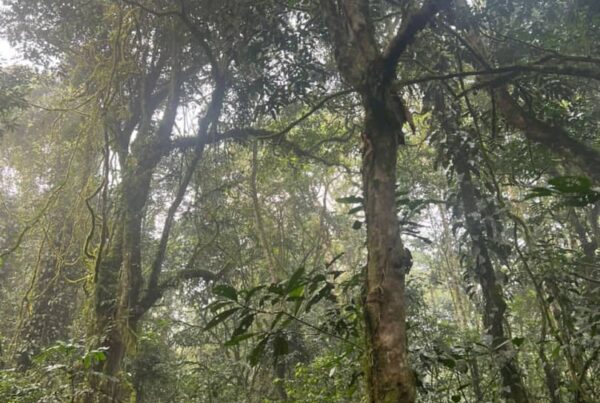
There are lists everywhere of things you should do before you die — restaurants, beaches, cities, concerts — full of things that are genuinely enjoyable and entirely forgettable within three years of doing them. Then there is gorilla trekking in Bwindi Impenetrable Forest, which occupies a different category: not a pleasurable item on a consumption list but an encounter with another kind of mind in its own territory that the people who have experienced it describe in the same specific language twenty years later. See Uganda gorilla permits, total cost breakdown, and 7-day Uganda safari.
- What makes it different: mountain gorillas share 98.3% of human DNA; they are the only great apes that cannot be seen in captivity; the encounter in Bwindi’s forest is with an animal that has chosen to tolerate your presence, not one that has been kept or trained
- The limit: 8 people per gorilla family per day; over 20 habituated families across Bwindi’s 4 sectors; permits USD 800 per person
- The combination: gorilla trekking at Bwindi plus Kibale chimpanzee trekking in one Uganda trip is the only place on Earth where both great ape species can be trekked in a single itinerary
- Plan and book: accredited Uganda operators handle permits, transport, and accommodation as a complete package
There are lists everywhere of things you should do before you die. They cover restaurants, beaches, cities, concerts, festivals, and sporting events. They are full of things that are genuinely enjoyable, often beautiful, and entirely forgettable within three years of doing them. Then there is gorilla trekking in Uganda. Every serious traveller who has compiled a list of the experiences that genuinely matter — the ones that change something fundamental in how you see yourself and your world — puts mountain gorillas near the top. Most put them at the top.
This is not hyperbole. It is the consistent testimony of people who have done it: scientists and artists, photographers and writers, first-time Africa visitors and seasoned round-the-world travellers. Something happens in that hour with the gorillas that does not happen at any beach, any concert, or any Michelin-starred restaurant. The encounter produces a shift in perspective that persists. It is worth understanding why.
What Makes an Experience Matter
Psychologists who study what makes experiences meaningful — rather than merely pleasant — identify several consistent factors. Novelty: the experience must be genuinely unlike anything you have done before. Emotional intensity: it must produce a response that your body and mind cannot easily contain in the ordinary frameworks you use to process daily life. Narrative: it must have the structure of a story, with a beginning that anticipates, a middle that delivers, and an end that resonates. And connection: it must create or reveal a relationship with something beyond your ordinary self.
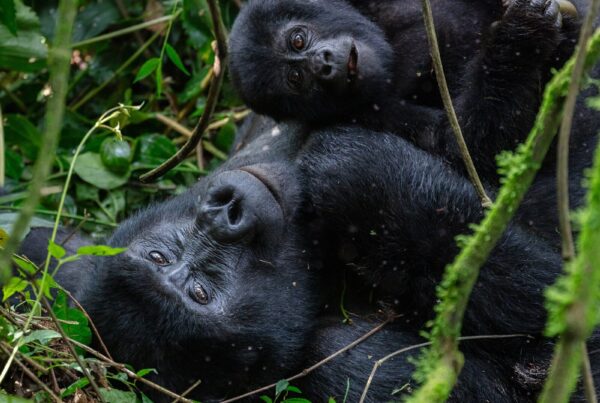
Gorilla trekking provides all four with unusual force. You have never done anything like it before — not even remotely. The emotional response to looking into a gorilla’s eyes from three metres away is immediate and overwhelming: a recognition that is almost impossible to prepare for and almost impossible to fully describe afterward. The structure of the trek has the shape of a journey toward something — the walk, the search, the encounter, the silence. And the connection — that moment when you understand, in your body rather than your mind, that these animals and you are related in a way that makes the word “animal” feel suddenly insufficient — is one of the most profound experiences available to any human being who still has access to a wild world.
Why Gorillas Are Different From All Other Wildlife
People who have been on African safaris and also done gorilla trekking are consistent in describing the two experiences as fundamentally different in kind, not just in degree. The safari is magnificent — the vast landscape, the unpredictable encounters, the ancient theatre of predator and prey. But it is experienced at distance, from a vehicle, with glass between you and the animals. The animals look at the vehicle, not at you. You are an observer.
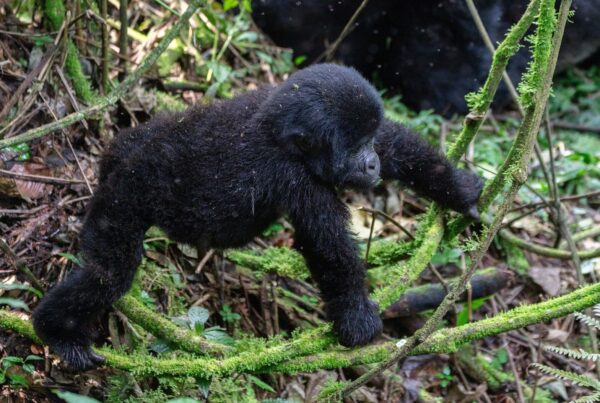
With mountain gorillas, the distance collapses. You are in the forest at the gorillas’ level, walking the same terrain, breathing the same air. The gorillas look at you specifically — not at a vehicle, but at you, with eyes that have a quality of recognition that is completely different from the blank regard of a lion or an elephant. They assess you. They occasionally dismiss you. Sometimes they approach. Sometimes a juvenile loses interest in foraging and wanders over to sit within arm’s reach, studying you with the same frank curiosity with which you are studying it.
The Shared Ancestry Feeling
What the gorilla encounter produces that almost no other wildlife encounter can is the visceral, embodied experience of shared ancestry. You know intellectually that humans and gorillas share approximately 98.3% of their DNA. You know intellectually that we share a common ancestor who lived somewhere in Africa several million years ago. These facts are interesting in the abstract. In the presence of a mountain gorilla, they become real in a way that rewrites something in your understanding of what you are and where you come from.
This is the experience that serious travellers put at the top of their lists. Not because it is the most comfortable or the most photogenic or the most easily Instagram-able. Because it produces an insight about what it means to be human — delivered through the eyes of a creature that is not human, but is close enough to recognise.
Why Uganda
Uganda is home to approximately half the world’s remaining mountain gorillas — around 500 of the estimated 1,000 individuals that survive. The gorilla trekking programme in Bwindi Impenetrable National Park and Mgahinga Gorilla National Park is one of the most carefully managed wildlife tourism operations in the world, combining genuine conservation effectiveness with an experience quality that consistently exceeds expectations.
The $800 permit in 2027 represents payment for access to something that fewer than 25,000 people per year can experience. It also represents a contribution to the conservation system that keeps the gorillas alive — a system that has seen the mountain gorilla population grow from fewer than 300 individuals in the 1980s to over 1,000 today. The permit is not just a ticket. It is a stake in the project of keeping one of the world’s most extraordinary animals in existence.
The Right Time to Go
There is no wrong time to go gorilla trekking in Uganda, and there is no right time except sooner. The mountain gorilla population is recovering — slowly, and under sustained human pressure on its habitat that will not diminish as human populations around the parks continue to grow. The window in which this experience exists is real but not unlimited. The gorilla trekking programme of 2027 is the result of thirty years of careful conservation investment. The programme of 2037 depends on decisions being made now — about funding, about community benefit-sharing, about habitat protection, and about the continued willingness of international visitors to pay for the experience.
When you go, you contribute to all of this. You also have an experience that belongs at the top of any serious list of what human beings should do while they still can. Not because it is exotic or adventurous or expensive. Because it is the encounter with another kind of intelligence that reminds you, without words, what kind of creature you actually are.
The list of experiences every human should have is long and includes many wonderful things. Gorilla trekking in Uganda is number one because nothing else does what it does. Contact us to book your permit for 2027 and join the short list of people who have understood this from the inside.
Why is gorilla trekking considered by many to be the top wildlife experience on Earth?
The ranking comes from three properties that no other wildlife experience shares simultaneously. Uniqueness: mountain gorillas exist in the wild only in Uganda, Rwanda, and DRC; there are no mountain gorillas in any zoo on Earth; the encounter at Bwindi is not a more expensive version of a cheaper option — it is the only version. Intimacy: the permit system limits groups to 8 people per family per day; the physical proximity in natural forest with no barrier creates an encounter quality that mass wildlife tourism cannot approach. Evolutionary resonance: the 98.3% DNA similarity makes the social behaviour of mountain gorillas immediately legible to any human observer — the family dynamics, the intelligence behind the eyes, the grooming and play — in a way that no other wild animal encounter does to the same degree. These three together produce something that has no equivalent in wildlife travel.
What are the top five wildlife experiences in Uganda besides gorilla trekking?
Uganda’s wildlife circuit is one of Africa’s most concentrated. 1. Chimpanzee trekking at Kibale: Kibale Forest has the highest density of primates in Africa; chimpanzee trekking here is considered one of the best chimp experiences in East Africa; pairs naturally with Bwindi in one itinerary. 2. Kazinga Channel boat safari: the channel at Queen Elizabeth NP connects Lakes George and Edward; the boat passes within metres of hippo pods, crocodiles, buffalo, and waterbirds in extraordinary density. 3. Shoebill trekking at Mabamba: Mabamba Bay shoebill encounters by dugout canoe in papyrus swamp — the shoebill is one of Africa’s most sought-after bird species and Mabamba is Uganda’s most reliable site. 4. Nile boat safari: Murchison Falls Nile launch trip to the base of the falls. 5. Kidepo Valley game drives: Kidepo Valley NP is Uganda’s most remote and spectacular savannah; cheetah, striped hyena, and eland not found in other Uganda parks.
Is gorilla trekking suitable for older travellers or those with limited fitness?
Gorilla trekking is more accessible than its reputation suggests. Age range: visitors in their 60s, 70s, and even early 80s successfully complete gorilla treks at Bwindi regularly; the minimum age is 15; there is no maximum. Fitness level: the trek requires the ability to walk for 1-8 hours (variable by gorilla location) on steep, uneven terrain; this is significantly more demanding than a city walk but not extreme; anyone who walks regularly can do it. Porter support: hiring a porter (USD 15-20) is strongly recommended for all visitors and especially those with any mobility limitation; the porter carries your bag, provides a steadying hand on steep sections, and knows the terrain intimately. Trekking poles: provided free by the park at the gate; take them regardless of fitness level. Preparation: aerobic walking exercise in the month before the trip significantly improves the experience.
What is the gorilla habituation experience and how is it different from a regular trek?
The gorilla habituation experience (GHE) is a different product from the standard trek. What it is: a full-day (up to 4 hours) with a semi-habituated gorilla family — a family in the process of being accustomed to human presence; the family is not yet fully habituated so the experience is less predictable and more dynamic. Location: based at Rushaga sector in Bwindi. Cost: USD 1,800 per person versus USD 800 for a standard trek. Group size: 4 people maximum versus 8 for standard treks. Duration: up to 4 hours with the gorillas versus 60 minutes. Who it is for: serious wildlife enthusiasts, photographers, and those who have already done the standard trek and want a deeper engagement; the unpredictability and extended time are the appeal. See habituation experience guide.
What should I read before deciding to book gorilla trekking in Uganda?
The most useful pre-booking resources are specific. Expectation setting: 30 things to know before gorilla trekking — the most comprehensive single resource on what the experience actually involves. Avoiding mistakes: 5 common gorilla trekking mistakes — what avoidable errors reduce the experience. Cost planning: gorilla trekking cost breakdown — the complete picture from permit to total trip. Sector choice: Bwindi sector guide — which sector fits your logistics and preferences. Operator selection: accredited Uganda operators — who can legally book your permit and how to verify them. The combination itinerary: 7-day Uganda gorilla trekking itinerary — how the gorilla trek fits into a full Uganda safari.
- Gorillas Have Human-Like Fingerprints: Scientists Can Tell Them Apart
- The Most Human Experience You Can Have Involves an Animal, Not a City
- Top Ugandan Cultural Experiences Every Safari Visitor Should Try
- Silverback Gorilla Size Compared To Human
- Safaris That Offer Unique Wildlife Experiences in Uganda: Beyond the Ordinary
- Uganda Food Dishes You Should Try: A Taste of Tradition, Culture, and Heart
- Why You Should Do a Golden Monkey Trek Before Your Mountain Gorilla Trek
- Top African Wildlife Experiences
- Are Humans Primates?
- Adventure Travel Experiences for 18–30’s Travellers in Africa