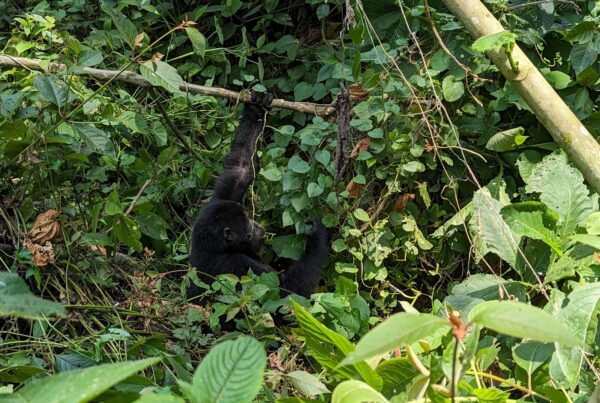
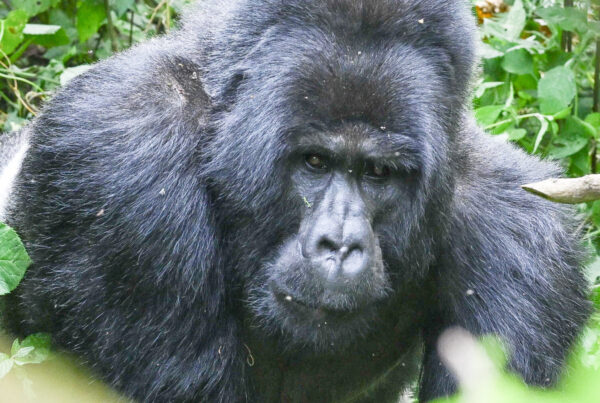
Gorillas have human-like fingerprints, and scientists use them to tell individual animals apart — a fact that surprised me when I first heard it and becomes astonishing when you watch a gorilla’s hand up close during a trek in Bwindi Forest. The fingerprints are not identical to human fingerprints; they are distinct in pattern, reflecting the gorilla’s specific identity as reliably as human fingerprints reflect ours. The parallels between how gorillas and humans have evolved in this respect — along with dozens of other shared anatomical features — illuminate something profound about what 98.3% shared DNA actually looks like when you put it in front of you in a living forest.
What Gorilla Fingerprints Look Like
Gorilla fingerprints share the fundamental structure of human fingerprints: ridges and valleys arranged in patterns (loops, whorls, and arches) that are unique to each individual. The ridges serve the same mechanical function — improving grip by increasing friction between the skin surface and objects being held. The uniqueness of the patterns to each individual is thought to arise from similar developmental processes: random variations in the way skin ridges form during fetal development, producing combinations that are statistically unique even within a species of millions.
The patterns in gorilla fingerprints differ from human fingerprints in their proportions and some of their structural details, but they are recognisably the same kind of structure. A fingerprint examiner who was shown gorilla and human fingerprints and asked to describe them would use the same vocabulary for both.
How Researchers Use Them
Field researchers use gorilla fingerprints as one of several methods for identifying individual animals. Photography of the hands during routine monitoring and veterinary checks provides fingerprint records that can be compared across time and between individuals. In conjunction with face recognition (gorilla nasal prints are unique in the way human fingerprints are unique, and are used more commonly by field researchers), fingerprints provide a backup identification system for situations where the nasal print is unclear.
Why Gorillas and Humans Have Fingerprints
The shared evolutionary heritage of fingerprints in gorillas and humans reflects a common ancestry. Both species evolved from primate ancestors that developed friction-ridge skin in the hands as an adaptation to tree-dwelling life — the enhanced grip provided by ridged skin is advantageous for climbing, and primates have had it for tens of millions of years. The fact that both gorillas and humans retain this feature, long after their lineages diverged approximately 10 million years ago, reflects how deeply useful the adaptation is.
Other Primates With Fingerprints
All great apes — gorillas, chimpanzees, bonobos, and orangutans — have fingerprints. Many Old World monkeys have them too. The pattern varies across species: some have fewer distinct whorls and arches, some have different ridge spacings. But the fundamental structure of individually unique friction-ridge skin appears consistently across the primate family tree, which reflects both its adaptive value and its deep evolutionary roots.
One Surprising Exception
Koalas, which are not primates at all but marsupials, have independently evolved fingerprints that are very similar to human fingerprints — a case of convergent evolution in which two unrelated lineages arrived at the same solution to the problem of manipulating objects and gripping surfaces. Koala fingerprints have been known to confuse forensic fingerprint databases.
What You See During a Gorilla Trek
The hands of mountain gorillas are one of the most striking aspects of close encounters. They are large — an adult male’s hand span is wider than most human heads — and visibly powerful, with the muscle development that reflects a creature capable of bending iron bars. But the structure is recognisable: four fingers and a thumb, nails rather than claws, the same basic jointing and flexibility as a human hand operating at a different scale and with different proportional emphases.
In moments when a gorilla picks up food, handles a branch, or grooms another animal, the hand movements are familiar in a way that distances between species do not usually produce. The grip, the precision of finger placement, the way individual digits move independently — all of it looks like hands doing what hands do, at a scale and power that makes the similarity both more obvious and more striking.
Fingerprints and Individual Recognition in Gorilla Research
The ability to identify individual gorillas reliably is fundamental to gorilla conservation research. Long-term behavioural studies — which produce the data needed to understand gorilla social dynamics, reproductive patterns, health trends, and population structure — require consistent identification of individuals across years and decades. Researchers who have worked with specific gorilla families for fifteen or twenty years know individual animals as well as they know colleagues, precisely because individual identification has been possible and reliable throughout.
What Individual Recognition Has Produced
Long-term individual tracking has revealed insights about mountain gorilla life that would have been impossible without it: the specific dynamics of silverback succession within family groups, the survival rates of infants born to different mothers, the long-term effects of early social experience on adult behaviour, the health trajectories of individuals over years. This research directly informs conservation management decisions — which families to prioritise for veterinary monitoring, how to manage encounters between family groups, how to plan anti-poaching patrol routes.
The fingerprints are a small piece of this. But they are a piece of the same biological reality that makes gorilla research possible and gorilla conservation effective.
The Broader Significance
That gorillas have fingerprints is a small fact. What it reflects is not small: the deep shared anatomy of two species that diverged 10 million years ago and still carry, in the ridges of their hands, evidence of the common ancestor they share. Every close encounter with a gorilla in Bwindi is an encounter with this evidence — made visible in hands that work like hands, faces that register expression, social bonds that operate on recognisable principles.
The 98.3% shared DNA is abstract until you see the hands. Then it becomes very concrete, very quickly.
Visit and See for Yourself
Uganda gorilla trekking permits are $800 per person. Contact Uganda Gorilla Trekking to book your permit and plan your visit to Bwindi Impenetrable National Park. The gorilla family you meet will have fingerprints. You will not be able to read them from a metre away, but you will see the hands that carry them, and those hands will be worth looking at closely.
Frequently Asked Questions
Uganda is home to the mountain gorilla (Gorilla beringei beringei), one of two subspecies of eastern gorilla. They live exclusively in the Virunga volcanic highlands (Uganda/Rwanda/DRC) and Bwindi Impenetrable Forest (Uganda only). Mountain gorillas are the only gorilla subspecies that cannot survive in captivity — every individual you can trek is a wild animal.
The standard gorilla trekking permit gives you exactly 1 hour with the gorilla family. This time begins when you make first contact with the family — the ranger signals the start. The Gorilla Habituation Experience gives 4 hours with a semi-wild family. The walk to find the gorillas can take 30 minutes to 5 hours depending on where the family has moved.
Stay calm, crouch down slowly, avoid direct eye contact, and remain quiet. Do not run — running triggers a chase response. Rangers accompanying your group manage close approaches. Habituated gorillas are accustomed to humans and almost never make contact, but a charging silverback is managed by staying still and following ranger instructions immediately.
A maximum of 8 visitors per habituated gorilla family per day for standard trekking. The Gorilla Habituation Experience has a maximum of 4 visitors per family per day. These limits are set by UWA to minimise stress on the gorilla families and maintain the quality of the experience.
Uganda is home to the mountain gorilla (Gorilla beringei beringei), one of two subspecies of eastern gorilla. They live exclusively in the Virunga volcanic highlands (Uganda/Rwanda/DRC) and Bwindi Impenetrable Forest (Uganda only). Mountain gorillas are the only gorilla subspecies that cannot survive in captivity — every individual you can trek is a wild animal.