Updated
gorilla encounter most human experience Uganda is a subject central to Uganda’s wildlife tourism, where mountain gorilla conservation and responsible visitor experiences go hand in hand. The itineraries most people build for their lives are overwhelmingly urban. The great cities. The cultural capitals. The places where human creativity and human organisation have produced things worth seeing: architecture, art, cuisine, the concentrated evidence of what our species can do when it builds at scale and across time. These are extraordinary experiences and worth every mile of travel to reach them. But they are all, in an important sense, mirrors. They reflect humanity back at itself. They show you what humans have made, and through that showing, something of what humans are.
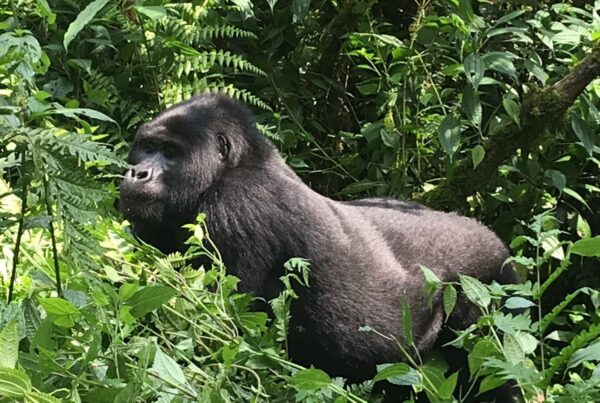
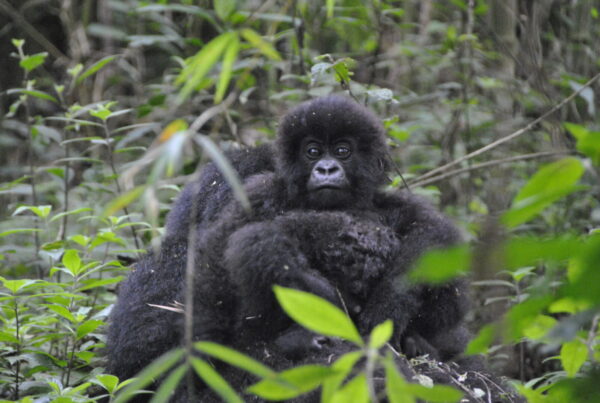
The gorilla encounter in Uganda’s Bwindi Impenetrable Forest shows you something different: what humans are when observed from outside, by eyes that do not share our language or our categories or our assumptions about the centrality of our species. The gorilla’s assessment of you — that brief, weighing look that precedes the decision to continue feeding or to move away or, occasionally, to approach — is the most genuinely othered you will ever feel in a wildlife context. And that othering is clarifying in ways that no mirror experience can be.
The Most Human Experience You Can Have Involves an Animal, Not a City
Why Animals Reveal What Cities Cannot
Cities reveal human achievement, human creativity, human social organisation at scale. They show the extraordinary things that tool-using, language-having, culture-building primates can do with resources and time. They are genuinely impressive and genuinely important as human environments.
What they cannot show is what you look like from outside the species. In a city, every observer you encounter shares your fundamental nature — the same cognitive architecture, the same general set of social assumptions, the same framework of meaning. Even in an unfamiliar culture, the frame is shared at a deep level: these are other humans, and humans understand humans in ways we do not understand other species.
The gorilla breaks this frame. The gorilla is intelligent enough to observe you specifically — not generically, but as the specific individual you are — but not human enough to share your framework for what that observation means. The gorilla looks at you and registers: not dangerous, not interesting, not significant. You are temporarily part of the gorilla’s environment, to be accommodated and then forgotten when you leave. Being accommodated and forgotten by another intelligence is a specific and unusual human experience. It is one of the most useful experiences available.
The Specific Human Experience of Being a Guest
In the gorilla encounter, you are a guest in a way that the word guest only rarely means. The forest is the gorilla’s home. You are there on their terms, which is to say on the terms of the forest itself. The ranger’s role is partly to manage your behaviour so that you are an acceptable presence in the gorilla’s environment — minimum distance, no sudden movements, no food, no flash photography, face masks. These are not restrictions that protect you from the gorillas. They are restrictions that protect the gorillas from you.
Being a guest who must behave to maintain a welcome is a role that modern travel rarely asks of us. We are usually the ones who set the terms — the consumer, the visitor, the person whose comfort and experience define the standards. In Bwindi, the gorillas’ comfort and wellbeing set the standards. Being genuinely secondary in an environment — being accommodated rather than served — is a rare and useful corrective to the assumed centrality that most of us carry most of the time.
What You Carry Back
The most human experience you can have involves an animal, not a city, because the city experience deepens your understanding of what humans have done. The gorilla experience deepens your understanding of what humans are. Both kinds of understanding matter. But the second is rarer, harder to find, and more persistently transformative in how it affects the way you relate to other living things.
The $800 gorilla permit in Uganda in 2027 buys access to the experience of being assessed by another intelligence and found ordinary. This is the most useful correction available to anyone who has spent too long in the company of cities and mirrors. Contact us to book your permit and return to the forest that was here before the first city existed.
Frequently Asked Questions
Kibale Forest National Park, near Fort Portal, has the highest density of chimpanzees in Africa and is Uganda’s premier chimpanzee destination. The standard chimp trekking permit costs $300 FNR. The Chimpanzee Habituation Experience at Kibale ($400 FNR) gives 4 hours with a habituated community — Uganda’s only chimp habituation programme.
Yes — the gorilla + chimp combination is Uganda’s most popular primate itinerary. A typical 8-day route: Entebbe → Kibale Forest (2 nights, chimp trekking) → Queen Elizabeth National Park (2 nights, game drives) → Bwindi (2 nights, gorilla trekking) → Entebbe. Charter flights on any leg reduce travel time significantly.
Uganda has 13 primate species. Commonly seen: olive baboon, vervet monkey, red-tailed monkey, black-and-white colobus, L’Hoest’s monkey, grey-cheeked mangabey. Golden monkeys are found at Mgahinga. Kibale Forest has the highest primate diversity of any East African forest. A dedicated primate safari can tick 7–8 species in a single itinerary.
Uganda has over 1,060 recorded bird species — one of the highest counts of any country in Africa. Bwindi alone has 350+ species including 23 Albertine Rift endemics. Murchison Falls, Queen Elizabeth, and the wetlands around Entebbe round out a world-class birding circuit. The African green broadbill and Shelley’s crimsonwing are Bwindi specialities.
Uganda is home to the mountain gorilla (Gorilla beringei beringei), one of two subspecies of eastern gorilla. They live exclusively in the Virunga volcanic highlands (Uganda/Rwanda/DRC) and Bwindi Impenetrable Forest (Uganda only). Mountain gorillas are the only gorilla subspecies that cannot survive in captivity — every individual you can trek is a wild animal.