Watching a silverback discipline his family is one of the experiences that gorilla trekking briefings do not prepare you for, partly because it happens rarely enough that guides cannot promise it, and partly because the description of what happens in advance does not convey what it actually looks like when it does. I watched Mwirima, the silverback of the Rushegura family, discipline two adolescent males who had pushed their play fight too close to a nursing infant, and what I saw was not what I expected. I expected power. I got power and something else that I kept trying to name for the rest of the day.
The Context: A Settled Morning With the Rushegura Family
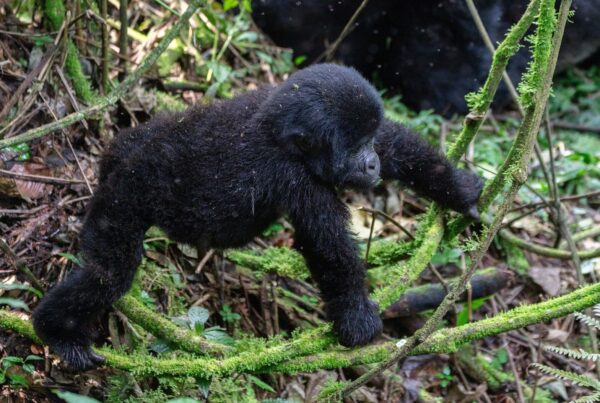
Our group of nine had been with the Rushegura family for about twenty minutes. The morning was settled — the family was feeding, the silverback was visible at the far edge of the clearing, the infants were active and the juveniles were doing what juveniles do, which on that morning involved an increasingly energetic play fight between two adolescent males that was generating more noise and physical displacement than the surrounding adults seemed pleased about.
Our guide, Christine, had been watching the escalating play fight with the specific quality of attention of someone who is reading a situation rather than simply observing it. She said nothing. She moved us slightly to the left, which I realised afterward was to improve our sightline to where Mwirima was sitting.
The Moment Before the Intervention
The two adolescents — both male, both probably around eight years old, engaged in the specific kind of wrestling that looks simultaneously like violence and play — had moved from the edge of the clearing toward the centre, where one of the nursing females was sitting with her infant. The female made a sound — low, short, unmistakably a protest — and the adolescents either did not hear it or chose to ignore it, as adolescents everywhere sometimes do.
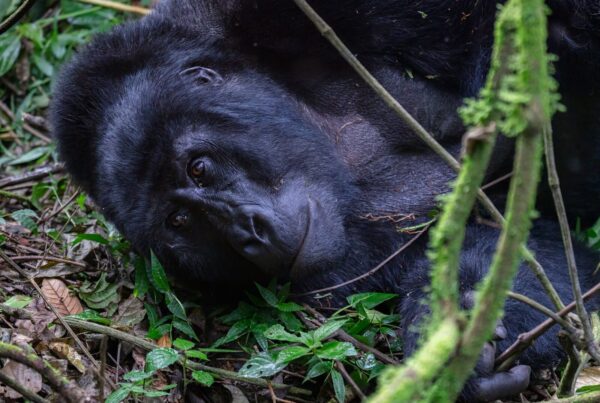
Mwirima, at the far edge of the clearing, raised his head. He had been eating. He stopped eating. He watched the adolescents for approximately three seconds.
Then he rose.
What Rising Looks Like
A silverback gorilla rising to his full height from a resting position is something that photographs do not prepare you for. The speed of it — the transition from lying to standing in one continuous motion — and the scale of what is suddenly vertical are both more than the frame of a photograph can contain. Mwirima’s full height brought his head to a level that made every person in our group instinctively take a step back, despite being well outside the regulation distance.
He did not charge. He walked. The walk was, in its own way, more arresting than a charge would have been: the deliberate, authoritative movement of something that has no need for haste because its authority is not in question.
The Intervention
He reached the two adolescents in approximately five seconds. He did not display — no chest beat, no vocalisation. He simply placed himself between the adolescents and the nursing female with the physical authority of someone who has exercised this authority many times before and knows exactly how much of it is required.
The adolescents separated immediately. Not dramatically — not with the panicked flight of animals suddenly terrified. With the specific kind of sudden awareness of someone who has just realised they went too far and would prefer not to have this conversation. They moved to opposite sides of the clearing and became very interested in vegetation.
Mwirima stood between them for about ten seconds, looking from one to the other. Then he turned and looked at the nursing female. She had not moved. The infant was still nursing, apparently unmoved by the proceedings. Mwirima looked at the infant for a moment in a way that Christine, beside me, described without hesitation as “checking.”
Then he turned and walked back to his feeding position and resumed eating.
The Something Else
I said I expected power and got power and something else. The something else was tenderness. Not performed tenderness, not the anthropomorphised tenderness that wildlife writers sometimes impose on animal behaviour. Actual observable tenderness: the look at the infant before returning to his position. The specific quality of that look.
Christine, who has watched gorilla family dynamics for twelve years and is precise about what she says, used the word “checking.” She described the silverback’s role in a family group as containing both authority and care — that the authority is not separable from the care, that the silverback’s social function requires both and operates with both simultaneously. “He is not just the boss,” she said. “He is the father. Both at once.”
What I saw in those ten seconds — the authority over the adolescents and the attention to the infant — was both at once in the most direct, unambiguous way I have ever witnessed the combination.
The Adolescents’ Response
Worth noting because it was both very gorilla and very familiar: the two adolescents who had been separated by Mwirima’s intervention gradually, over the following twenty minutes, resumed their social proximity. They were not playing by the end of the hour, but they had moved back toward each other and were feeding near each other with the slightly subdued energy of individuals who have recently been reminded of where the limits are.
Christine described this as entirely normal: “They test. He reminds them. They adjust. This is how young males learn to be adult males in a gorilla group. Mwirima was like this himself when he was their age. His father did the same thing.”
The continuity of this — the same social mechanism operating across generations in the same forest, the same correction passing from one generation to the next — was something I kept thinking about on the walk back.
What This Moment Shows About Family Life
The Rushegura family, in those ten minutes, demonstrated a complete social system: juvenile testing of limits, adult female’s first-response protest, silverback’s monitoring and intervention, clear correction without extended punishment, the rapid return to normal social functioning. The entire arc, from the escalating play fight to Mwirima resuming eating, took perhaps eight minutes. The family absorbed the disruption, addressed it, and continued.
This is what functional family systems do. In gorillas, in humans, in any social species — the capacity to process conflict without fracturing, to apply authority without destroying relationship, to protect the vulnerable while maintaining group cohesion. None of this is uniquely human. All of it is deeply familiar.
Why This Encounter Is Not Advertised
It is not advertised because it cannot be guaranteed. Most gorilla treks offer sustained observation of family members feeding, grooming, playing — the baseline activities of a settled group. Family dynamics events — silverback interventions, conflict resolution, social corrections — happen on the family’s schedule, not the tourism schedule.
This is, actually, part of what makes gorilla trekking different from a managed wildlife show: you get what the family is doing, not a performance designed for an audience. On most mornings, the family will be feeding and resting. On some mornings, they will give you something like what I saw with Mwirima and the adolescents. Both are real. Both are worth the $800 and the trek.
For Anyone Planning a Gorilla Trek
Contact Uganda Gorilla Trekking to book your permit and plan your visit. Go with no specific expectation beyond the genuine presence of wild mountain gorillas in their forest. Let the family show you what they are doing on the day you arrive. Whatever it is, it will be more than enough.
Frequently Asked Questions
A silverback is a mature male mountain gorilla (12+ years old) whose saddle-area back hair has turned silver-grey — a visible sign of adulthood. The silverback leads and protects his family group, decides when and where the group moves, and mediates conflicts. Each habituated gorilla family in Uganda has at least one silverback.
Adult male mountain gorillas weigh 140–200kg and stand 1.5–1.8m tall. Their arm span can reach 2.3 metres. Females are significantly smaller at 70–113kg. Mountain gorillas are the largest living primates. Despite their size, mountain gorillas are generally peaceful and only become aggressive if threatened.
Habituated silverbacks are accustomed to small groups of human visitors and generally ignore the trekking group. You may see the silverback feeding, resting, grooming family members, or moving the group through the forest. Direct eye contact should be avoided. If a silverback charges or bluff-charges, rangers instruct visitors to crouch down, avoid eye contact, and stay still.
A blackback is a sub-adult male gorilla (8–12 years old) whose hair has not yet turned silver. Blackbacks have not reached full maturity and typically live in the family group until they leave to establish their own. A silverback is a fully mature male, larger, dominant, and recognisable by the silver saddle. Both may be present in a single habituated family.
Uganda is home to the mountain gorilla (Gorilla beringei beringei), one of two subspecies of eastern gorilla. They live exclusively in the Virunga volcanic highlands (Uganda/Rwanda/DRC) and Bwindi Impenetrable Forest (Uganda only). Mountain gorillas are the only gorilla subspecies that cannot survive in captivity — every individual you can trek is a wild animal.