A gorilla trekking photograph does something most wildlife photographs cannot: it puts you face to face with an animal whose gaze meets yours with evident intelligence, and that specificity is visible in the image even years after the encounter. The photographs that come out of Bwindi Impenetrable National Park are not trophy shots — they are portraits of individuals with names, histories, and family relationships that rangers know by sight. This post looks at what gorilla trekking photography captures and why it differs from every other wildlife photography experience. See the complete Bwindi trekking guide for photography rules, and the gorilla families page for the individuals you’ll be photographing.
- Flash photography: strictly prohibited — the burst of light startles gorillas and is banned by UWA
- Distance: minimum 7 metres — most compelling shots are taken at this distance with a 200–400mm lens
- Best light: morning treks (starting 8am) give soft forest light; afternoon can be darker under heavy canopy
- Equipment: a camera with a fast lens (f/2.8 or wider) handles the low light better than a phone in dense forest
- Permit for photos: your gorilla permit covers photography — no separate permit required
Gorilla trekking photos tell a story that written descriptions can only approximate. The experience of walking into Bwindi Impenetrable Forest at dawn, following a ranger through ancient undergrowth, and arriving in the presence of a mountain gorilla family is one that changes people — permanently, viscerally, in ways they struggle to articulate when they return home. But photographs taken during the encounter tell the story with a directness that words cannot match. These 15 photographs represent the complete gorilla trekking experience, from the walk to the encounter to the moment of meeting — and they make the case for why gorilla trekking stands apart from every other wildlife experience in the world.
Photo 1: The forest at dawn
The trek begins before sunrise. Trekkers gather at the park gate in darkness, collect their permits, receive a briefing from the ranger, and set off into the forest as first light filters through the canopy overhead. The forest at dawn is alive with bird calls, the sound of the wind in the canopy, and the creak of ancient trees. Photographs taken in this first light — the trekkers’ silhouettes against the pale sky at the forest edge, the path disappearing into the darkness of the undergrowth — capture the atmosphere of anticipation that every gorilla trekker describes as one of the most memorable parts of the experience.
Photo 2: The ranger reading the forest
Uganda Wildlife Authority rangers who lead gorilla treks have spent years learning to read the forest. They know the daily movement patterns of each habituated family, can identify individual gorillas by face and build, and understand the vegetation well enough to move through it with a speed and confidence that continually impresses their guests. Photographs of a ranger pausing at a trail junction — crouching to examine a fresh footprint, holding a broken branch and assessing how recently it was broken, listening to the forest with a focused intensity — capture the knowledge and skill that make the gorilla encounter possible.
The tracking network behind each encounter
What trekkers do not see is the network of trackers who have been following the gorilla family since before dawn, sending radio updates to the lead ranger about the family’s location and direction. When the lead ranger pauses and lifts his radio, he is receiving information from colleagues deep in the forest who have been with the gorillas since first light. This system — invisible to most trekkers — is what makes the gorilla encounter reliable, and photographs of the ranger on his radio capture a moment in this invisible coordination network.
Photo 3: The first glimpse
There is a specific moment on every successful gorilla trek when the ranger raises a hand, the group stops, and the first gorilla becomes visible through the vegetation. It might be a dark shape moving slowly 20 metres away. It might be the sound of something large and close in the undergrowth. It might be the sudden stillness that falls over the forest when a gorilla family knows it is being approached. The photographs taken in these first seconds of the encounter — trekkers frozen, eyes searching the undergrowth, faces expressing a mixture of disbelief and excitement — capture the emotional peak that every trekker reports as transformative.
Photo 4: The silverback at rest
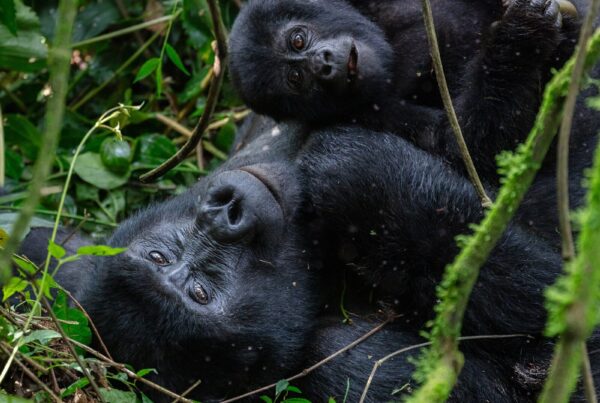
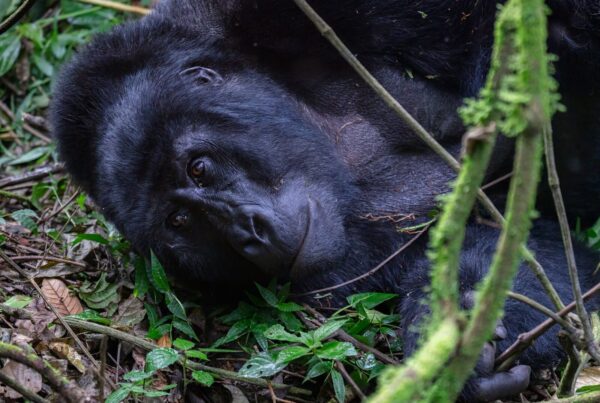
Mountain gorilla silverbacks spend a significant portion of each day resting. They eat for several hours, then rest, then eat again, moving gradually through the forest between feeding and sleeping sites. Photographs of a resting silverback — his enormous body reclined against a tree or spread across the forest floor, his silver back catching the filtered light, his face composed and unhurried — communicate something profound about the animal’s relationship with its environment. He is not nervous, not vigilant, not performing. He is simply resting in his forest, and the humans have entered his space, not the other way around.
Photo 5: Eye contact
The moment when a mountain gorilla makes direct eye contact with a trekker is consistently described as the most powerful single moment of the entire experience. Wildlife photographers who have worked across Africa say there is no equivalent — not lions, not elephants, not leopards — for the quality of intelligence that a gorilla’s gaze communicates. It is not the empty stare of a reptile or the nervous alertness of an antelope. It is something that feels, for a few seconds, like genuine mutual recognition. Photographs of this moment — the gorilla’s face in focus, the trekker’s expression visible in the background — capture it imperfectly but compellingly.
Photo 6: An infant at arm’s length
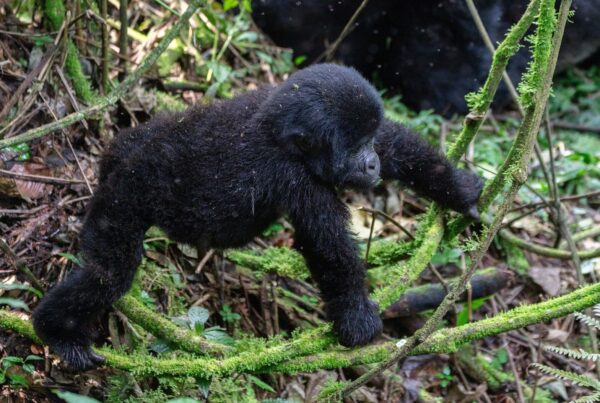
Young gorilla infants are irresistibly curious about the visitors who enter their family’s territory. Rangers manage the situation carefully, but habituated infants sometimes approach within a metre or two of trekkers before retreating. Photographs taken when a gorilla infant is at arm’s length — its small face examining the camera with wide-eyed curiosity, its fingers exploring the air in front of it — are among the most emotionally powerful images that trekkers bring home. The combination of the infant’s size, its obvious intelligence and curiosity, and the sheer improbability of the moment creates an image of overwhelming impact.
Photo 7: The family feeding
Gorilla families spend four to six hours each day feeding, and the feeding period is one of the most photogenic phases of the daily routine. Family members spread through a feeding site — a hillside rich in wild celery, bamboo shoots, or fruit-bearing trees — and the variety of postures, positions, and interactions produces a continuous stream of photographic opportunities. A mother eating one-handed while supporting her infant with the other. Two juveniles competing for the same branch. The silverback consuming enormous quantities of vegetation with deliberate, methodical efficiency. These images capture the daily reality of gorilla life with an intimacy and detail that wildlife documentaries rarely achieve.
Photo 8: The trekkers in the forest
Some of the most powerful gorilla trekking photographs are the ones showing the human visitors in their relationship with the forest and the gorillas. A line of trekkers crouching in the undergrowth, watching a gorilla family through a gap in the vegetation. A trekker lowering their camera to make eye contact directly, without a lens between them. An elderly trekker moving slowly through difficult terrain, supported by a ranger’s hand, her face expressing total absorption in what she is witnessing. These images tell the human story of gorilla trekking — the effort, the emotion, and the reward.
Photo 9: The gorilla mother watching her infant play
A gorilla mother watching her juvenile infant at play — her expression composed, her body relaxed, her attention constant — is a photographic subject of such universal emotional appeal that it works across every cultural and linguistic context. The parallels with human maternal behaviour are too strong to ignore, and photographs that capture this moment — the mother’s calm watchfulness, the infant’s exuberant play, the relationship between them visible in every detail — communicate something fundamental about the bonds that connect gorilla family members, and about the similarities between our species and theirs.
Photo 10 through 15: The moments that cannot be planned
The final five photographs in any collection of great gorilla trekking images are always the ones that could not have been anticipated. A gorilla using a stick as a tool. A silverback sneezing with enough force to send leaves swirling. Two adult females engaged in a dispute over a preferred resting spot. A juvenile discovering a tourist’s hat that has fallen on the path and examining it with forensic curiosity. A family group crossing a clearing in single file, each member pausing briefly in a shaft of sunlight before re-entering the forest. These are the photographs that define gorilla trekking as an experience — unpredictable, intimate, and utterly unlike anything else that wildlife travel has to offer.
Every photograph in this collection was taken by visitors to Bwindi Impenetrable Forest on a standard gorilla trekking permit. No special access or unusual circumstances were required — only a permit, a good guide, and the willingness to walk into the forest and be present when something extraordinary happened. That is what gorilla trekking in Uganda offers. Contact our team to arrange yours.
Can I use flash photography during gorilla trekking?
No — flash photography is strictly prohibited. Uganda Wildlife Authority bans all flash during gorilla encounters because the sudden intense light startles the animals and can cause defensive reactions. Rangers enforce this rule strictly. Modern mirrorless cameras and phones perform well in low light at high ISO without flash. If you use a DSLR or mirrorless camera, set it to automatic ISO with a minimum shutter speed of 1/200s before entering the forest to handle the lighting conditions without flash.
What camera equipment works best for gorilla trekking photography?
A mirrorless or DSLR camera with a 100–400mm zoom lens gives the most versatility — the range handles both tight portraits at 7 metres and wider shots of gorillas in forest context. A fast prime (85mm or 135mm f/1.8) produces stunning low-light portraits if you prefer single focal lengths. Smartphone cameras with portrait mode perform better than many visitors expect, especially in the moments when gorillas approach closer and the 7-metre minimum effectively shortens. Bring a weather-sealed bag or waterproof cover — Bwindi can rain at any time.
What moments during gorilla trekking photograph best?
Eye contact — the moment a gorilla looks directly at your camera — is the most powerful single image from any trek. Silverbacks sitting upright produce iconic portraits. Juveniles playing in vegetation overhead give dynamic action shots. Mothers with infants clinging to them photograph like portrait studies. The feeding sequences — gorillas breaking apart stems, selecting leaves, chewing — are less dramatic but scientifically interesting. Most visitors report that the best images come from staying still rather than chasing movement: gorillas that forget you are there resume natural behaviour.
Can I share gorilla trekking photos on social media?
Yes — there are no restrictions on sharing gorilla trekking photographs personally. Social media posts from visitors are a significant part of how gorilla trekking is discovered by potential visitors worldwide, and conservation organisations actively encourage responsible sharing. When tagging locations, use national park names (Bwindi Impenetrable National Park) rather than specific GPS coordinates of gorilla group locations, to avoid the very rare but real risk of poachers using location data.
Do I need a professional photographer permit for gorilla trekking?
Standard gorilla trekking permits cover personal photography for all visitors. Commercial filming — productions intended for broadcast, documentary release, or commercial advertising — require a separate Uganda Wildlife Authority commercial filming permit with different pricing and conditions. If you are a journalist, filmmaker, or content creator on a professional assignment (not a personal trip), contact UWA in advance to clarify which permit category applies to your project.
- How to Take the Best Gorilla Trekking Photos: Photography Tips
- Why the Gorilla Permit Price Increase Was the Best Thing for Conservation
- The Africa No One Shows on Instagram and Why It Is the Best Africa
- The Africa No One Shows on Instagram and Why It Is the Best Africa
- Best things to do in Kabale for gorilla trekking visitors
- Best Time for Gorilla Trekking in Uganda – Monthly Guide to 2025 Seasons
- What a 3-Day Uganda Wildlife and Cycling Safari Did to My Family Was Beyond Anything We Expected
- The Best Time to Climb or Hike Mount Rwenzori
- Birds of Uganda: The Untamed Symphony of Africa’s Best Birding Paradise
- Cultural Tourism Sites in Uganda – Best Uganda Heritage