Every first-time gorilla trekker in Uganda arrives with expectations — and almost every one of them is surprised by something they did not anticipate, because the encounter with a mountain gorilla family in Bwindi Impenetrable Forest operates at a different register from any wildlife experience most people have had before. These are not the surprises of things going wrong. They are the surprises of things being more — more physical, more emotional, more quiet, more socially complex, more permanently affecting — than the photographs and documentaries suggested. This guide draws from hundreds of trekker accounts and ranger observations to document the ten most consistent surprises first-timers report after their hour with the gorillas.
The 10 Surprises
- The silverback’s physical presence feels categorically different from any zoo or screen encounter
- The one-hour time limit is not too short — it is precisely right
- Bwindi’s forest is remarkably quiet — not the cacophony that popular media suggests
- The physical demand of the hike is part of the experience, not just transport to it
- Infant gorillas produce stronger emotional responses than the adults
- Gorillas approach closer than the 7-metre rule — sometimes to arm’s reach
- The social complexity visible in one hour is comparable to watching a human family
- Rain enhances rather than ruins the encounter
- The porter becomes a genuine companion, not just a bag carrier
- The experience continues affecting you for weeks and months after the trek
The Surprises You Cannot Prepare For
Every first-time gorilla trekker arrives in Bwindi with expectations shaped by photographs, documentaries, and travel blogs. Most of these expectations are accurate in broad strokes. Yes, the gorillas are large. Yes, the forest is dense. Yes, the permit costs eight hundred dollars. But beyond these obvious facts lie subtler surprises that catch nearly every newcomer off guard — quieter, more personal moments of realisation that transform a wildlife viewing into something far more profound.
How Small the Gorillas Make You Feel
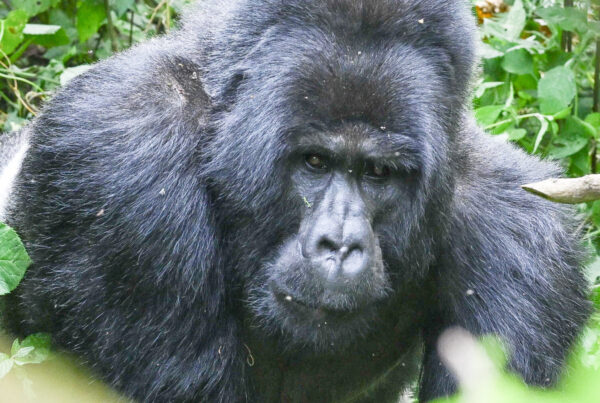
Everyone knows mountain gorillas are large. The statistics are readily available: adult males weigh up to two hundred kilograms, stand over five feet tall when upright, and possess arm spans exceeding two metres. But knowing these numbers intellectually and experiencing the physical reality are entirely different propositions. When a silverback makes eye contact with you from three metres away, your brain does not process statistics. It processes presence.
The surprise is not the gorilla’s size alone but the quality of his stillness. A silverback can remain motionless for minutes at a time, observing his surroundings with an intensity that feels almost evaluative. In those moments, you become acutely aware that you are being assessed by an intelligent being who possesses physical power that could seriously injure you without effort. Yet he chooses not to. He simply watches. That voluntary restraint, combined with obvious capability, creates a humbling sensation that no photograph can convey.
Many trekkers describe this as the moment they understood what it means to share the planet with another sentient species. It is not fear, exactly, though fear’s echo is present. It is more like recognition. The gorilla is not an exhibit. He is a person, in the broad sense of the word, and he is allowing you into his home. You can read about the specific silverbacks you might meet at the Uganda gorilla families page before your trek.
The Intensity of the One Hour
Before the trek, the one-hour time limit seems absurdly short. How can sixty minutes justify an eight-hundred-dollar permit, months of planning, and potentially hours of hiking? This scepticism evaporates within the first five minutes of the encounter. The hour is not short. It is concentrated.
Time perception changes dramatically in the presence of gorillas. Partly this is physiological; adrenaline and heightened sensory awareness alter how the brain processes duration. Partly it is attentional; when every second contains new visual information, emotional responses, and behavioural observations, the brain encodes more memories per minute than during normal life. Many trekkers report that their hour felt like thirty minutes while simultaneously feeling more densely packed with experience than entire days of normal life.
The surprise is realising that the one-hour limit is a design feature, not a rip-off. Longer encounters would exhaust both gorillas and trekkers. The intensity of the hour is sustainable precisely because it is bounded.
How Quiet the Forest Actually Is
Popular media depicts rainforests as cacophonous jungles filled with constant animal noise. Bwindi defies this. Much of the forest is remarkably quiet, especially during morning hours. The dominant sounds are wind in the canopy, occasional bird calls, and the soft rustle of your own movement through undergrowth.
This quiet creates a meditative atmosphere most trekkers do not expect. Without constant auditory stimulation, your hearing becomes more sensitive. You notice sounds that would normally be drowned out: the snap of a twig, the distant call of a colobus, the drip of condensation from leaves. When you finally reach the gorillas, the contrast is striking. Their sounds — chewing vegetation, soft vocalisations, infants playing — fill the acoustic space in a way that feels almost intrusive after the forest’s hush. This contrast amplifies the sense that you have entered another world.
The Physical Demands of the Hike
Even trekkers who consider themselves physically fit are often surprised by how demanding the hike feels. Part of this is the terrain: every step requires a micro-decision about footing, balance, and weight distribution. You are never walking on a flat, predictable surface. The sector you choose determines how demanding this is — Buhoma is the most accessible, Nkuringo the most challenging — but no sector in Bwindi is a flat walk.
Part of the demand is altitude — Bwindi sits between 1,160 and 2,607 metres, reducing available oxygen for visitors arriving from sea level. The biggest surprise is often psychological: the hike is not merely transportation to the gorillas. It is part of the experience. The effort creates a sense of earned privilege. When you finally see the gorillas, you feel that you have worked for the encounter, and that work deepens your appreciation of the hour.
The Emotional Impact of Infant Gorillas
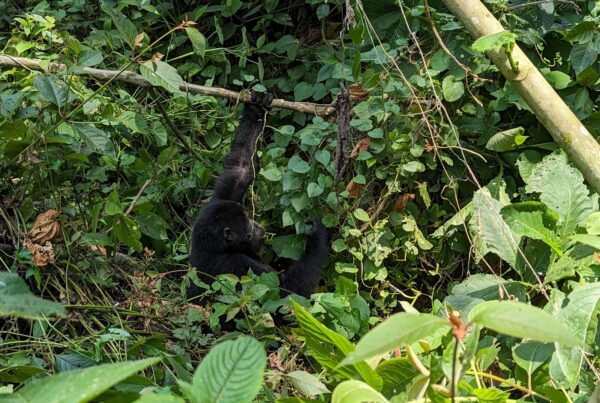
Adult gorillas command respect through size and presence, but it is often the infants who trigger the strongest emotional responses. A juvenile tumbling down a slope, playing with a sibling, or clinging to its mother’s back while she feeds creates an immediate sense of kinship that transcends species boundaries.
The surprise is not that infant gorillas are appealing. Everyone expects that. The surprise is the intensity of the response — unexpected tears, laughter, or a lump in the throat when watching infant behaviour whose resemblance to human childhood is uncanny. Watching a baby gorilla throw a tantrum because its mother walked away is simultaneously hilarious and deeply moving. This emotional response is part of what makes gorilla trekking a conservation tool: people who have looked into a gorilla infant’s eyes become advocates in a way that no documentary achieves.
How Close You Actually Get
The seven-metre rule is explicit and repeated frequently during the briefing. In practice, gorillas do not understand the seven-metre rule and occasionally approach much closer — sometimes within arm’s reach. These close approaches create a genuine surprise for most trekkers. Your guide will quietly instruct you to remain still, avoid eye contact, and let the gorilla pass. The encounter is brief, usually seconds, but those seconds are seared into memory.
The surprise is realising that the seven-metre rule protects the gorillas from you, not you from the gorillas. A silverback could close that distance in seconds if he chose to. His restraint is voluntary, and that voluntary choice makes the proximity feel like a gift rather than a risk.
The Complexity of Gorilla Social Dynamics
Before the trek, most people imagine gorilla families as simple units dominated by a single male. The reality is far more nuanced. During your hour, you may witness subtle social negotiations: a female choosing which male to sit near, a juvenile testing boundaries with an older sibling, the silverback monitoring his family with what appears to be genuine concern. Each of the habituated Uganda gorilla families has a documented social history — your guide can tell you who is related to whom, which alliances are current, and what the family has been through.
The surprise is recognising that gorilla society has rules, hierarchies, and relationships as complex as any human community. The silverback is not merely a brute enforcer. He is a leader who provides protection, mediates disputes, and maintains group cohesion. You are not just watching gorillas — you are watching specific characters with known histories.
The Rain Does Not Ruin the Experience
Many trekkers dread rain. Bwindi’s rain happens frequently and you will get wet. But the surprise is discovering that rain often enhances rather than diminishes the experience. Wet gorilla fur takes on a different texture — darker, more defined. The forest smells more intensely after rain. Water droplets on leaves create light effects photographers love. And there is something undeniably atmospheric about watching gorillas in mist, their dark forms emerging from grey humidity.
The physical discomfort of wet clothing is real but temporary. The visual and emotional impact of gorillas in rain is lasting. Many experienced trekkers specifically choose the wet season for this reason — and Uganda’s low-season permits in April, May, and November drop to USD $600, making wet-season trekking the best-value option available.
The Porters Are Essential, Not Optional
Some trekkers initially view porters as an unnecessary expense. This attitude typically changes within the first hour of hiking. The surprise is realising that porters are not merely bag carriers. They are skilled forest navigators who assist on difficult sections, spot hazards you would miss, and provide physical stability on slippery terrain. They know the trails because many grew up in communities surrounding the park.
Beyond practical assistance, hiring a porter directly supports local communities in one of Uganda’s poorest regions. The USD $15–20 represents significant income for families with few economic alternatives. Many trekkers find their porter becomes a genuine companion — someone with whom they share one of the most meaningful experiences of their travels.
The Aftermath Lasts Longer Than the Trek
The final surprise is not something that happens in the forest. It happens days, weeks, or months later, when the emotional impact of the encounter finally settles. Many trekkers report that their gorilla experience continues affecting them long after they have returned home. Some become conservation advocates. Others find the encounter reframes their relationship with the natural world entirely. A surprising number report that the experience helped them process personal challenges, providing perspective that made human problems feel more manageable.
The hour with gorillas is brief, but its echo is long. You do not simply see mountain gorillas. You meet them — in a sense that only becomes fully clear with distance and reflection.
Frequently asked questions
Is gorilla trekking worth the cost?
Consistently rated as one of the most transformative wildlife experiences in the world, gorilla trekking in Uganda is considered worth the cost by the overwhelming majority of people who do it. The USD $800 permit funds Uganda Wildlife Authority conservation operations, anti-poaching rangers, and community benefit programmes around Bwindi and Mgahinga. The encounter itself — one hour with a wild, habituated mountain gorilla family — is impossible to replicate in any other context. Of the travellers who have trekked, very few describe it as anything other than the highlight of their trip to Uganda and one of the defining experiences of their lives.
How fit do you need to be for gorilla trekking in Uganda?
The fitness requirement depends heavily on which sector you trek in. Buhoma is the most accessible — a reasonably fit person of any age can complete it with modest effort. Nkuringo is the most demanding and requires genuine physical preparation. Rushaga and Ruhija fall between those extremes. As a general guide: if you can walk at a moderate pace for 2–4 hours with some hill climbing, you can trek in Buhoma. For Nkuringo, you should be able to manage 5–6 hours of vigorous hiking on uneven terrain. Porters assist with bags and provide support on steep sections, and are recommended for all trekkers regardless of fitness level.
What is the best time of year to go gorilla trekking in Uganda?
The dry seasons — June to August and December to February — offer the best trail conditions and clearest photography. These are also the busiest and most expensive periods, with permits and lodges booking up months in advance. The low season (April, May, November) offers a USD $600 permit rate and 20–40% lodge discounts, with the trade-off of wetter trails and more cloud. Gorilla encounters happen year-round — the animals are found regardless of weather, and many trekkers find the misty wet-season atmosphere more atmospheric. There is no “wrong” season for gorilla trekking in Bwindi.
How long is a typical gorilla trekking day?
A full gorilla trekking day runs from 7 a.m. briefing to returning to your lodge, typically 4–8 hours total depending on sector and the gorilla family’s location that day. The briefing is at 7 a.m. at the sector ranger station — mandatory, with no exceptions. The hike to find the family takes between 30 minutes (Sabyinyo-equivalent short days) and 5+ hours depending on overnight movement. The encounter itself is exactly one hour. The return hike is typically shorter than the approach. You will be back at your lodge by early to mid-afternoon on most days, with the evening free.
Can you do gorilla trekking more than once on the same trip?
Yes — multiple treks on consecutive days are permitted and many visitors do two or three treks across their Uganda trip. Each trek requires a separate permit (USD $800 peak / USD $600 low season per trek). You may be assigned the same family or a different one on each day — the assignment is made each morning based on the family’s overnight position. A popular combination in Rushaga is one standard trek on day one and the Gorilla Habituation Experience (USD $1,800, four hours) on day two, which gives you two entirely different qualities of encounter back to back.
Book your gorilla trek
- Uganda Gorilla Permit Guide — how to book, current prices, sectors
- All Uganda Gorilla Families — who you may encounter on your trek
- Bwindi Sector Comparison — choose the terrain that suits your fitness
- Full Safari Cost Guide — permits, lodges, transport all in one place
- Safari Itineraries — 2-day to 12-day trip shapes ready to customise
- 7 Things That Surprised Every First-Time Gorilla Trekker: Honest List
- Uganda Gorilla Trekking Myths: 12 Things People Get Completely Wrong
- Uganda Gorilla Trekking Checklist: 30 Things to Do Before You Go
- Rabies Vaccination Uganda: Should Gorilla Trekkers Get It
- Mountain Gorilla Fun Facts: 20 Surprising Things About Gorillas
- Uganda Visa Requirements: Entry Guide for Gorilla Trekkers
- 12 Things That Happen on a Gorilla Trek Nobody Photographs
- 25 Things You Did Not Know About Mountain Gorillas: Illustrated Guide
- 9 Things Gorillas Do That Look Exactly Like What Humans Do
- 30 Things to Know Before Gorilla Trekking: The Illustrated Checklist