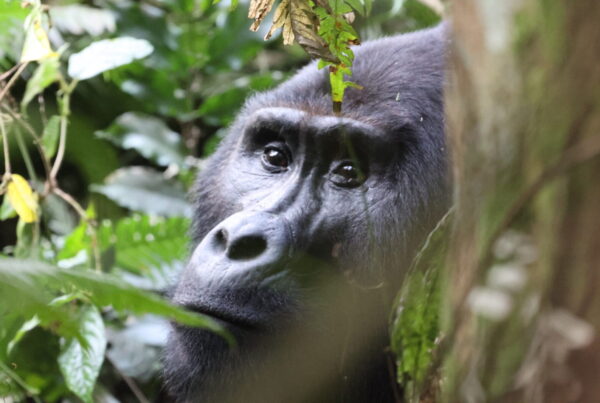
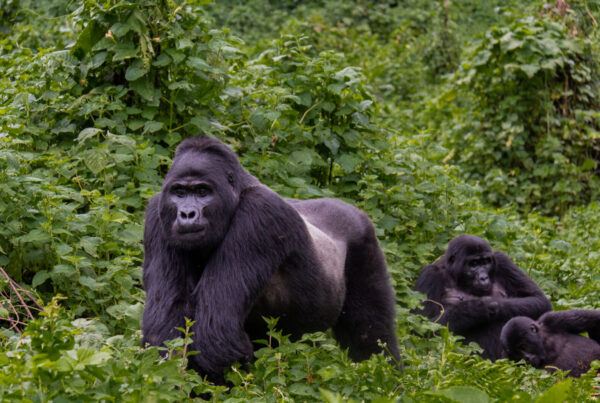
Before you see a habituated gorilla family, you often hear them. A low, rumbling belch vocalization carries through the undergrowth ahead of you, and your guide slows his pace and raises his hand. You have found them. Understanding what that sound means — and the dozens of other sounds a gorilla family produces throughout a morning in the forest — transforms what might otherwise be a visual spectacle into something much closer to comprehension. Gorillas communicate constantly, and they do so with a vocal range that researchers have been cataloguing and interpreting for decades.
The belch vocalization: gorilla contentment
The belch vocalization is the most frequently heard gorilla sound on a trek, and its meaning is consistently positive: it signals contentment, group cohesion, and calm. Silverbacks produce it while feeding, females use it during grooming sessions, and juveniles make versions of it while playing. When a habituated group is relaxed and feeding undisturbed, the forest fills with a series of low, rumbling, almost conversational belch vocalizations — the sound of a family conducting its morning in peace.
Researchers who have spent extended time with specific families describe the belch vocalization as a contact call — a way of maintaining awareness of each group member’s position without visual confirmation. In dense vegetation where sight lines are limited, the belch allows the group to stay connected across distances of twenty to thirty metres, each animal knowing approximately where the others are without having to move toward them. It is, in a functional sense, the gorilla equivalent of background conversation.
The pig grunt: mild alarm and attention
A sharper, more staccato series of grunts — described by researchers as “pig grunts” for their resemblance to the sound of domestic pigs — signals a different emotional state. Pig grunts indicate mild alarm or disturbance, the gorilla equivalent of looking up sharply from what you are doing. Visitors who move too quickly, speak too loudly, or approach closer than the seven-metre minimum distance may provoke pig grunts from nearby animals, particularly females with infants.
The appropriate response to pig grunts is immediate stillness and reduced noise. Experienced guides respond instinctively, and visitors who follow their lead find that the disturbance settles quickly in habituated families. The pig grunt is a boundary signal — it tells you that you have crossed into uncomfortable proximity — and respecting it by backing off slightly is both polite and effective at restoring calm.
The question bark: alertness and social checking
A sharp, rising bark — sometimes described as a “question bark” because of its upward intonation — indicates a gorilla that has noticed something unusual and is assessing the situation before deciding how to respond. It is more intense than the pig grunt but less than a full alarm call, and it is commonly produced by silverbacks and senior females when something in the environment has caught their attention: an unfamiliar sound in the canopy, a change in the visitor group’s composition, or simply an unexpected movement.
In a habituated family, a question bark from the silverback generally produces an immediate response from the rest of the group — juveniles stop playing and move toward their mothers, females look in the direction the silverback is facing. If the stimulus turns out to be non-threatening, the silverback will settle again within a minute or two and the family will resume normal behaviour. Watching this rapid social coordination — the way a single sound from the silverback reorganises the whole group within seconds — is one of the more instructive demonstrations of gorilla social structure available during a trek.
The chest beat: communication, not aggression
The chest beat is the most dramatic and most misunderstood gorilla sound. Popular representation has turned it into a symbol of raw aggression — the angry ape pounding its chest before an attack. In reality, the chest beat is a complex, multi-purpose communication with far more varied and sophisticated meanings than simple aggression.
Silverbacks beat their chests to signal their location to group members in dense vegetation, to establish dominance without physical confrontation, to warn rival males that are approaching group territory, and — in the context of interactions with human visitors — to communicate presence and status to an unfamiliar entity that has appeared in their space. The chest beat is often followed by a bluff charge that stops well short of actual contact, designed to assess whether the observed intruder will flee or hold its ground.
The sound itself is produced not by beating closed fists but by cupped hands slapping a partially inflated chest, creating a resonating boom that carries through forest over considerable distances. The specific rhythm and tempo of an individual silverback’s chest beat is distinctive enough that researchers can identify individuals by their beat pattern — a form of vocal fingerprinting that has proven useful in population monitoring.
Infant vocalisations: screaming, whimpering, and play sounds
Gorilla infants and juveniles are the most vocally expressive members of their families. Infants separated momentarily from their mothers produce a distinctive, high-pitched scream that immediately draws the mother back. The scream triggers a coordinated response from the whole group — females look toward the sound, the silverback becomes alert, and nearby juveniles freeze in their play. The mother’s response is typically immediate and physical, scooping the infant back into contact.
Juveniles playing together produce a distinctive laugh-like panting vocalization that is functionally analogous to human play laughter — it signals play intent rather than aggression, allowing rough-and-tumble wrestling and chasing to occur without triggering defensive responses from adults. The panting laugh is heard frequently during the gorilla hour when juveniles in a relaxed, well-habituated family are engaged in the boisterous play that consumes a large part of their day.
How guides interpret sound to find gorillas
The park rangers who track habituated families before visitor groups arrive use vocalisations alongside visual signs — bent vegetation, knuckle prints, dung — to locate the group’s morning position. An experienced tracker following a gorilla family through dense forest relies heavily on periodic belch vocalisations to stay oriented to the group’s movement direction and to confirm that the animals heard moving through undergrowth are the right family rather than another group or a lone individual.
Your guide’s ability to read gorilla sounds in real time is one of the most valuable dimensions of the trek. Pausing when your guide pauses, listening when they listen, and watching where they look — these attentive responses allow you to perceive much more of what is happening in the family’s behaviour than you would manage alone. The sounds you would otherwise dismiss as background forest noise your guide is actively interpreting, and the interpretations they share — quietly, in a word or two — dramatically enrich what you are able to take in during the one-hour encounter.