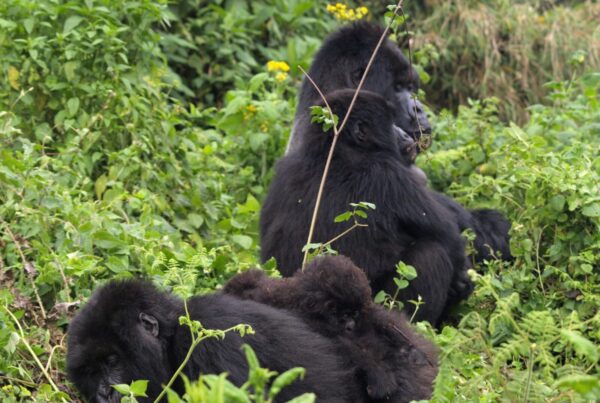
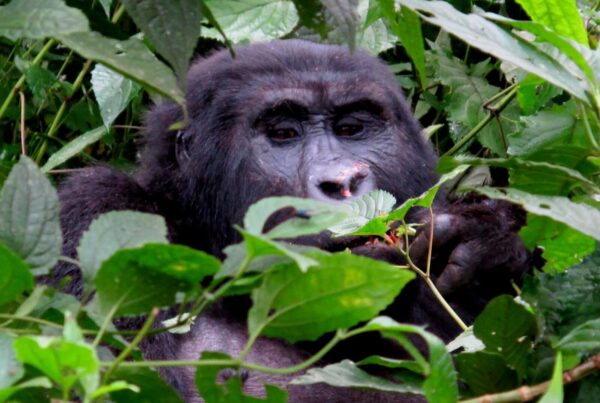
Mountain gorillas are not silent animals. The popular image of the brooding, still silverback does not capture the acoustic richness of a habituated gorilla group going about its daily life. From the deep, rumbling belch-vocalisations that signal contentment during feeding to the sharp alarm barks that warn of approaching threats, from the playful screams of juveniles to the earth-shaking roar that precedes a silverback charge, gorilla communication is a complex, multi-layered system that researchers have spent decades beginning to decode. For gorilla trekking visitors, understanding the sounds they encounter during the sixty-minute observation period transforms an already remarkable experience into one informed by genuine understanding of what is being expressed.
Belch vocalisations: the sound of contentment
The most frequently heard gorilla sound during a relaxed encounter is the belch vocalisation — a deep, resonant “mmm-mmm” or “rruummm” produced from the chest with the mouth partially open. Despite the name, this sound is not a literal belch but a distinctive vocalisation produced during or after feeding, during grooming, and at rest when the group is settled and undisturbed. It functions as an ongoing social contact signal — a way of saying “I am here, I am calm, all is well” — and its presence in the acoustic environment of a gorilla encounter signals that the group is relaxed and undisturbed by the visitors.
Silverbacks produce belch vocalisations more frequently than other group members, and their reponse is deeper and more resonant. When the silverback belches repeatedly during the observation period, it is one of the most reliable signs that the encounter is going well — the dominant male’s calm is contagious in both directions, reassuring the group’s other members and also reassuring experienced guides that no intervention is needed. Hearing the silverback produce steady belch vocalisations while visitors quietly observe and photograph is the baseline condition of a successful gorilla trek encounter.
Pig grunts: mild alarm and attention
The pig grunt — a short, staccato grunting sound produced in quick series — indicates a mild alarm or attention response. It is produced when a gorilla notices something unexpected in its environment that does not rise to the level of a full alarm response. Visitors who move too quickly, produce a loud sound, or approach too closely may trigger pig grunt responses from nearby gorillas. A single pig grunt from an adult female watching a visitor closely is a mild warning; a series of pig grunts from multiple animals suggests that the group’s comfort level is being tested and that the visitors should reduce movement and noise.
Guides listen for pig grunts as real-time feedback on how the group is responding to the visitors’ presence. A guide who hears pig grunts and immediately moves the group back slightly, asks visitors to crouch, or signals for silence is responding to acoustic information that tells him the group needs more space. This responsiveness to the gorillas’ acoustic signals is one of the most important skills experienced guides develop through years of daily forest immersion.
Screams and play vocalisations
Juvenile gorillas produce high-pitched, excited screams during play — the acoustic equivalent of human children’s shrieking during active games. Play in gorilla groups is vigorous and sometimes looks alarming to first-time observers: wrestling, chasing, rolling down slopes, tumbling from branches. The accompanying screams are a reliable indicator that what is occurring is play rather than genuine conflict — aggressive interactions produce different, harsher sounds.
Screams are also produced in distress contexts — a separated infant calling for its mother, a juvenile caught in an adult social interaction that turns rough, or an individual reacting to pain or fear. The distinction between play screams and distress screams is audible to experienced observers in the quality and continuity of the sound: play screams tend to be episodic, varied, and interrupted by periods of normal activity; distress screams are more insistent, higher-pitched, and continuous. Guides distinguish these situations rapidly and adjust their management of the visitor group accordingly.
The double bark: alarm calls
The double-bark is a sharp, forceful exhalation produced twice in rapid succession — “kho-kho” — that indicates a genuine alarm response. When a gorilla detects something unexpected and threatening, the double-bark alerts other group members and often triggers an immediate response from the silverback. Trackers use the double-bark as one of the most valuable acoustic tracking signals in the morning — hearing a double-bark from the forest indicates that the gorillas are aware of something in their environment and helps trackers localise the group’s position from a distance.
During a trekking visit, a double-bark from a gorilla looking toward the visitor group indicates that the seven-metre minimum distance may have been breached, that a visitor has made a sudden movement or sound, or that the group has simply registered the visitors’ presence more acutely than previously. The correct response — crouching, avoiding eye contact, complete stillness — follows automatically from the guide’s direction. The double-bark is a warning system, and responding to it appropriately prevents the escalation to a more intense display.
The roar and the charge
The silverback’s full alarm vocalisation — a sequence that can escalate from pig grunts through screams to a deep, reverberating roar — is one of the most physically impressive sounds in the natural world. The roar is produced with the mouth wide open, the chest expanded, and the full body weight behind the exhalation. At close range, the sound is felt as much as heard — a physical pressure in the chest cavity. It typically precedes or accompanies the chest-beating display and the charge sequence.
A silverback charge is typically a bluff — a high-speed rush toward a perceived threat that is halted before contact. The acoustic accompaniment is full-intensity: roaring, screaming, crashing through vegetation, and the percussive sound of chest-beating. The correct visitor response — crouching, avoiding eye contact, remaining still — allows the charge to dissipate as it approaches without triggering the escalation that flight or direct eye contact would provoke. The silence that follows a charge that has been correctly handled is one of the most profound moments in the gorilla trekking experience: the forest resettles, the silverback returns to feeding or resting, and the group resumes its normal activity as if nothing occurred.
Research into gorilla language
Research on gorilla vocal communication has advanced significantly in recent decades through a combination of field recordings, experimental studies with captive gorillas, and cross-species comparative analysis. Studies published in the 2020s have identified that gorilla vocalisations include elements of intentionality and context-sensitivity that were not previously appreciated — gorillas modify their calls based on who they are communicating with and what response they are seeking, rather than producing stereotyped signals in response to fixed stimuli.
The question of whether gorilla communication constitutes a rudimentary form of language — with combinatorial structure and displacement (the ability to communicate about things not present in the immediate environment) — remains actively debated. Wild gorillas have not been demonstrated to have the combinatorial vocal complexity that some cetaceans and corvids display, but the richness of their communicative repertoire and their apparent flexibility in signal production continues to yield surprises as research tools improve. The gorilla is not merely a biological curiosity — it is a window into the evolutionary origins of human communication itself.