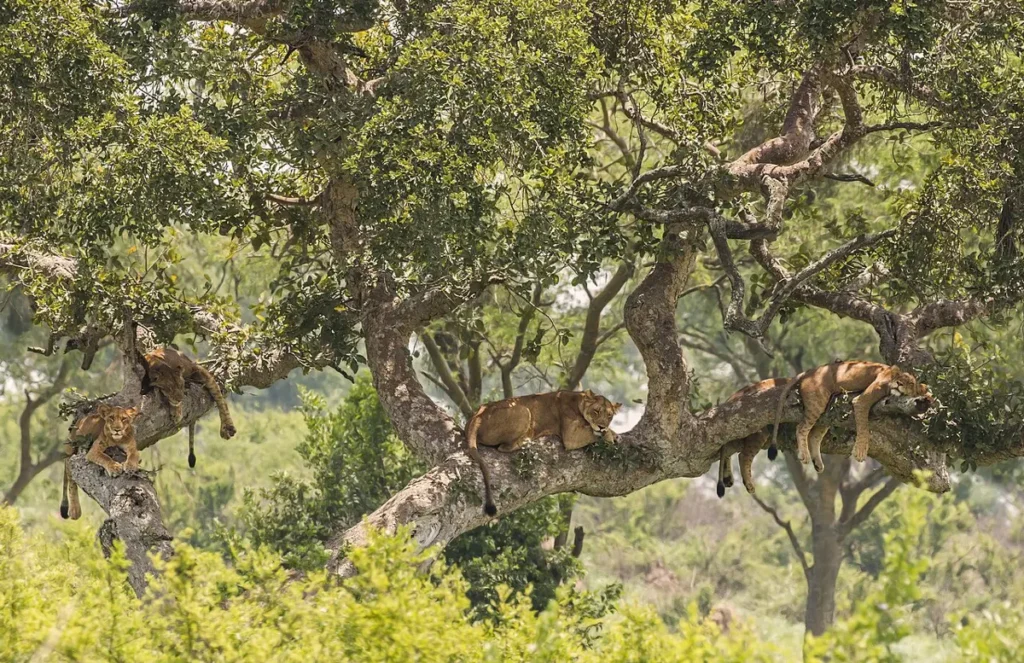
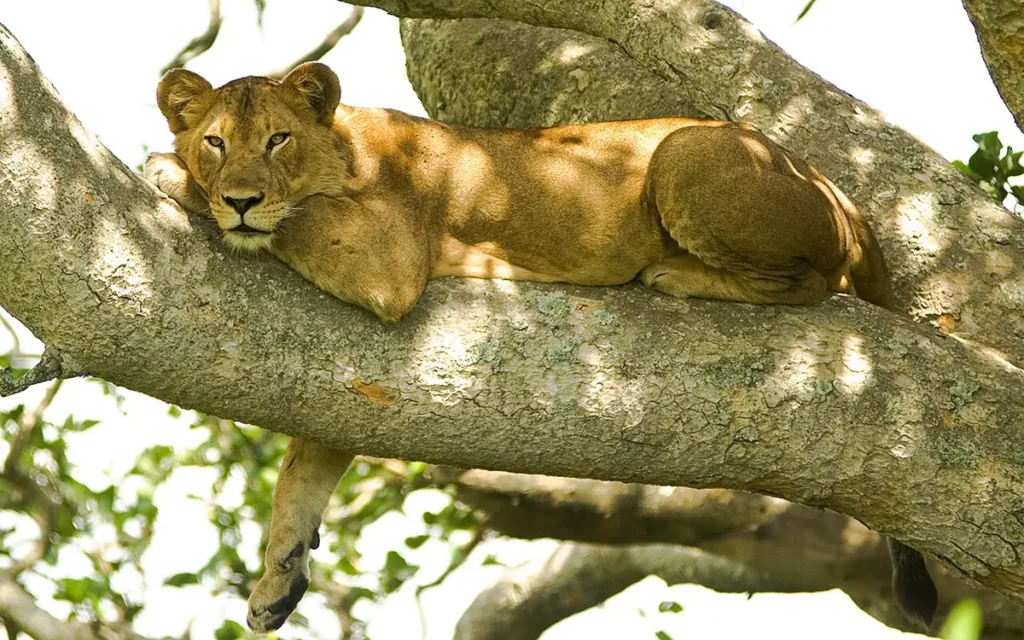
In the Ishasha sector of Queen Elizabeth National Park, in the far southwest of Uganda near the DRC border, lions do something that lions almost nowhere else on Earth do: they climb trees. Not occasionally, not accidentally — routinely, deliberately, and with the comfortable ease of animals that have been doing this for generations. The Ishasha tree-climbing lions are one of Uganda’s most extraordinary wildlife encounters, and one of the most photographed and discussed animal behaviours in East Africa.
Where the Behaviour Is Documented
Tree-climbing lions are documented reliably in only two places in Africa: the Ishasha sector of Queen Elizabeth National Park in Uganda, and the Lake Manyara National Park / Tarangire area of Tanzania. A few isolated observations exist elsewhere — individual lions in Kruger and elsewhere have been photographed in trees — but consistent, habitual, multigenerational tree-climbing as a pride behaviour occurs almost exclusively in these two locations.
This geographic specificity is itself remarkable. Lions are not physiologically built for climbing the way leopards are — their bodies are heavier, their claws less curved, their musculature less adapted for vertical movement. That certain populations have developed this behaviour while nearby populations have not suggests that it is a learned cultural trait rather than an instinctive behaviour: passed from individuals to cubs through observation and imitation over generations.
The Favoured Trees
In Ishasha, the lions favour a specific tree: the large wild fig (Ficus natalensis), also called the cluster fig. These are substantial trees with broad horizontal branches that begin low on the trunk, making them accessible to large animals. The branches extend outward rather than upward, providing comfortable platforms on which a lion can stretch out — tail hanging, head resting on a paw — with the same indifference to gravity that is deeply incongruous with the animal’s size.
Specific trees in the Ishasha sector have become famous for repeated lion use. Rangers and guides know which trees to check during game drives, and the probability of finding lions in a favoured tree on any given morning is surprisingly high during the dry season when the lions are most active in the area.
Why Do They Do It?
The honest answer is that the reasons are not definitively established. Several hypotheses have been proposed and are not mutually exclusive. The most commonly cited is thermoregulation: elevated branches benefit from significantly more airflow than the ground on a hot savanna afternoon, and the temperature difference between the ground and a branch 3 to 4 metres up can be substantial. A second hypothesis involves avoidance of insects: biting flies, particularly tsetse flies, are considerably more concentrated at ground level than in the canopy, and lions have been observed moving into trees when fly pressure is high. A third is the vantage point — a lion in a tree can observe a much wider area than a lion on the ground, which may be useful for monitoring prey or rival prides. And a fourth is simply cultural inertia: the cubs in the Ishasha pride learn to climb by watching their mothers do it, regardless of the original reason for the behaviour.
The Ishasha Pride
The tree-climbing behaviour is associated with specific pride lineages in Ishasha rather than all lions in the area. The most consistently documented tree-climbing individuals belong to prides that have held territories in the Ishasha sector for decades. The behaviour has been observed across multiple generations of the same family lines, strongly supporting the cultural transmission hypothesis.
Ishasha lions prey primarily on Uganda kob and buffalo in the sector’s open grasslands and riverine areas. The Ishasha River corridor provides water and attracts prey throughout the dry season, making it the sector’s most productive wildlife area. Lions are seen on the ground hunting and interacting socially, and in the trees resting — the same individuals moving between both contexts with complete ease.
How to See Them
The Ishasha sector is in the southern portion of Queen Elizabeth National Park, accessed from the Ishasha entrance gate near the town of Ishasha. It is approximately 6 hours’ drive from Kampala. Most visitors who specifically want to see the tree-climbing lions stay in the sector for at least one night, allowing a morning and evening game drive.
The best strategy is to drive the Ishasha River circuit in the early morning, checking the known fig trees systematically. An experienced local guide will know which trees are currently being used. Sightings are most reliable in the dry season (June to August and December to February) when the lions concentrate near permanent water. In the wet season, the lions disperse more widely and sightings are less predictable, though the landscape is dramatically beautiful in its own right.
Ishasha is frequently combined with gorilla trekking at Bwindi Impenetrable Forest, which is located just north of the sector. The combination — tree-climbing lions one day, mountain gorillas the next — is one of the most extraordinary two-day wildlife itineraries available anywhere in Africa, and Uganda is the only place on Earth where both are possible in a single visit.