The Uganda kob is on the country’s coat of arms. It is on banknotes. It is the national antelope, so deeply embedded in Uganda’s identity that its image has been used to represent the nation for generations. And yet outside East Africa, it remains largely unknown — overshadowed by the more famous species of the Serengeti and Kruger, by lions and elephants and leopards. On the ground in Uganda, however, the kob is everywhere: the grasslands of Queen Elizabeth National Park hold some of the largest concentrations of antelope anywhere in Africa, and the Uganda kob is their most abundant and conspicuous member.
Physical Characteristics
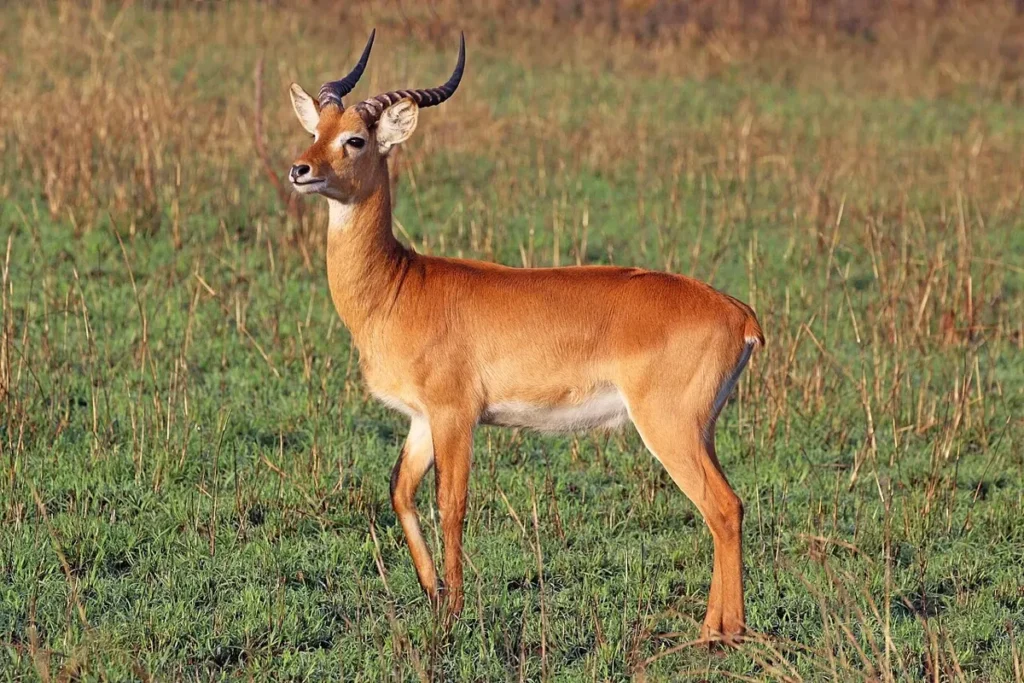
The Uganda kob (Kobus kob thomasi) is a medium-sized antelope weighing 60 to 120 kilograms. Males are substantially larger than females and carry lyre-shaped horns that curve upward and backward, reaching 40 to 70 centimetres in length. The coat is a warm reddish-brown, with paler underparts and a distinctive white ring around the eye and white patches on the throat and inner legs. Females and young are more uniformly coloured and lack horns.
The kob is built for the open grassland: medium height, compact and muscular, capable of sustained running at speeds up to 60 kilometres per hour. It is a grazer, feeding primarily on short grasses, and shows a strong preference for areas near permanent water — a preference that makes the floodplains and papyrus edges of Queen Elizabeth’s Kasenyi area ideal habitat.
The Lek Breeding System
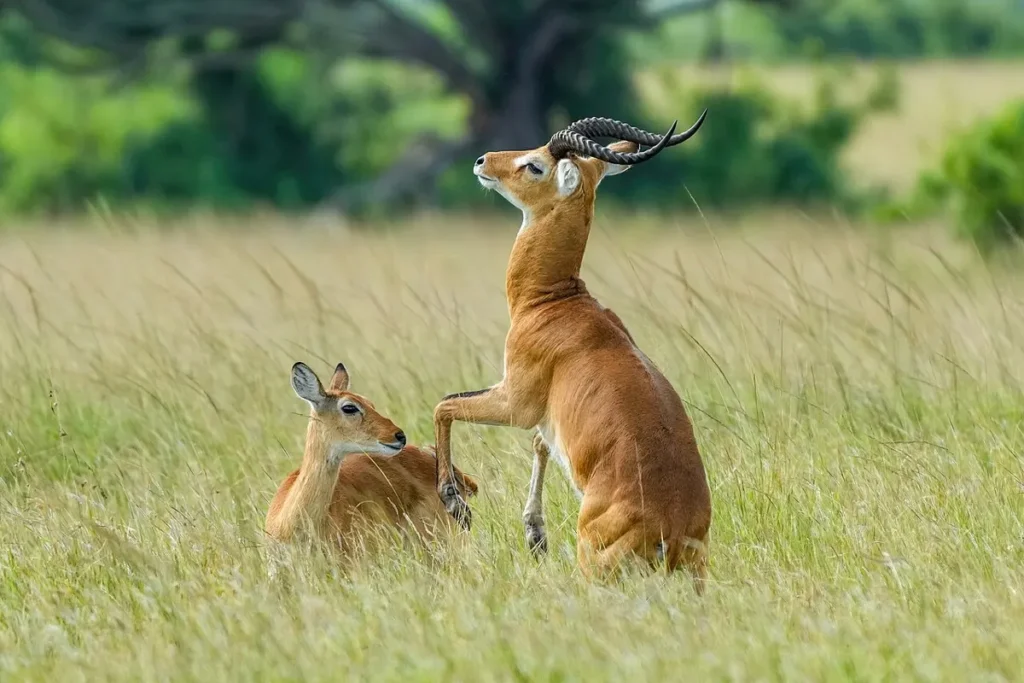
The Uganda kob has one of the most dramatic mating systems of any antelope: the lek. A lek is a communal display ground where males gather and compete for small defended territories, typically 15 to 30 metres in diameter. Females move through the lek choosing mates based on the quality of the male’s territory and display. The most central and most fiercely defended territories belong to the most successful males.
Kob leks in Queen Elizabeth National Park can contain dozens to hundreds of males in a relatively small area. The competition between males — chasing, displaying, horn-clashing — is continuous and intense. A successful male may mate numerous times in a day while holding his territory, but the energy expenditure is so high that most individuals can maintain lek position for only a few days at a time before being displaced. The lek system concentrates genetic selection with extraordinary efficiency: the females’ mate choice means a small number of males father a disproportionate share of each generation.
Population and Ecology
Uganda kob populations in Queen Elizabeth National Park number in the tens of thousands. The Kasenyi Plains in the park’s northern sector are particularly productive, with kob visible in every direction during a morning game drive. Their abundance makes them the primary prey of the park’s lion prides and a major food source for leopards, spotted hyenas, and wild dogs.
The kob’s grazing habits shape the grassland ecosystem. Concentrated grazing on short-grass areas maintains the open, productive sward that supports not just kob but the full suite of grassland wildlife. Their role as prey supports predator populations that in turn regulate the entire food web. The kob is a keystone species in the Uganda savanna ecosystem — not because it is rare or endangered, but because its abundance and behaviour are foundational to how the ecosystem functions.
Conservation Status
The Uganda kob is listed as Least Concern on the IUCN Red List, and Uganda’s populations are healthy. The primary threats are habitat loss at park boundaries and poaching pressure in areas outside protected zones. Within Queen Elizabeth National Park and Murchison Falls, where the kob is also abundant, populations are stable and growing. The species is a conservation success story — protected, abundant, and ecologically functional in its native habitat.
Seeing Kob in Uganda
Queen Elizabeth National Park offers the most spectacular kob viewing in East Africa. The Kasenyi Plains game drives routinely produce sightings of hundreds of kob — feeding, running, displaying at leks, fleeing lions in explosive sprints across the open grass. The scale of these aggregations, the colour of the animals in the equatorial light, and the constant activity of the lek system give kob viewing a drama that more famous antelope species rarely match. The Uganda kob is on the coat of arms for reasons that become immediately clear the first time you see several hundred of them flowing across a Kasenyi grassland at dawn.