

Updated
Fig trees are a keystone of Bwindi Impenetrable Forest. Because fig trees fruit at different times through the year rather than all in one season, there is almost always ripe fruit somewhere in the forest, and that steady supply feeds gorillas, chimpanzees, monkeys, hornbills, turacos and fruit bats when little else is available.
On a gorilla trek, a fruiting fig can explain why a family has moved, why the trek was longer than expected, and why the gorillas are unusually active when you find them. This guide explains how figs work, why they matter so much, and how to recognise them on the trail.
What makes a fig different
The genus Ficus has around 850 species worldwide, from shrubs and climbers to some of the largest trees in tropical forests. What unites them is the fig itself, which is not a true fruit but a hollow, fleshy structure lined with hundreds of tiny flowers. Because the flowers are hidden inside, bees and butterflies cannot reach them. Each fig species relies instead on its own tiny wasp, sometimes only one species, that fits through a narrow opening at the tip.
The cycle works like this. A female fig wasp carrying pollen squeezes into a young fig, often losing her wings in the process. She pollinates the flowers, lays eggs in some of them and dies inside. Her young develop in the galls. The wingless males hatch first, mate with the females and chew exit tunnels, and the females fly off carrying pollen to a fig on another tree. Neither partner can reproduce without the other, a partnership that has lasted tens of millions of years.
Why figs keep the forest fed
Because the wasps live only a day or two as adults, they need receptive figs somewhere nearby at all times. So fig trees do not fruit together. Each tree sets its crop on its own schedule, often more than once a year, and the result is a rolling supply of fruit across the forest. Most other trees in Bwindi fruit seasonally, so when they finish, figs are often the main fruit left. Ecologists call this a keystone resource. If figs disappeared, many fruit-eating animals would struggle through the lean months.
Figs are also nutritious. Studies of tropical figs have found them unusually rich in calcium compared with other wild fruits, which matters for large, growing primates and for nursing mothers. Their seeds pass through animals intact, so every animal that eats figs also helps plant the next generation, often far from the parent tree.
Figs and Bwindi’s gorillas
Bwindi’s gorillas eat much more fruit than the gorillas of the Virunga volcanoes, which live higher up where fruit trees are scarce and feed mainly on leaves, stems and bamboo. Research in Bwindi has shown that on days when the gorillas eat a lot of fruit, they tend to travel further, moving between scattered fruiting trees rather than grazing on plentiful leaves. Figs are among the fruits they seek out.
For trekkers, this has practical consequences. When a group is moving between fruit trees, trackers have more ground to cover and treks can be longer. When you find a family at a fruiting fig, the scene is often livelier than usual, with youngsters climbing high into the crown, adults jostling for the best branches and a silverback feeding at the base. It is also one of the few times you may see heavy gorillas well up in a tree. Our guide to how rangers find gorillas every morning explains how trackers follow a family’s movements from day to day.
Strangler figs
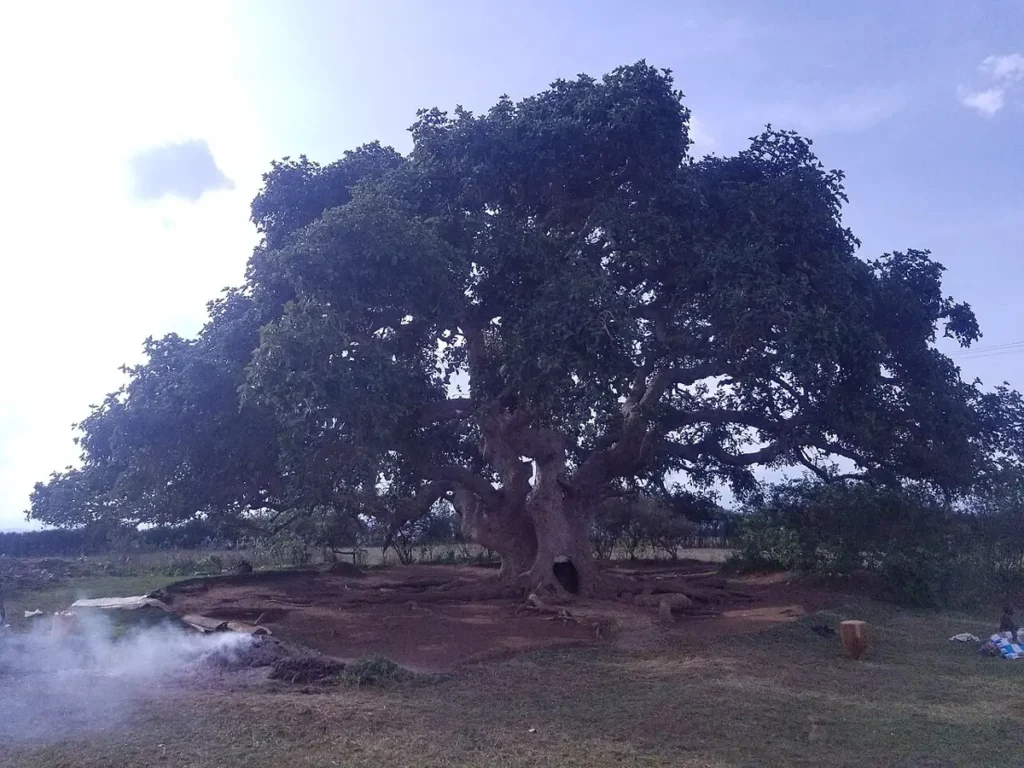
Some of Bwindi’s most striking trees are strangler figs. They begin life as epiphytes, when a bird, monkey or bat drops a fig seed in a fork high in another tree. The seedling grows leaves in the light and sends long roots down the host’s trunk to the ground. Once those roots reach soil, the fig grows quickly. Its roots thicken and fuse into a lattice around the host, and its crown spreads above the host’s crown.
Over decades the host is shaded out and squeezed, and eventually it dies and rots away. What remains is a free-standing fig with a hollow, net-like trunk, sometimes wide enough to look through. Those hollows become roosts and nest sites for bats, owls, small mammals and insects. Your guide will usually point one out if you ask, and they are among the most photogenic trees on the trail.
Who else visits a fruiting fig
A big fig in fruit acts like a feeding station, and on a still morning you can often hear it before you see it. Black-and-white casqued hornbills arrive with loud, whooshing wingbeats. Great blue turacos, the size of a small turkey, clamber through the branches, and African green pigeons are often there too.
Primates join in: red-tailed and L’Hoest’s monkeys, black-and-white colobus, which eat mostly leaves but take some fruit, and Bwindi’s small chimpanzee population. At night fruit bats take over, and fallen figs feed duikers, bush pigs and rodents on the ground. Read more about the colobus monkeys of Bwindi.
Recognising figs on your trek
You do not need botanical training to spot a fig. Look for smooth grey or pale bark, often with buttresses or aerial roots, and a lattice of fused roots on strangler figs. Break a leaf or twig and many figs ooze white, milky latex, although you should only do this on a fallen leaf, because nothing may be picked in the park.
The figs themselves grow in clusters along branches or directly from the trunk and turn yellow, orange, red or purple when ripe, depending on the species. Dropped figs, half-eaten fruit and droppings full of tiny seeds on the trail are signs that animals have been feeding overhead.
The best way to see the bigger picture is to spend time on Bwindi’s forest trails beyond the gorilla trek, or to combine it with a birding walk, especially in Buhoma’s lower, warmer forest, where fruiting trees are richer. For the forest’s other defining tree, read our guide to the Hagenia trees of the highland forest. To understand why Bwindi is so biologically rich overall, see our guide to Bwindi as a UNESCO World Heritage Site.
Frequently asked questions
Because individual fig trees fruit at different times, there is fruit somewhere in the forest almost year-round, which carries many fruit-eating animals through seasons when other trees are not fruiting.
Yes. Bwindi’s gorillas eat far more fruit than Virunga gorillas, and figs are among the fruits they seek out, sometimes travelling further to reach fruiting trees.
A fig that starts life high in another tree, sends roots down to the ground and gradually encloses and kills its host, leaving a hollow, lattice-like trunk.
By tiny fig wasps that enter the fig through a small opening, pollinate the flowers inside and lay their eggs there. Each fig species depends on its own wasp species.










