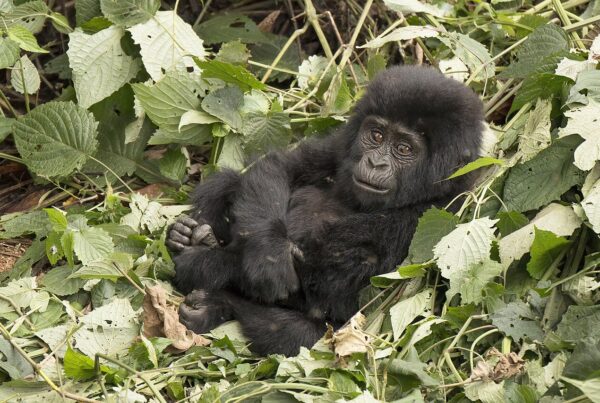
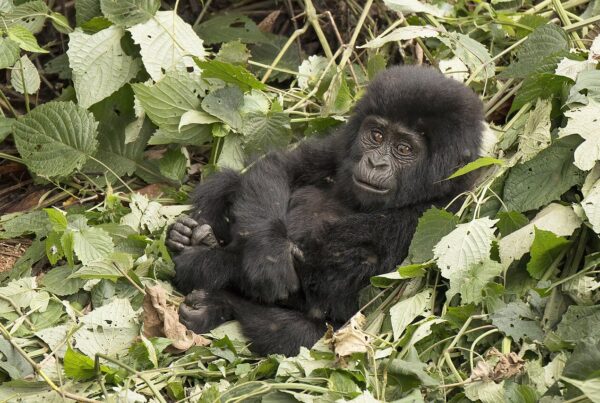
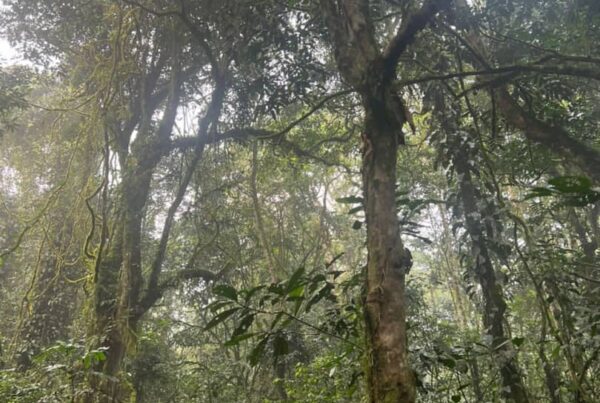
Fig trees (genus Ficus) are the ecological keystone of Bwindi Impenetrable Forest — not because they are the most abundant tree species in the forest, but because their asynchronous fruiting pattern (individual fig trees fruit independently of each other and of the seasons, meaning ripe figs are available somewhere in the forest throughout the year) makes them the one reliable food source that sustains frugivorous wildlife through the dry season months when other fruit species are not fruiting and forest food availability drops sharply. Mountain gorillas, chimpanzees, fruit bats, hornbills, turacos, bushpigs, and multiple primate species all depend on Bwindi’s fig tree network as a year-round nutritional anchor — the gorilla families’ ranging behaviour in dry months is substantially determined by where the fruiting fig trees are at any given time, which is one reason the gorilla trek duration varies dramatically by season. Understanding the fig tree’s role explains much of Bwindi’s ecological structure that is otherwise puzzling to gorilla trekking visitors: why the forest supports such dense primate biomass, why certain trail sections show higher wildlife activity, and why the forest’s botanical diversity is so critical to its conservation. For the gorilla trekking permits that bring visitors into this ecosystem, see the permit guide.
Fig Trees at Bwindi: Ecological Overview
- Genus: Ficus — over 800 species globally; multiple species present in Bwindi
- Fruiting pattern: Asynchronous — individual trees fruit independently year-round, creating a continuous food source
- Wildlife dependents: Mountain gorillas, chimpanzees, L’Hoest’s monkeys, hornbills, turacos, fruit bats, bushpigs
- Mutualistic relationship: Fig trees depend on fig wasps for pollination — each fig species has a specific wasp species
- Gorilla diet: Figs form a significant component of gorilla diet especially in dry months (July–September)
- Bwindi fig species include Ficus mucuso, F. natalensis, F. urceolaris — identifiable by their distinctive bark and root systems
Not all trees are equal in a forest ecosystem. Some species are so central to the survival of so many other organisms that removing them would trigger cascading collapses through the food web. Ecologists call these species keystones — a term borrowed from architecture, where the wedge-shaped central stone holds an arch together and its removal brings the structure down. In Bwindi Impenetrable Forest, fig trees (genus Ficus) play this keystone role with a consistency and importance that makes them arguably the single most ecologically significant plant group in the entire ecosystem.
Understanding fig trees transforms how you see the forest during a gorilla trek. When your ranger guide points to a large fig in fruit, they are pointing to a place where the food web has temporarily concentrated — where birds, primates, bats, insects, and mammals are drawn together by the abundance of nutritious fruit. Mountain gorillas, chimpanzees, red-tailed monkeys, colobus, hornbills, turacos, fruit bats, and forest elephants all depend on fig fruiting events. Learning to recognise figs and understand why they matter turns a trekking day into an ecological education.
What makes a fig tree distinctive
Ficus is one of the largest genera of plants in the world, with approximately 850 species distributed across tropical and subtropical regions globally. In Bwindi, around a dozen fig species occur, ranging from small understorey shrubs to enormous canopy emergents that overtop the surrounding forest. What unites all figs is a distinctive reproductive biology centred on the syconium — the structure we call a fig — which is technically not a fruit in the botanical sense but a hollow receptacle containing hundreds of tiny flowers on its inner surface.
The fig’s reproduction depends entirely on a specialised relationship with tiny wasps of the family Agaonidae. Each fig species is pollinated by one or a very small number of specific wasp species. The female wasp enters the fig through a tiny opening called the ostiole, pollinates the flowers inside, lays her eggs within some of the flowers, and dies inside. The wasp larvae develop inside the fig; male wasps hatch first, fertilise the females, and die inside the fig; the females hatch, collect pollen from the maturing flowers, and exit through holes chewed by the males. They carry pollen to the next fig. Without the wasp, no figs. Without the fig, no wasp. This mutualism — each species entirely dependent on the other — is one of the most intimate examples of co-evolution in the natural world.
Asynchronous fruiting: why figs matter year-round
Most fruit trees in tropical forests fruit seasonally — they synchronise fruiting with rainfall patterns, temperature cues, or other seasonal signals. This produces a seasonal abundance and then a prolonged scarcity of fruit across the forest. Figs are different. Different fig species and even different individual trees of the same species fruit at different times of year, with individual trees fruiting two or more times annually. This asynchronous, staggered fruiting means that at any given moment somewhere in Bwindi’s 331 square kilometres, fig trees are in fruit.
For frugivorous animals — those that depend heavily on fruit for nutrition — this year-round availability is the difference between seasonal feast and year-round survival. Mountain gorillas consume fig fruit whenever it is available and adjust their ranging patterns to include current fruiting trees. Researchers at Bwindi have documented gorilla groups travelling considerably further than their average daily range to reach fruiting figs, demonstrating how strongly the animals prioritise this food source when it is available.
The nutritional quality of fig fruit is high. Figs contain significant levels of calcium — essential for large-bodied primates — as well as carbohydrates, protein, and the vitamins and minerals that forest animals obtain from a varied diet. The calcium content of figs is among the highest of any tropical fruit and is thought to be particularly important for pregnant and lactating gorilla females whose mineral demands are elevated.
Strangler figs: the forest’s most dramatic growth strategy
Among Bwindi’s fig species, the strangler figs are the most visually dramatic and ecologically interesting. Strangler figs begin their lives not as ground-rooted seedlings but as epiphytes — plants that grow on other plants for physical support without taking nutrients from them. A bird or bat deposits fig seeds in a crack in a large host tree’s bark. The seed germinates, the seedling sends roots downward toward the soil, and as the roots grow around the outside of the host tree’s trunk they gradually form a lattice of woody tissue that eventually encases the host completely.
Over decades, the strangler fig’s roots merge with each other to form a solid trunk around the host. The fig’s canopy shades out the host tree above, reducing its photosynthesis. The root lattice around the trunk may compress the host’s vascular tissue and restrict water and nutrient flow. Eventually the host tree dies and decomposes, leaving a hollow-trunked fig that stands independently — the host that supported it through its early growth now entirely gone. The hollows left in these mature strangler figs provide nesting and roosting sites for owls, bats, and small mammals that the solid-trunked trees around them cannot offer.
Fig trees and the gorilla diet
Long-term dietary studies at Bwindi and other mountain gorilla sites have documented that figs rank among the most important fruit foods consumed by gorillas when seasonally available. During peak fruiting events when large fig trees bear heavily, gorilla groups may spend hours at a single fruiting tree, with multiple individuals feeding simultaneously. The social dynamics at these concentrated feeding opportunities are distinctive — more jostling for position, more vocalisation, more movement than during the sedate leaf-feeding that characterises much of the gorillas’ day.
For gorilla trekking visitors, encountering a gorilla group at an active fig tree is one of the most photogenic and behaviourally interesting situations possible. The animals are concentrated, active, and often visible at various heights in the same tree — from juveniles in the upper branches to the silverback feeding at the base. Ask your ranger guide to alert you if you approach a group near a fruiting fig; this context explains the unusual energy level and positional clustering you will observe.
Other species that depend on Bwindi’s figs
The diversity of species that exploit fig fruiting events in Bwindi is remarkable. Great blue turacos and Ross’s turacos — large, spectacularly coloured birds — move through the canopy between fruiting trees and are reliably found near active figs. African grey parrots, black-and-white casqued hornbills, and African green pigeons all concentrate at fruiting figs. The bird activity around a large fruiting fig in Bwindi is a birdwatcher’s highlight — a single tree that may hold fifteen species simultaneously.
Fruit bats play a critical role in fig seed dispersal. Unlike birds that digest fig seeds, bats swallow figs whole, digest the flesh, and deposit seeds in their flight paths far from the parent tree. This dispersal service is essential for the maintenance of fig populations across the forest — without long-distance seed movement, figs would cluster near parent trees where competition between offspring and parent would limit establishment success. The nocturnal activity of fruit bats over Bwindi, invisible to daytime trekkers, underpins the forest’s fig population structure in ways that are only becoming clear through research.
Recognising figs in the forest
Identifying fig trees in Bwindi’s dense vegetation requires learning a few key features. Most Bwindi figs have large, somewhat glossy leaves with a distinctive stipule — a pointed leaf-like structure — at the tip of each growing shoot that falls off as the shoot matures, leaving a circular scar around the stem. The figs themselves, when present, are borne directly on branches or on the trunk rather than at the ends of shoots, a characteristic arrangement called cauliflory that maximises accessibility to large animals that cannot access thin branch tips.
Broken stems of most fig species exude a white latex — a milky sap that is distinctive and immediately recognisable. The aerial roots of strangler figs are visible draped around host tree trunks. Your ranger guide will identify figs when you encounter them; asking them to show you examples of different fig species during the approach trek builds a botanical awareness that enriches the encounter with the gorillas when the fig trees’ role in their diet becomes direct and observable.
Conservation significance of figs
The keystone role of figs means that any threat to fig populations has disproportionate effects on the entire forest community. Forest fragmentation is the most significant current threat — figs depend on their specific wasp pollinators, which are small insects with limited dispersal ability. As forest fragments become isolated, the fig-wasp mutualism may break down if wasps cannot move between fragments. Genetic diversity in fig populations may also decline in isolated fragments, reducing long-term adaptability.
Bwindi’s protected status and the intact nature of most of its forest area provide good conditions for fig population maintenance relative to more fragmented forest landscapes. The buffer zone management around the park’s perimeter — maintaining some tree cover and limiting the total clearance of vegetation adjacent to the park boundary — helps maintain ecological connectivity that benefits pollinator movement. This is one of the less visible but genuinely important dimensions of the conservation work that makes gorilla trekking possible: preserving the forest system at a scale and completeness that sustains the intricate relationships like the fig-wasp mutualism on which the entire food web ultimately depends.
Frequently Asked Questions
Fig trees are disproportionately important to mountain gorillas in Bwindi for the specific reason that figs provide high-calorie, high-sugar fruit at times of year when other forest fruit sources are not available. Mountain gorillas are primarily folivores — their diet is dominated by leaves, stems, bark, and pith — but fruit, when available, is a preferred food source that provides quick-metabolising energy. The problem for fruit-dependent wildlife in tropical forests is seasonal: most fruit species in Bwindi have defined fruiting seasons, meaning large windows of the year when specific fruit species are unavailable. Ficus trees are the ecological exception: because each fig tree fruits independently and the population of trees in the forest fruits at different times, there are always some fig trees producing ripe fruit somewhere in Bwindi’s territory, regardless of the month. During the dry season months when Bwindi’s other fruit species are not fruiting, fig trees become the primary fruit source, and gorilla families move their home ranges toward fruiting fig trees rather than remaining in their dry-season foliage-rich but fruit-poor sectors. This fig-tree-following behaviour is one reason gorilla trek durations vary by season — in dry months (July–September), families may range toward high-altitude fig groves farther from the sector trail heads, producing longer treks than in the wet season months when food is more evenly distributed through the forest. What other animals depend on fig trees in Bwindi Impenetrable Forest? The fig tree’s year-round fruiting pattern supports a diverse community of frugivores in Bwindi that extends well beyond the mountain gorillas. Chimpanzees in Bwindi (a smaller population than Kibale’s, but present) are highly fig-dependent and time their ranging movements around fruiting fig trees with even more precision than the gorillas, since chimpanzees are more exclusively frugivorous than gorillas. L’Hoest’s monkeys, red-tailed monkeys, and blue monkeys all incorporate figs heavily into their seasonal diet. Hornbills — particularly the black-and-white casqued hornbill and the African grey hornbill — are among the most visible non-primate fig consumers at Bwindi, arriving at fruiting figs in groups and remaining until the fruit is exhausted. African green pigeons and multiple turaco species visit fruiting figs with the same pattern. At night, straw-coloured fruit bats (a highly mobile African species) and the smaller hammer-headed bat move between fruiting figs. Bushpigs — largely nocturnal and rarely seen by trekking visitors — consume fallen figs at the forest floor. The net effect of this multi-species dependence on the Ficus network is that any individual fruiting fig tree in Bwindi is briefly a highly concentrated wildlife node, drawing species from across multiple forest strata to a single location — a pattern that experienced birding guides and wildlife trackers use to locate wildlife activity zones. What is the mutualistic relationship between fig trees and fig wasps? The fig-fig wasp relationship is one of the most specialised and ecologically critical mutualisms in tropical botany. Every fig species is pollinated by a specific fig wasp species in the family Agaonidae — the relationship is so specialised that neither partner can complete its reproductive cycle without the other. The fig “fruit” is actually an enclosed inflorescence (called a syconium) with the flowers inside, not on the surface. A female fig wasp enters through a tiny opening (the ostiole) at the tip of the developing syconium, pollinates the internal flowers with pollen she has carried from the fig tree where she developed, and lays her eggs in some of the female flowers. The developing wasps emerge, and the male wasps mate with the females before the males die inside the fig; the newly mated females exit through holes the males have chewed, collect pollen from the male flowers on their way out, and fly to find another receptive fig to continue the cycle. The animal that eats the ripe fig (gorilla, hornbill, bat) disperses the seeds through defecation or dropping, completing the reproduction cycle. The ecological consequence at the forest scale: losing Bwindi’s fig wasp species would eliminate the fig trees’ reproduction over one generation, collapsing the fig network and the entire fruit-based food web that depends on it. Can you see fig trees during gorilla trekking at Bwindi? Yes — fig trees are visible throughout the Bwindi gorilla trekking routes, and a knowledgeable ranger guide can identify them along the trail by their characteristic bark and root structures. The large Ficus species at Bwindi often have the buttressed root systems and smooth grey bark characteristic of the genus; the strangler figs (a growth form where the Ficus germinated epiphytically on a host tree and gradually enclosed it) are particularly visible architectural features of the forest interior. A fruiting fig tree on or near the gorilla trail is immediately identifiable from the activity it generates: if you see multiple hornbills, turacos, and monkeys in the same large tree, that tree is almost certainly a fruiting fig. The best gorilla encounter days sometimes coincide with a fruiting fig tree close to the gorilla family’s position — the family may be settled and feeding with minimal movement, allowing extended close observation. Asking your ranger guide to identify fig trees by species during the trek is one of the specific botanical value-adds that specialist naturalist guides provide over standard driver-guides, and adds an ecological dimension to the encounter that deepens the understanding of why the gorillas are where they are in the forest at that moment. How does Bwindi’s botanical diversity support the mountain gorilla population? Bwindi Impenetrable Forest’s extraordinary botanical diversity — over 1,000 plant species in 331 km², including 163 tree species and a high density of endemic and near-endemic species — is the ecological foundation that supports the mountain gorilla population’s density and health. Mountain gorillas are nutritional generalists with an opportunistic diet strategy: they eat the leaves, stems, bark, pith, and fruit of dozens of species across all vegetation strata, which means that a botanically diverse forest provides a more stable and nutritionally complete food landscape than a simplified or degraded forest. The specific botanical components that are critical: the herbaceous understorey plants (wild celery, thistles, nettles) that form the gorilla’s daily foliage diet; the bamboo zones in certain Bwindi sectors that are particularly important as bamboo shoot food sources in the wet season; the fruiting trees (fig and non-fig) that provide the high-energy fruit diet component; and the bark and pith sources (particularly in the dry season when leaf quality drops). Any significant degradation of Bwindi’s botanical diversity — through climate change effects on the highland forest, boundary encroachment, or invasive species — directly reduces the gorilla population’s food security. The conservation case for protecting Bwindi’s botanical diversity is therefore identical to the conservation case for protecting the gorillas themselves. Understand Bwindi’s ecology before your gorilla trek Gorilla Permit Guide — the permit that grants access to the fig tree ecosystem where the gorillas range Uganda Gorilla Families — the families whose ranging behaviour is guided by Bwindi’s fruiting fig network Bwindi Sector Guide — sector terrain and the forest ecology at each Bwindi sector Full Safari Cost Guide — cost guide for the visit that accesses Bwindi’s ecological wealth Safari Itineraries — Uganda itineraries that incorporate naturalist guide services for deeper forest ecology interpretation Further Reading Fig trees as keystone species: how one plant feeds Bwindi’s whole forest community The fig trees of Bwindi: keystone species and the forest’s feeding calendar Forest therapy in Bwindi: the science of shinrin-yoku and ancient trees Strangler figs of Bwindi: the remarkable trees that build and destroy a forest African mahogany and the forest giants of Bwindi: Uganda’s timber trees Strangler figs in Bwindi: the trees that reshape the forest Top 10 bird species to see in Bwindi Impenetrable Forest Bwindi Impenetrable Forest – Gorilla Trekking in Uganda’s UNESCO Jungle Chimpanzees Confirmed in Bwindi Forest Bwindi Forest: What Happened to the White-Bellied Duiker? <
The fig tree’s year-round fruiting pattern supports a diverse community of frugivores in Bwindi that extends well beyond the mountain gorillas. Chimpanzees in Bwindi (a smaller population than Kibale’s, but present) are highly fig-dependent and time their ranging movements around fruiting fig trees with even more precision than the gorillas, since chimpanzees are more exclusively frugivorous than gorillas. L’Hoest’s monkeys, red-tailed monkeys, and blue monkeys all incorporate figs heavily into their seasonal diet. Hornbills — particularly the black-and-white casqued hornbill and the African grey hornbill — are among the most visible non-primate fig consumers at Bwindi, arriving at fruiting figs in groups and remaining until the fruit is exhausted. African green pigeons and multiple turaco species visit fruiting figs with the same pattern. At night, straw-coloured fruit bats (a highly mobile African species) and the smaller hammer-headed bat move between fruiting figs. Bushpigs — largely nocturnal and rarely seen by trekking visitors — consume fallen figs at the forest floor. The net effect of this multi-species dependence on the Ficus network is that any individual fruiting fig tree in Bwindi is briefly a highly concentrated wildlife node, drawing species from across multiple forest strata to a single location — a pattern that experienced birding guides and wildlife trackers use to locate wildlife activity zones. What is the mutualistic relationship between fig trees and fig wasps? The fig-fig wasp relationship is one of the most specialised and ecologically critical mutualisms in tropical botany. Every fig species is pollinated by a specific fig wasp species in the family Agaonidae — the relationship is so specialised that neither partner can complete its reproductive cycle without the other. The fig “fruit” is actually an enclosed inflorescence (called a syconium) with the flowers inside, not on the surface. A female fig wasp enters through a tiny opening (the ostiole) at the tip of the developing syconium, pollinates the internal flowers with pollen she has carried from the fig tree where she developed, and lays her eggs in some of the female flowers. The developing wasps emerge, and the male wasps mate with the females before the males die inside the fig; the newly mated females exit through holes the males have chewed, collect pollen from the male flowers on their way out, and fly to find another receptive fig to continue the cycle. The animal that eats the ripe fig (gorilla, hornbill, bat) disperses the seeds through defecation or dropping, completing the reproduction cycle. The ecological consequence at the forest scale: losing Bwindi’s fig wasp species would eliminate the fig trees’ reproduction over one generation, collapsing the fig network and the entire fruit-based food web that depends on it. Can you see fig trees during gorilla trekking at Bwindi? Yes — fig trees are visible throughout the Bwindi gorilla trekking routes, and a knowledgeable ranger guide can identify them along the trail by their characteristic bark and root structures. The large Ficus species at Bwindi often have the buttressed root systems and smooth grey bark characteristic of the genus; the strangler figs (a growth form where the Ficus germinated epiphytically on a host tree and gradually enclosed it) are particularly visible architectural features of the forest interior. A fruiting fig tree on or near the gorilla trail is immediately identifiable from the activity it generates: if you see multiple hornbills, turacos, and monkeys in the same large tree, that tree is almost certainly a fruiting fig. The best gorilla encounter days sometimes coincide with a fruiting fig tree close to the gorilla family’s position — the family may be settled and feeding with minimal movement, allowing extended close observation. Asking your ranger guide to identify fig trees by species during the trek is one of the specific botanical value-adds that specialist naturalist guides provide over standard driver-guides, and adds an ecological dimension to the encounter that deepens the understanding of why the gorillas are where they are in the forest at that moment. How does Bwindi’s botanical diversity support the mountain gorilla population? Bwindi Impenetrable Forest’s extraordinary botanical diversity — over 1,000 plant species in 331 km², including 163 tree species and a high density of endemic and near-endemic species — is the ecological foundation that supports the mountain gorilla population’s density and health. Mountain gorillas are nutritional generalists with an opportunistic diet strategy: they eat the leaves, stems, bark, pith, and fruit of dozens of species across all vegetation strata, which means that a botanically diverse forest provides a more stable and nutritionally complete food landscape than a simplified or degraded forest. The specific botanical components that are critical: the herbaceous understorey plants (wild celery, thistles, nettles) that form the gorilla’s daily foliage diet; the bamboo zones in certain Bwindi sectors that are particularly important as bamboo shoot food sources in the wet season; the fruiting trees (fig and non-fig) that provide the high-energy fruit diet component; and the bark and pith sources (particularly in the dry season when leaf quality drops). Any significant degradation of Bwindi’s botanical diversity — through climate change effects on the highland forest, boundary encroachment, or invasive species — directly reduces the gorilla population’s food security. The conservation case for protecting Bwindi’s botanical diversity is therefore identical to the conservation case for protecting the gorillas themselves. Understand Bwindi’s ecology before your gorilla trek Gorilla Permit Guide — the permit that grants access to the fig tree ecosystem where the gorillas range Uganda Gorilla Families — the families whose ranging behaviour is guided by Bwindi’s fruiting fig network Bwindi Sector Guide — sector terrain and the forest ecology at each Bwindi sector Full Safari Cost Guide — cost guide for the visit that accesses Bwindi’s ecological wealth Safari Itineraries — Uganda itineraries that incorporate naturalist guide services for deeper forest ecology interpretation Further Reading Fig trees as keystone species: how one plant feeds Bwindi’s whole forest community The fig trees of Bwindi: keystone species and the forest’s feeding calendar Forest therapy in Bwindi: the science of shinrin-yoku and ancient trees Strangler figs of Bwindi: the remarkable trees that build and destroy a forest African mahogany and the forest giants of Bwindi: Uganda’s timber trees Strangler figs in Bwindi: the trees that reshape the forest Top 10 bird species to see in Bwindi Impenetrable Forest Bwindi Impenetrable Forest – Gorilla Trekking in Uganda’s UNESCO Jungle Chimpanzees Confirmed in Bwindi Forest Bwindi Forest: What Happened to the White-Bellied Duiker? <
The fig-fig wasp relationship is one of the most specialised and ecologically critical mutualisms in tropical botany. Every fig species is pollinated by a specific fig wasp species in the family Agaonidae — the relationship is so specialised that neither partner can complete its reproductive cycle without the other. The fig “fruit” is actually an enclosed inflorescence (called a syconium) with the flowers inside, not on the surface. A female fig wasp enters through a tiny opening (the ostiole) at the tip of the developing syconium, pollinates the internal flowers with pollen she has carried from the fig tree where she developed, and lays her eggs in some of the female flowers. The developing wasps emerge, and the male wasps mate with the females before the males die inside the fig; the newly mated females exit through holes the males have chewed, collect pollen from the male flowers on their way out, and fly to find another receptive fig to continue the cycle. The animal that eats the ripe fig (gorilla, hornbill, bat) disperses the seeds through defecation or dropping, completing the reproduction cycle. The ecological consequence at the forest scale: losing Bwindi’s fig wasp species would eliminate the fig trees’ reproduction over one generation, collapsing the fig network and the entire fruit-based food web that depends on it. Can you see fig trees during gorilla trekking at Bwindi? Yes — fig trees are visible throughout the Bwindi gorilla trekking routes, and a knowledgeable ranger guide can identify them along the trail by their characteristic bark and root structures. The large Ficus species at Bwindi often have the buttressed root systems and smooth grey bark characteristic of the genus; the strangler figs (a growth form where the Ficus germinated epiphytically on a host tree and gradually enclosed it) are particularly visible architectural features of the forest interior. A fruiting fig tree on or near the gorilla trail is immediately identifiable from the activity it generates: if you see multiple hornbills, turacos, and monkeys in the same large tree, that tree is almost certainly a fruiting fig. The best gorilla encounter days sometimes coincide with a fruiting fig tree close to the gorilla family’s position — the family may be settled and feeding with minimal movement, allowing extended close observation. Asking your ranger guide to identify fig trees by species during the trek is one of the specific botanical value-adds that specialist naturalist guides provide over standard driver-guides, and adds an ecological dimension to the encounter that deepens the understanding of why the gorillas are where they are in the forest at that moment. How does Bwindi’s botanical diversity support the mountain gorilla population? Bwindi Impenetrable Forest’s extraordinary botanical diversity — over 1,000 plant species in 331 km², including 163 tree species and a high density of endemic and near-endemic species — is the ecological foundation that supports the mountain gorilla population’s density and health. Mountain gorillas are nutritional generalists with an opportunistic diet strategy: they eat the leaves, stems, bark, pith, and fruit of dozens of species across all vegetation strata, which means that a botanically diverse forest provides a more stable and nutritionally complete food landscape than a simplified or degraded forest. The specific botanical components that are critical: the herbaceous understorey plants (wild celery, thistles, nettles) that form the gorilla’s daily foliage diet; the bamboo zones in certain Bwindi sectors that are particularly important as bamboo shoot food sources in the wet season; the fruiting trees (fig and non-fig) that provide the high-energy fruit diet component; and the bark and pith sources (particularly in the dry season when leaf quality drops). Any significant degradation of Bwindi’s botanical diversity — through climate change effects on the highland forest, boundary encroachment, or invasive species — directly reduces the gorilla population’s food security. The conservation case for protecting Bwindi’s botanical diversity is therefore identical to the conservation case for protecting the gorillas themselves. Understand Bwindi’s ecology before your gorilla trek Gorilla Permit Guide — the permit that grants access to the fig tree ecosystem where the gorillas range Uganda Gorilla Families — the families whose ranging behaviour is guided by Bwindi’s fruiting fig network Bwindi Sector Guide — sector terrain and the forest ecology at each Bwindi sector Full Safari Cost Guide — cost guide for the visit that accesses Bwindi’s ecological wealth Safari Itineraries — Uganda itineraries that incorporate naturalist guide services for deeper forest ecology interpretation Further Reading Fig trees as keystone species: how one plant feeds Bwindi’s whole forest community The fig trees of Bwindi: keystone species and the forest’s feeding calendar Forest therapy in Bwindi: the science of shinrin-yoku and ancient trees Strangler figs of Bwindi: the remarkable trees that build and destroy a forest African mahogany and the forest giants of Bwindi: Uganda’s timber trees Strangler figs in Bwindi: the trees that reshape the forest Top 10 bird species to see in Bwindi Impenetrable Forest Bwindi Impenetrable Forest – Gorilla Trekking in Uganda’s UNESCO Jungle Chimpanzees Confirmed in Bwindi Forest Bwindi Forest: What Happened to the White-Bellied Duiker? <
Yes — fig trees are visible throughout the Bwindi gorilla trekking routes, and a knowledgeable ranger guide can identify them along the trail by their characteristic bark and root structures. The large Ficus species at Bwindi often have the buttressed root systems and smooth grey bark characteristic of the genus; the strangler figs (a growth form where the Ficus germinated epiphytically on a host tree and gradually enclosed it) are particularly visible architectural features of the forest interior. A fruiting fig tree on or near the gorilla trail is immediately identifiable from the activity it generates: if you see multiple hornbills, turacos, and monkeys in the same large tree, that tree is almost certainly a fruiting fig. The best gorilla encounter days sometimes coincide with a fruiting fig tree close to the gorilla family’s position — the family may be settled and feeding with minimal movement, allowing extended close observation. Asking your ranger guide to identify fig trees by species during the trek is one of the specific botanical value-adds that specialist naturalist guides provide over standard driver-guides, and adds an ecological dimension to the encounter that deepens the understanding of why the gorillas are where they are in the forest at that moment. How does Bwindi’s botanical diversity support the mountain gorilla population? Bwindi Impenetrable Forest’s extraordinary botanical diversity — over 1,000 plant species in 331 km², including 163 tree species and a high density of endemic and near-endemic species — is the ecological foundation that supports the mountain gorilla population’s density and health. Mountain gorillas are nutritional generalists with an opportunistic diet strategy: they eat the leaves, stems, bark, pith, and fruit of dozens of species across all vegetation strata, which means that a botanically diverse forest provides a more stable and nutritionally complete food landscape than a simplified or degraded forest. The specific botanical components that are critical: the herbaceous understorey plants (wild celery, thistles, nettles) that form the gorilla’s daily foliage diet; the bamboo zones in certain Bwindi sectors that are particularly important as bamboo shoot food sources in the wet season; the fruiting trees (fig and non-fig) that provide the high-energy fruit diet component; and the bark and pith sources (particularly in the dry season when leaf quality drops). Any significant degradation of Bwindi’s botanical diversity — through climate change effects on the highland forest, boundary encroachment, or invasive species — directly reduces the gorilla population’s food security. The conservation case for protecting Bwindi’s botanical diversity is therefore identical to the conservation case for protecting the gorillas themselves. Understand Bwindi’s ecology before your gorilla trek Gorilla Permit Guide — the permit that grants access to the fig tree ecosystem where the gorillas range Uganda Gorilla Families — the families whose ranging behaviour is guided by Bwindi’s fruiting fig network Bwindi Sector Guide — sector terrain and the forest ecology at each Bwindi sector Full Safari Cost Guide — cost guide for the visit that accesses Bwindi’s ecological wealth Safari Itineraries — Uganda itineraries that incorporate naturalist guide services for deeper forest ecology interpretation Further Reading Fig trees as keystone species: how one plant feeds Bwindi’s whole forest community The fig trees of Bwindi: keystone species and the forest’s feeding calendar Forest therapy in Bwindi: the science of shinrin-yoku and ancient trees Strangler figs of Bwindi: the remarkable trees that build and destroy a forest African mahogany and the forest giants of Bwindi: Uganda’s timber trees Strangler figs in Bwindi: the trees that reshape the forest Top 10 bird species to see in Bwindi Impenetrable Forest Bwindi Impenetrable Forest – Gorilla Trekking in Uganda’s UNESCO Jungle Chimpanzees Confirmed in Bwindi Forest Bwindi Forest: What Happened to the White-Bellied Duiker? <
Bwindi Impenetrable Forest’s extraordinary botanical diversity — over 1,000 plant species in 331 km², including 163 tree species and a high density of endemic and near-endemic species — is the ecological foundation that supports the mountain gorilla population’s density and health. Mountain gorillas are nutritional generalists with an opportunistic diet strategy: they eat the leaves, stems, bark, pith, and fruit of dozens of species across all vegetation strata, which means that a botanically diverse forest provides a more stable and nutritionally complete food landscape than a simplified or degraded forest. The specific botanical components that are critical: the herbaceous understorey plants (wild celery, thistles, nettles) that form the gorilla’s daily foliage diet; the bamboo zones in certain Bwindi sectors that are particularly important as bamboo shoot food sources in the wet season; the fruiting trees (fig and non-fig) that provide the high-energy fruit diet component; and the bark and pith sources (particularly in the dry season when leaf quality drops). Any significant degradation of Bwindi’s botanical diversity — through climate change effects on the highland forest, boundary encroachment, or invasive species — directly reduces the gorilla population’s food security. The conservation case for protecting Bwindi’s botanical diversity is therefore identical to the conservation case for protecting the gorillas themselves. Understand Bwindi’s ecology before your gorilla trek Gorilla Permit Guide — the permit that grants access to the fig tree ecosystem where the gorillas range Uganda Gorilla Families — the families whose ranging behaviour is guided by Bwindi’s fruiting fig network Bwindi Sector Guide — sector terrain and the forest ecology at each Bwindi sector Full Safari Cost Guide — cost guide for the visit that accesses Bwindi’s ecological wealth Safari Itineraries — Uganda itineraries that incorporate naturalist guide services for deeper forest ecology interpretation Further Reading Fig trees as keystone species: how one plant feeds Bwindi’s whole forest community The fig trees of Bwindi: keystone species and the forest’s feeding calendar Forest therapy in Bwindi: the science of shinrin-yoku and ancient trees Strangler figs of Bwindi: the remarkable trees that build and destroy a forest African mahogany and the forest giants of Bwindi: Uganda’s timber trees Strangler figs in Bwindi: the trees that reshape the forest Top 10 bird species to see in Bwindi Impenetrable Forest Bwindi Impenetrable Forest – Gorilla Trekking in Uganda’s UNESCO Jungle Chimpanzees Confirmed in Bwindi Forest Bwindi Forest: What Happened to the White-Bellied Duiker? <