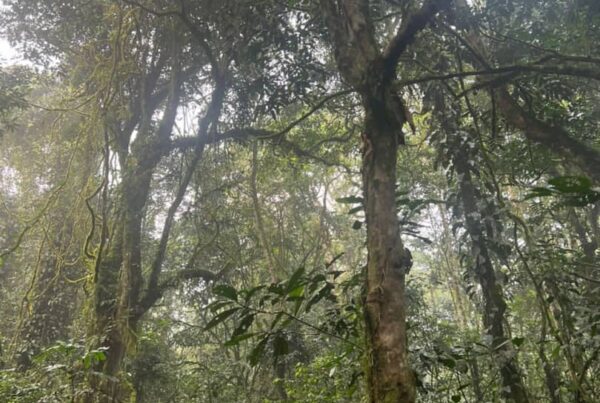
The canopy of Bwindi Impenetrable National Park is held up by trees of extraordinary scale—emergents that rise 40 to 50 metres above the forest floor, their crowns spreading across the upper light zone while their roots grip the steep laterite slopes with a tenacity that has kept them in place through decades of storms and upheaval. Among these forest giants, the African mahoganies and their close relatives are the most imposing—large, buttressed, and ecologically central in ways that the forest’s structure, biodiversity, and resilience all depend upon. They are also the reason Bwindi became a protected area in the first place: not the gorillas, but the timber.
The Entandrophragma species: African mahoganies
African mahogany is not a single species but a family of large, valuable hardwood trees in the genus Entandrophragma—closely related to the West African mahoganies more commonly used in furniture and boatbuilding. In Bwindi and the broader Albertine Rift forest zone, Entandrophragma excelsum (the large-leafed mahogany) and Entandrophragma cylindricum (sapele) are the most significant species ecologically and historically. Both are large trees—reaching 40 to 60 metres in height with trunk diameters exceeding 2 metres—and both produce excellent timber: straight-grained, durable, naturally resistant to fungal and insect attack. Their commercial value was the primary driver of logging pressure on the Bwindi forest before its gazettal as a Forest Reserve in 1932 and ultimately as a National Park in 1991.
The logging history of Bwindi
Bwindi’s forest was subject to commercial timber extraction during the colonial period and into the post-independence era. Selective logging of the most commercially valuable species—primarily the Entandrophragma mahoganies and other large hardwoods—created gaps in the canopy, degraded access to the forest interior, and disturbed the ecological structure of the logged zones in ways that are still visible in the relative scarcity of large mature specimens in some sections of the park. The decision to gazette Bwindi as a national park in 1991 ended all legal timber extraction, but illegal pit-sawing—the hand-sawing of felled trees into planks within the forest—continued as a community livelihood activity in the park buffer zone and occasionally within the park itself for years afterward. Anti-pit-sawing operations remain a component of UWA ranger work in the park, with decreasing but not eliminated incidence.
Buttress roots: the tree’s structural engineering
The most visually striking feature of large forest trees in Bwindi—and the one that gives the forest floor its characteristic Gothic architecture—is the buttress root system. Buttress roots are broad, thin flanges of wood that project from the base of the trunk and extend outward along the ground for several metres in multiple directions, providing a lateral stability system for trees growing in shallow, wet tropical soils where a conventional root ball would be inadequate. In Entandrophragma and similar large-boled species, these buttresses can rise three to five metres up the trunk and extend six to eight metres outward, creating enclosed spaces between them large enough for a person to stand in. The buttresses are not merely structural—they provide habitat for a community of organisms: ferns and mosses colonise their upper surfaces, small mammals and reptiles shelter in the enclosed bays, and the leaf and debris accumulation between the roots creates a microhabitat with distinct soil chemistry and moisture regime.
Brachystegia and the highland transition
At higher elevations in Bwindi—above 2,000 metres—the forest composition shifts away from the lowland mahogany dominance toward a highland community dominated by different genera. Brachystegia species (miombo woodland trees) and Podocarpus (yellowwood, the only large conifer genus native to the African tropics) become more prevalent in the upper montane zones. Podocarpus trees—with their small, yew-like leaves and distinctive red-fleshed “fruit” (technically a modified cone)—are ecologically important as food sources for fruit-eating birds. The Rwenzori turaco, one of Bwindi’s most spectacular birds, feeds specifically on Podocarpus reproductive structures in the upper forest zones. Finding a Podocarpus in fruit on a ridge-top section of the trek—identified by its distinctive narrow leaves and the red-and-green developing receptacles in the canopy—is often a reliable predictor of turaco activity nearby.
The ecology of forest giants: why big trees matter
Large old trees—the forest giants that took two to four centuries to reach their current size—provide ecological functions that younger trees cannot replicate. Their canopy spread creates the large-scale horizontal structure of the forest, providing cover for hawks-eagles nesting sites, providing large epiphyte communities (orchids, ferns, mosses) with the stable, long-lived substrate they require, and providing the structural complexity that determines the density and diversity of cavity-nesting birds. Their root systems extend deep into the soil, accessing nutrients and water unavailable to shallower-rooted species and transferring some of those nutrients to the broader forest ecosystem through mycorrhizal networks. When a giant falls—and in a storm or due to root failure they do fall, creating the forest-gap disturbance events that trigger regeneration—the fallen trunk becomes a nurse log: a slow-decomposing substrate that hosts hundreds of species of fungi, insects, reptiles, and pioneer plants over the decades of its decay. A freshly fallen giant creates a light gap that can take fifty to a hundred years to close; in that gap, the next generation of forest giants begins.
Reading the forest on trek
Trekkers who learn to identify a few of Bwindi’s large tree species—the buttressed mahogany, the smooth-barked Podocarpus, the distinctive spalted trunk of a fig strangler—transform the forest from an undifferentiated backdrop to a readable ecological text. Your guide can point out specific trees if you express interest; most rangers and guides have vernacular names for the common large species and basic knowledge of their uses and ecological roles. The Institute of Tropical Forest Conservation at Ruhija publishes tree identification guides for Bwindi that are available at the park gate; carrying one on trek and attempting to key out species from leaf, bark, and growth form observations is a rewarding botanical exercise that keeps attention focused on the forest during the approach walk and adds a layer of scientific engagement to the experience. The gorilla encounter is the destination. The forest is the journey. Both reward attention.
- African forest elephants of Bwindi: the hidden giants of the impenetrable forest
- What Makes Bwindi Different From Every Other African Forest
- African Golden Cat Uganda: Bwindi’s Secretive Forest Predator
- Fig trees of Bwindi: the keystone species that feeds the whole forest
- Forest therapy in Bwindi: the science of shinrin-yoku and ancient trees
- The fig trees of Bwindi: keystone species and the forest’s feeding calendar
- Strangler figs of Bwindi: the remarkable trees that build and destroy a forest
- Strangler figs in Bwindi: the trees that reshape the forest
- Forest elephants in Uganda: the giants that share Bwindi’s ecosystem
- African wild ginger and other medicinal plants of Bwindi’s forest floor