Updated
forest therapy Bwindi shinrin-yoku ancient forest is one of Uganda’s outstanding natural or cultural attractions, drawing visitors in search of wildlife, scenery, and authentic African experiences. The Japanese concept of shinrin-yoku — forest bathing, the practice of spending time in forested environments with specific attention to sensory presence rather than physical achievement — has attracted scientific attention since the 1980s when Japanese researchers began quantifying the measurable physiological changes that forest environments produce: reduced cortisol levels, lower blood pressure, elevated natural killer cell activity, and reduced sympathetic nervous system activation compared to equivalent time in urban environments — findings that have now been replicated across dozens of studies in forest settings from Japan to Finland to the United States. Bwindi’s forest environment delivers the specific sensory conditions that produce these effects alongside the gorilla trekking experience. See Uganda safari packages.
- Phytoncides: volatile organic compounds (primarily terpenes) emitted by trees; measurably increase NK cell activity in humans after 2-hour forest exposure
- Cortisol reduction: forest walks produce cortisol reductions of 12-15% compared to urban walks of equivalent duration in multiple studies
- Attention restoration: natural environments support involuntary attention (effortless awareness) which allows directed attention systems to recover; relevant to mental fatigue
- Bwindi’s specifics: high biodiversity, multi-layered canopy, high phytoncide concentration from diverse tree species, mosses, and ferns
The Japanese concept of shinrin-yoku — forest bathing, or the practice of spending time in forested environments for health and psychological benefits — has attracted considerable scientific attention over the past three decades. Research studies, primarily conducted in Japanese cedar and oak forests, have documented measurable physiological effects of time in forested environments: reduced cortisol levels, lower blood pressure, enhanced immune function through increased natural killer cell activity, reduced anxiety, and improved mood outcomes across a range of populations. Bwindi Impenetrable National Park, one of the world’s most ancient and ecologically complex forests, offers the same core resource that shinrin-yoku research has studied — and then considerably more.
Forest therapy in Bwindi: the science of shinrin-yoku and ancient trees
The science behind forest effects on the body
The physiological mechanisms proposed to explain shinrin-yoku effects include several that apply directly to the Bwindi forest environment. Phytoncides — volatile organic compounds released by trees and other plants as part of their chemical defence systems — are inhaled during time in forests and have been shown to stimulate natural killer cell activity, a component of the immune system that identifies and destroys virus-infected cells and abnormal cells. The dense, ancient forest of Bwindi produces phytoncide concentrations that far exceed those of managed plantation forests in Japan and Scandinavia.
Visual exposure to green, natural environments has consistent effects on psychological state across studies: reduced activity in the medial prefrontal cortex (associated with rumination and self-referential thought), reduced subjective reports of anxiety and depression, and increased scores on measures of attention and cognitive performance. The mechanism is partially explained by Attention Restoration Theory — the proposal that natural environments, which attract effortless fascination rather than requiring directed attention, allow the directed attention systems associated with urban, work-focused life to recover. Bwindi’s forest provides effortless fascination in extraordinary abundance.
Sound environments also contribute to forest health effects. Natural soundscapes — bird calls, running water, wind in leaves — are associated with reduced physiological stress markers in laboratory studies. The forest soundscape of Bwindi, with its dawn chorus, the continuous insect backdrop, the occasional distant call of a hornbill — is one of the richest natural acoustic environments on earth. This is not simply pleasant; it is physiologically restorative in ways that the science increasingly supports.
Ancient trees and the sense of deep time
Bwindi Impenetrable National Park has been forested continuously for over 25,000 years — through the last glacial maximum, when most of the surrounding landscape dried and cooled, Bwindi persisted as a refugium, a refuge of moisture and life that sustained species through conditions that eliminated them elsewhere. The forest you walk through is not simply old in the way that a mature park or plantation forest is old; it is ancient in the geological sense, its ecological communities shaped by processes operating across timescales that exceed recorded human history by orders of magnitude.
The trees of Bwindi’s forest reflect this antiquity. Some of the largest canopy emergents — the trees that push above the general canopy level and whose root buttresses spread several metres across the forest floor — are estimated to be 200–500 years old or more. Walking past these trees and looking up at their canopies produces a specific kind of small-making feeling that is both humbling and, paradoxically, comforting. You are a very recent arrival in a very old place. The forest does not care about your deadlines, your social anxieties, or the content of your email inbox. It existed long before you and will exist long after you. This perspective is, for many people, one of the most psychologically beneficial aspects of time in wild places.
Gorilla trekking as forest therapy
The gorilla trek is structured as a wildlife activity rather than a therapeutic one, but the conditions it creates are closely aligned with what shinrin-yoku research identifies as optimal for forest therapy benefits. The slow movement through dense forest — matched to terrain rather than to schedule — creates the pace that forest bathing practices recommend. The attentive listening required to follow a ranger guide and to be aware of the forest environment activates exactly the effortless fascination mode that Attention Restoration Theory describes as restorative. The complete absence of mobile data coverage in most of Bwindi’s forest removes the habitual smartphone check that fragments attention in everyday environments.
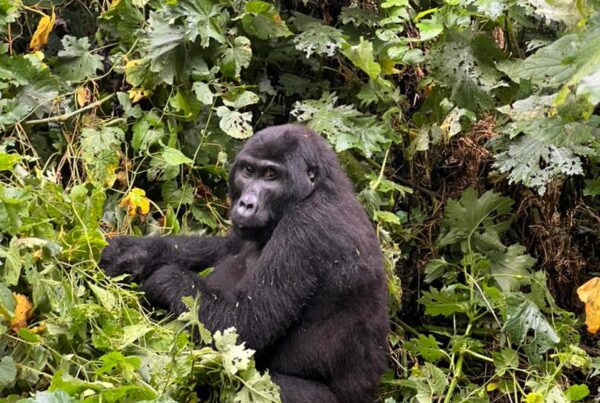
The gorilla encounter itself adds a dimension that shinrin-yoku research has not yet studied: direct, extended contact with a closely related species in its wild environment. The psychological impact of sustained eye contact with a mountain gorilla — the recognition of kinship, the confrontation with questions about consciousness and continuity, the simple strangeness of the encounter — produces a cognitive and emotional reset that goes beyond anything that walking in trees alone can achieve. Whether this is measurable in the same physiological terms as phytoncide exposure or natural killer cell activity, it is real and reported consistently by trekkers regardless of background.
Practical forest therapy approaches for Bwindi visitors
Visitors who want to maximise the restorative value of their time in Bwindi can take some simple steps. Arrive a day before the trek rather than on the day — an evening at a forest-edge lodge with time to sit on the veranda and listen to the forest provides gentle acclimatisation to the acoustic and sensory environment before the more intense experience of the trek itself.
On the trek, resist the impulse to photograph everything immediately. There will be time for photography, but the first minutes of any significant encounter — the walk through a bamboo zone, the first sighting of the gorilla family, the moment a juvenile approaches closer than expected — are worth experiencing through direct attention rather than through a camera screen. The photographs are a record; the direct experience is the thing itself.
After the trek, the forest continues to be available. Evening walks near the lodge, early morning sits in the garden where birdsong is richest, or simply sitting outside after dinner as the insect chorus builds — all of these extend the forest exposure time and, according to the research, extend the physiological and psychological benefits. You are already in one of the world’s great healing environments. Make use of all of it, not only the gorilla hour.
What are phytoncides and why do they affect human health in forest environments?
Phytoncides are volatile organic compounds — primarily terpenes, terpenoids, and other aromatic hydrocarbons — emitted by trees and plants as part of their defence against insects, bacteria, and fungi. Alpha-pinene, beta-pinene, limonene, and d-3-carene are among the most studied phytoncides in the forest health research literature. In Japanese forest therapy research, most extensively conducted by Dr. Qing Li at Nippon Medical School, exposure to forest air containing elevated phytoncide concentrations has been consistently associated with increased activity of natural killer (NK) cells — immune cells that play a role in the body’s response to cellular abnormalities. Studies showing that three-day forest exposure produces NK cell activity elevations that persist for up to a month after the exposure have been replicated in multiple cohorts. The mechanism is not fully resolved but involves direct inhalation of phytoncides and possible dermal absorption. Bwindi’s old-growth closed-canopy forest has high phytoncide emission from its diverse hardwood tree species, tree ferns, mosses, and decomposing organic material — the smell that visitors notice on entering Bwindi is partly the phytoncide complex of the forest air.
How is Bwindi specifically different from other forests for this kind of experience?
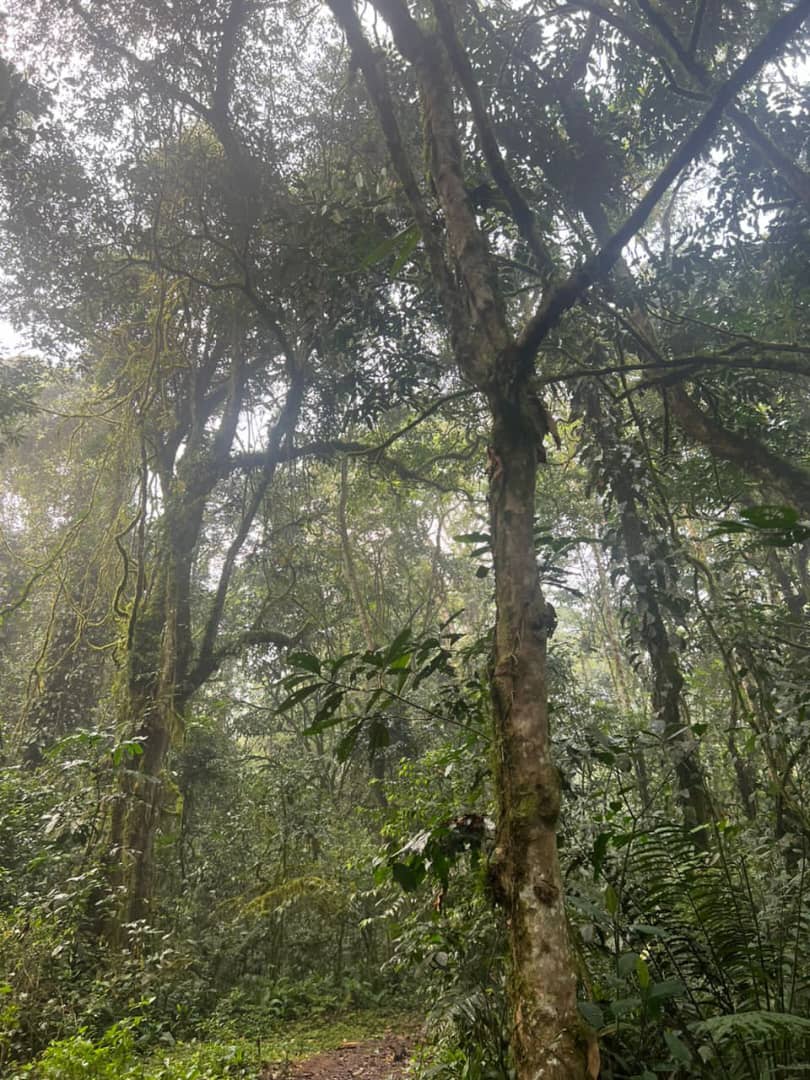
Bwindi’s specific qualities that maximise forest therapy effects are its biodiversity density and its sensory depth. An old-growth tropical forest with Bwindi’s plant diversity (over 1,000 plant species, 163 tree species, exceptional fern and moss richness) emits a more complex phytoncide mixture than a managed plantation or a less-diverse temperate forest. The multiple canopy layers — from the forest floor through the understory, midstory, and closed canopy above — produce a sensory environment with sound, light, smell, and spatial quality that research on attention restoration theory suggests is maximally effective for cognitive and emotional recovery. The specific Bwindi experience: the fractured canopy light that produces moving shadow patterns on the forest floor; the constant but non-alarming sounds of birds, insects, and distant primate calls; the complex smell of decomposing leaf litter, moss, and tree resin; and the physical density of the environment that concentrates attention on the immediate rather than the distant. These are the conditions that attention restoration theory identifies as most restorative for human cognitive and emotional systems.
Do the Batwa people have traditional practices connected to forest healing?
Yes — the Batwa, who lived within Bwindi’s forest until their eviction in 1991, maintained a pharmacopoeia of forest plants used for medicinal purposes that represents accumulated knowledge of forest healing going back across many generations of forest habitation. This knowledge includes: specific tree barks and roots used to manage fever and respiratory illness; moss poultices for wound treatment; specific plant combinations used for gastrointestinal complaints; and plants used in spiritual and ritual healing contexts that combine botanical pharmacology with social and psychological healing practice. The Batwa Cultural Trail at Bwindi Buhoma, guided by Batwa community members, includes demonstration of traditional plant knowledge as part of the cultural experience. The connection between Batwa forest knowledge and the contemporary scientific literature on forest therapy is not a straightforward equation — the traditions are different in epistemology and practice from Japanese shinrin-yoku research — but the underlying observation that prolonged forest habitation produces specific human wellbeing effects is consistent across both the Batwa tradition and the research literature.
Can I do a dedicated forest bathing experience at Bwindi or do I need to trek?
A dedicated slow forest walk focused on sensory immersion rather than wildlife achievement is available at Bwindi outside the gorilla trekking context. The UWA-guided nature walks at Buhoma, Ruhija, and other Bwindi sectors are the formal version: guided walks of 2-4 hours in the forest focusing on plants, birds, insects, and general forest ecology rather than specifically tracking gorillas. These walks move at a slower pace than gorilla trekking and allow more time for stopping, looking, smelling, and attending to the forest environment. A less structured alternative: simply spend time on your lodge’s forest-edge veranda or garden, which at Bwindi lodges is typically set against the forest boundary with the forest sounds and light conditions immediately accessible. The morning hours at Bwindi lodges — sitting with coffee as the forest wakes up, listening to the dawn bird chorus, watching the mist clear from the canopy — produce a passive version of the forest immersion that research identifies as restorative. This is not a substitute for a forest walk but is an accessible complement to it that most visitors underuse.
What does research say about the psychological effects of wildlife encounters?
The psychological effects of wildlife encounters have been studied in a smaller but growing body of research that supplements the forest therapy literature. Key findings: encounters with charismatic wildlife in natural settings produce significant short-term reductions in anxiety and negative affect measured by validated psychological scales; they increase awe-based emotional states that are associated with a shift in self-focus (reduced rumination about personal concerns); and they produce what researchers in the awe literature describe as “vastness accommodation” — the cognitive adjustment required to process something that exceeds existing mental frameworks. The gorilla encounter specifically produces awe in the technical sense used by Dacher Keltner and colleagues at UC Berkeley who have studied awe systematically: it is large, it is unexpected even when anticipated, and it challenges the perceiver’s understanding of what kind of creatures are in the world. Studies of visitor accounts from habituated great ape encounters consistently identify the direct eye contact with the silverback as the single most awe-inducing moment. The physiological correlates of awe — goosebumps, slowed breathing, reduced heart rate — are the body’s response to this category of experience and explain why so many gorilla trekking accounts describe a physical sensation alongside the emotional one.
- Shinrin-yoku and forest bathing: applying the Japanese practice in Bwindi’s rainforest
- Fig trees of Bwindi: the keystone species that feeds the whole forest
- The fig trees of Bwindi: keystone species and the forest’s feeding calendar
- Strangler figs of Bwindi: the remarkable trees that build and destroy a forest
- African mahogany and the forest giants of Bwindi: Uganda’s timber trees
- Strangler figs in Bwindi: the trees that reshape the forest
- Fig trees as keystone species: how one plant feeds Bwindi’s whole forest community
- Tree ferns and prehistoric plants: Bwindi’s connection to ancient forest ecosystems
- Bwindi Impenetrable Forest – Gorilla Trekking in Uganda’s UNESCO Jungle
- Chimpanzees Confirmed in Bwindi Forest