TALK TO AN EXPERT +256 716 068 279 WHATSAPP OPEN NOW.
Wildlife Beyond Gorillas

Serval Cat Uganda: The Tall-Eared Grassland Hunter Facts

Home / Travel News, Stories & Tips / Tales from the Mist / Serval Cat Uganda: The Tall-Eared Grassland Hunter Facts

The serval is one of Africa’s most elegantly designed predators — a medium-sized wild cat with legs proportionally longer than any other cat on Earth, enormous satellite-dish ears capable of detecting prey underground, and a spotted coat that provides near-perfect camouflage in the tall grasslands it hunts. It is not rare in Uganda, but it is rarely seen — primarily nocturnal, highly secretive, and perfectly adapted to using grass cover. When a serval is spotted on a Uganda game drive, it is usually by guides who know exactly where to look. Here is what makes the serval one of Africa’s most remarkable felids.

Physical Characteristics

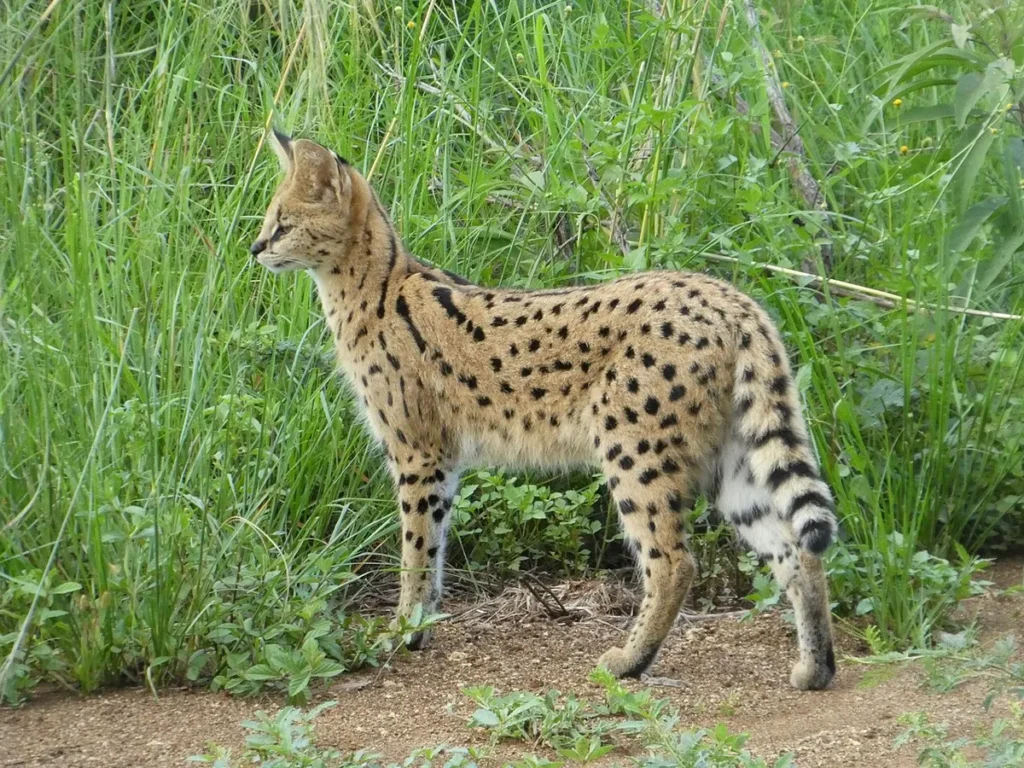
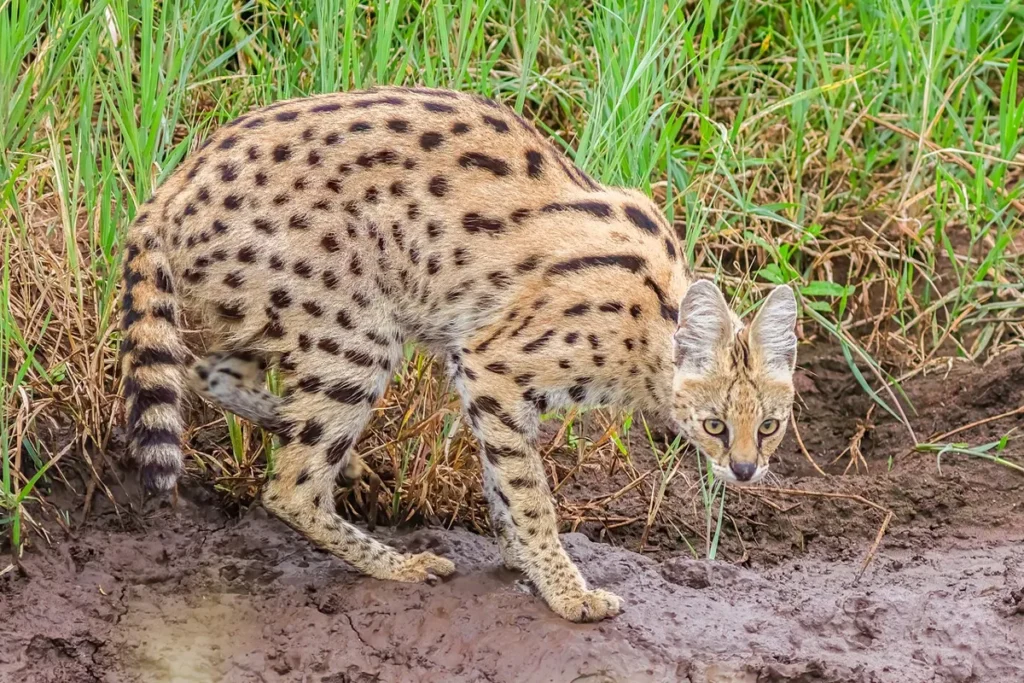
The serval (Leptailurus serval) weighs 9 to 18 kilograms — considerably lighter than a leopard but substantial for a grassland specialist cat. Its most distinctive features are its legs and ears. The legs are the longest relative to body size of any cat species, giving the serval both an elevated vantage point above tall grass and extraordinary jumping capability. The ears are massive relative to head size, funnel-shaped, and highly mobile — they can rotate and focus independently to locate sounds with precision. The combination allows the serval to detect and pinpoint small mammals, birds, and reptiles in grass and underground before making a high-jumping, precision strike.

The coat is pale yellow to tawny, covered with solid black spots and stripes that break up the animal’s outline in dappled grass light. Melanistic (all-black) individuals occur rarely. The tail is short relative to body length compared to forest cats — the serval’s lifestyle does not require a long balancing tail because it hunts on flat ground rather than in trees.

Hunting Technique

The serval has one of the highest hunting success rates of any wild cat — studies estimate 50 to 60 percent of strikes land prey, far exceeding the 20 to 25 percent typical of leopards or lions. The technique relies on the extraordinary ears. A serval will stand completely still in tall grass, ears swivelling independently, listening. When it locates prey by sound — a rodent moving underground, a bird in thick grass — it rears up on its hind legs and launches a high, arching pounce that brings its forepaws down precisely on the target. The strike can reach targets 3 to 4 metres away horizontally and up to 2 metres high, and the accuracy is remarkable even when prey is invisible beneath the grass surface.

Servals eat primarily rodents — particularly vlei rats, grass mice, and cane rats — supplemented with birds, reptiles, frogs, and large insects. Frogs are particularly important in wet grasslands during the rains. The serval’s dietary generalism, combined with its hunting efficiency, makes it one of the savanna’s most effective predators of small mammals.

Nocturnal and Crepuscular Activity

Servals are primarily active at night and around dawn and dusk. During the day they rest in dense grass cover, making daytime sightings genuinely uncommon. The best opportunities for serval encounters on Uganda safaris are night drives in parks that permit them, or dawn game drives in Queen Elizabeth or Lake Mburo when servals are returning from overnight hunts. The animal’s tall silhouette above the grass in the early light — ears above the grass line, body moving in the characteristic stiff-legged hunting walk — is one of the characteristic images of the East African grassland at dawn.

Serval Habitat and Uganda Distribution

Servals inhabit grassland, wetland edges, and light woodland throughout Uganda wherever suitable prey density exists. They are absent from dense forest — unlike their forest-adapted relatives — and require tall grass or reed beds for both hunting and concealment. In Uganda’s national parks, they are present in Queen Elizabeth, Murchison Falls, Lake Mburo, and Kidepo. Outside parks, they persist in areas of agricultural grassland and in papyrus wetlands, where they can coexist with low levels of human activity.

The serval is listed as Least Concern globally — it is not threatened and its populations are stable in most of its range. In Uganda, habitat loss at park boundaries reduces serval density in some areas, but within protected zones the species is well-represented. Seeing one — ears tracking something in the grass, that extraordinary pounce, the whole engineered precision of a predator perfectly matched to its environment — is one of the quieter pleasures of a Uganda safari. Not the headline act, but the kind of encounter that makes the people who know what they are looking at feel extremely lucky.

Ready to experience Uganda’s mountain gorillas in 2026? Secure your gorilla permits early and let us craft a seamless safari tailored to your travel style, preferred trekking sector, and accommodation level. From luxury lodges to well-designed midrange journeys, every detail is handled for you. Every itinerary is carefully planned to maximize your time in the forest while ensuring comfort, safety, and unforgettable encounters.

Have questions about gorilla permits, travel dates, or the best itinerary for you? Speak with a safari expert and get clear, honest guidance to plan your trip with confidence.

When is the last time you had an adventure? African Gorillas!!! Up Close With Uganda’s Wild Gorillas Touched by a Wild Gorilla: An Unforgettable Encounter Inside Gorilla Families: Bonds, Hierarchies & Jungle Life Face to Face With a Silverback: The Wild Encounter You’ll Never Forget