The Largest Living Primates
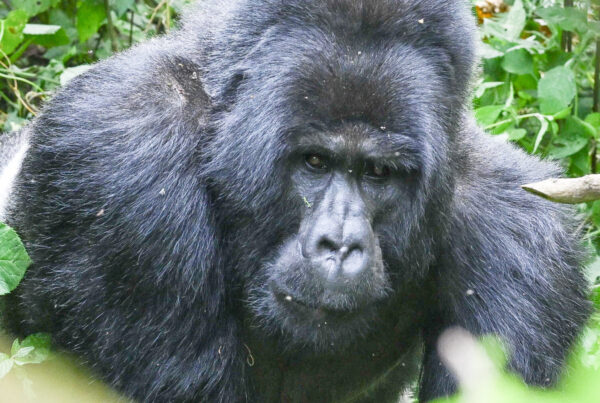
Mountain gorillas are the largest of the four gorilla subspecies and, along with their eastern lowland gorilla cousins, the largest primates on Earth. Their size is not merely impressive in the abstract — it is immediately apparent when you encounter a silverback at close range in Bwindi’s forest. The scale of the animal, the physical presence it commands even while resting, is one of the most visceral aspects of the gorilla trekking experience.
Understanding the numbers behind that presence — the weights, heights, and strength measurements that define mountain gorilla physique — provides context for what makes these animals so extraordinary.
Adult Male (Silverback) Size and Weight
Adult male mountain gorillas, designated silverbacks from around age 12 when a distinctive silver saddle develops across their backs, are substantially larger than females. A fully adult silverback in prime condition weighs between 140 and 200 kilograms, with averages in wild populations typically around 160 kilograms. Captive silverbacks, with guaranteed food access and reduced energy expenditure, sometimes exceed 200 kilograms significantly — the heaviest captive silverback on record weighed 267 kilograms.
Height when standing bipedally ranges from approximately 1.5 to 1.8 metres, roughly comparable to a tall human male. However, gorillas rarely stand for extended periods. Their typical quadrupedal knuckle-walking posture means their effective height profile is lower, though the width of their shoulders — which can span 1.2 metres or more — makes a silverback appear massive even in a resting crouch.
The arm span of an adult male mountain gorilla can exceed 2.3 metres — significantly greater than their height. This disproportionate arm length reflects the gorilla’s evolutionary adaptation to arboreal locomotion (though adult males spend most time on the ground) and provides exceptional reach when feeding from tall vegetation.
Adult Female Size and Weight
Female mountain gorillas are significantly smaller than males, a sexual dimorphism that is among the most extreme in the primate order. Adult females typically weigh 70 to 100 kilograms, averaging around 80 kilograms — roughly half the weight of a large silverback. Female height when bipedal is typically 1.2 to 1.4 metres.
The extreme size difference between male and female gorillas reflects a polygynous social system in which male competitive ability is a primary determinant of reproductive success. Large body size in silverbacks confers both competitive advantage in confrontations with rival males and deterrence value that reduces the need for costly physical combat.
Infant and Juvenile Size
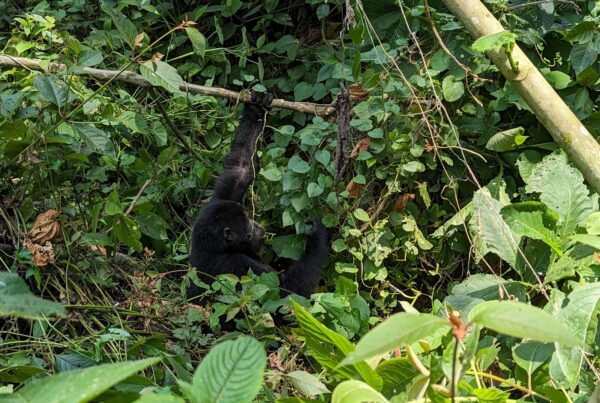
Newborn gorillas weigh approximately 1.8 to 2.2 kilograms — less than half the weight of a typical human newborn relative to maternal size. They grow rapidly: by one year, gorilla infants weigh 7 to 9 kilograms. Juvenile gorillas (ages 3 to 7) weigh 20 to 40 kilograms and are physically capable and active, engaging in the energetic play behaviour that occupies most of their waking hours.
Male gorillas continue growing through their blackback phase (ages 8 to 12) into full silverback status around age 15 to 20. The period of continued growth is one of the longest among primates and reflects the complexity of preparing for a competitive adult male role.
Gorilla Strength: The Numbers
Gorilla strength relative to body weight has been studied both in controlled settings and through field observation of natural behaviour. The results consistently indicate that gorillas are exceptionally strong relative to humans of comparable weight, though the exact multiplier is difficult to measure precisely.
Studies of grip strength and pulling force in captive gorillas suggest that an adult male gorilla can exert approximately 1,300 kilograms of force — roughly six to eight times the maximum force that an athletic human male can produce. This extraordinary strength is partly a function of muscle composition (gorilla muscles contain a higher proportion of fast-twitch fibres than human muscles) and partly a function of skeletal geometry optimised for force generation over precision control.
Field observations support these measurements. Gorillas routinely handle vegetation that humans cannot bend, break branches with casual ease, and lift and carry objects — including other gorillas — that would be beyond the capacity of any human. A silverback carrying his own body weight while knuckle-walking up a steep Bwindi hillside is performing a feat of functional strength that would be extraordinary in any other animal.
Body Composition: Muscle, Not Fat
The impressive weight of a silverback is not fat-padded. Wild mountain gorillas have very low body fat percentages — typically 5 to 10% — despite their enormous caloric intake. The weight is primarily lean muscle mass developed through a life of constant physical activity: daily travel through steep terrain, processing enormous quantities of dense vegetation, and the occasional physical confrontations that define silverback social existence.
Captive gorillas, living more sedentary lives with guaranteed high-calorie nutrition, often develop higher body fat percentages and can appear visibly different from their wild counterparts. When studying gorilla size data, it is important to distinguish wild from captive measurements.
What Gorilla Size Means for the Encounter
When you are assigned a seven-metre distance from a mountain gorilla family and your guide whispers to keep still as a silverback approaches, the reason the seven metres feels inadequate is precisely gorilla size. An animal that weighs 160 kilograms, spans over two metres arm-to-arm, and can generate 1,300 kilograms of force does not need to be threatening to be physically impressive. Simply existing at that scale, in close proximity, is an experience that photographs cannot fully convey.
Most trekkers report that the scale of silverbacks surprises them, even after seeing photographs. The combination of bulk, muscle definition, and calm command over the forest environment creates a physical presence that is genuinely humbling. It is one of the most honest answers to the question of why gorilla trekking costs what it costs and why those who experience it describe it as transformative.
Final Thoughts
A mountain gorilla silverback at 160+ kilograms, with arms spanning over two metres and strength estimated at six to eight times human capacity, is among the most physically impressive animals on Earth. These numbers become real only in person, in Bwindi’s forest, when the scale of the animal occupies your full field of vision. That moment of visceral recognition — of encountering another primate so similar in biology and yet so different in physical reality — is what makes gorilla trekking unlike any other wildlife experience.
Frequently Asked Questions
Uganda is home to the mountain gorilla (Gorilla beringei beringei), one of two subspecies of eastern gorilla. They live exclusively in the Virunga volcanic highlands (Uganda/Rwanda/DRC) and Bwindi Impenetrable Forest (Uganda only). Mountain gorillas are the only gorilla subspecies that cannot survive in captivity — every individual you can trek is a wild animal.
The standard gorilla trekking permit gives you exactly 1 hour with the gorilla family. This time begins when you make first contact with the family — the ranger signals the start. The Gorilla Habituation Experience gives 4 hours with a semi-wild family. The walk to find the gorillas can take 30 minutes to 5 hours depending on where the family has moved.
Stay calm, crouch down slowly, avoid direct eye contact, and remain quiet. Do not run — running triggers a chase response. Rangers accompanying your group manage close approaches. Habituated gorillas are accustomed to humans and almost never make contact, but a charging silverback is managed by staying still and following ranger instructions immediately.
A maximum of 8 visitors per habituated gorilla family per day for standard trekking. The Gorilla Habituation Experience has a maximum of 4 visitors per family per day. These limits are set by UWA to minimise stress on the gorilla families and maintain the quality of the experience.
Uganda is home to the mountain gorilla (Gorilla beringei beringei), one of two subspecies of eastern gorilla. They live exclusively in the Virunga volcanic highlands (Uganda/Rwanda/DRC) and Bwindi Impenetrable Forest (Uganda only). Mountain gorillas are the only gorilla subspecies that cannot survive in captivity — every individual you can trek is a wild animal.