TALK TO AN EXPERT +256 716 068 279 WHATSAPP OPEN NOW.
Wildlife Beyond Gorillas

Spotted Hyena Uganda: Intelligence, Night Hunting and Social Life

Home / Travel News, Stories & Tips / Tales from the Mist / Spotted Hyena Uganda: Intelligence, Night Hunting and Social Life

The spotted hyena is one of the most misunderstood animals in Africa. Its reputation as a cowardly scavenger — reinforced by decades of popular culture, from The Lion King to countless nature documentary narrations — is almost entirely wrong. The spotted hyena is a skilled and highly efficient hunter, a remarkably intelligent social mammal with a brain-to-body ratio comparable to primates, and one of the most successful large carnivores on the continent. Uganda’s national parks hold resident spotted hyena populations, and any night drive in Queen Elizabeth or Murchison Falls has a realistic chance of encountering them.

Physical Facts

The spotted hyena (Crocuta crocuta) is the largest hyena species and one of Africa’s largest carnivores. Adults weigh 40 to 90 kilograms, with females significantly larger than males — the spotted hyena is one of very few mammal species in which females are consistently larger. The body is powerfully built with a distinctive sloping profile: the front legs are longer than the hind legs, giving the animal its characteristic loping gait. The skull is enormously powerful, with jaw muscles and bone structure capable of cracking bones that no other carnivore can access, allowing the hyena to extract marrow and consume skeletal elements that others discard.

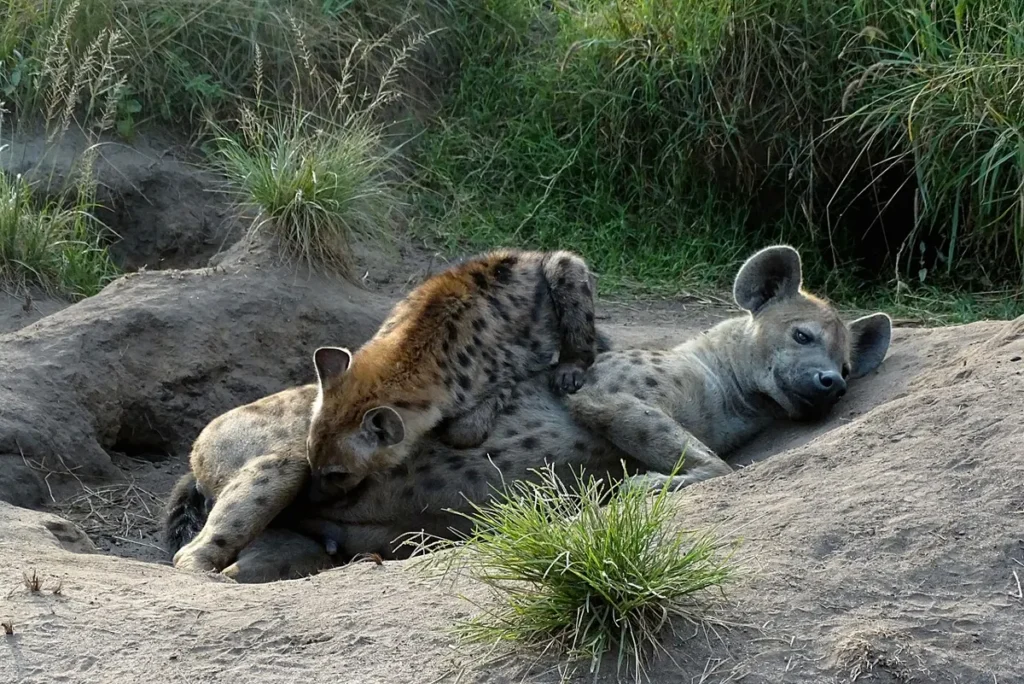
The coat is spotted in younger animals and becomes increasingly plain with age. The spots vary in pattern between individuals and can be used to identify specific animals in long-term research studies. The famous “laugh” — a series of rapid, high-pitched whoops and giggles — is a social call indicating excitement or submission, most often heard during feeding aggregations and social interactions. The territorial call (the “whoop”) is one of the most distinctive sounds of the African night.

Social Structure: The Clan

Spotted hyenas live in clans of up to 80 individuals, though in Uganda’s parks most clans are smaller — typically 10 to 30 members. Clans are matriarchal: the dominant female and her female offspring hold the highest social positions, and even low-ranking females outrank all males. Social rank is heritable — a female’s cubs inherit a rank just below her own — and the consequences of rank are significant: high-ranking individuals have priority access to food, mates, and resting sites.

The clan’s social life is complex, involving long-term alliances, coalitions, and sophisticated tactical behaviour. Hyenas recognise individual clan members and assess their relative rank, and use this knowledge to make decisions about when to challenge for food or territory. Laboratory and field experiments have demonstrated that hyenas solve problems requiring collaboration, remember social relationships over years, and can be trained to perform tasks that challenge chimpanzees. Their cognitive complexity is genuinely comparable to higher primates.

Hunters, Not Scavengers

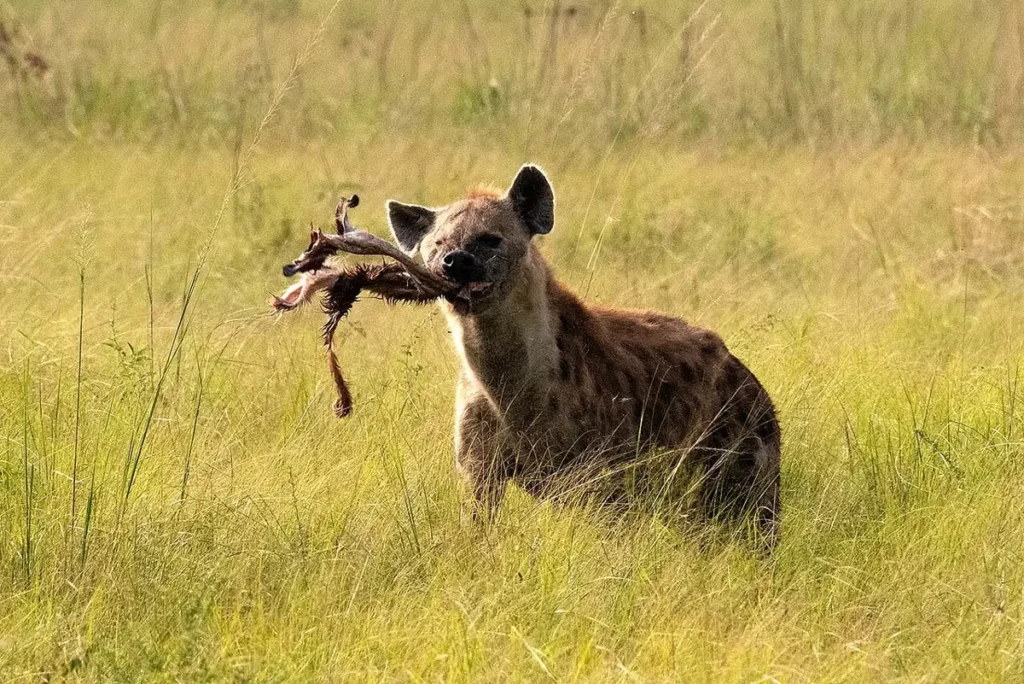
The “scavenger” reputation of the spotted hyena derives primarily from observation of their behaviour around lion kills — they are aggressive enough to displace lions from kills in large numbers, and patient enough to consume what lions leave. But long-term research at multiple African sites has shown that hyenas kill the majority of their food themselves. In the Serengeti and other well-studied systems, hyenas kill 60 to 95 percent of the food they eat, depending on season and prey availability. It is frequently lions that steal from hyenas rather than the reverse.

Night Hunting in Uganda’s Parks

Spotted hyenas are primarily nocturnal hunters. In Uganda’s national parks, they are most active between dusk and midnight, patrolling clan territories and hunting opportunistically. Night drives in Queen Elizabeth National Park and Murchison Falls frequently produce hyena sightings — often already in pursuit of prey or returning from a kill. The hyena’s eyes reflect strongly in a spotlight, producing the distinctive amber reflection that guides use to locate them across open grassland.

Watching a spotted hyena at close range on a night drive — the powerful, sloped body, the extraordinary teeth visible in a brief yawn, the oddly sociable interactions within the clan — dismantles the cartoon villain version with considerable efficiency. This is an intelligent, successful, ecologically critical animal that deserves the same respect accorded to the more glamorous carnivores. In Uganda’s national parks, it gets the chance to make that case on its own terms.

Ready to experience Uganda’s mountain gorillas in 2026? Secure your gorilla permits early and let us craft a seamless safari tailored to your travel style, preferred trekking sector, and accommodation level. From luxury lodges to well-designed midrange journeys, every detail is handled for you. Every itinerary is carefully planned to maximize your time in the forest while ensuring comfort, safety, and unforgettable encounters.

Have questions about gorilla permits, travel dates, or the best itinerary for you? Speak with a safari expert and get clear, honest guidance to plan your trip with confidence.

When is the last time you had an adventure? African Gorillas!!! Up Close With Uganda’s Wild Gorillas Touched by a Wild Gorilla: An Unforgettable Encounter Inside Gorilla Families: Bonds, Hierarchies & Jungle Life Face to Face With a Silverback: The Wild Encounter You’ll Never Forget