Mountain gorillas are among the world’s most studied great apes, yet most visitors arrive at Bwindi with a surprisingly incomplete picture of what these animals are actually like. Beyond the well-known facts about DNA similarity and endangered status, gorilla biology, social structure, and daily behaviour contain details that consistently surprise even well-read trekkers. Before you go, the gorilla families guide and Bwindi trekking overview fill in what the facts alone don’t convey.
- Species: Gorilla beringei beringei (mountain gorilla)
- Wild population: approximately 1,063 (2018 census — most recent full count)
- DNA similarity to humans: approximately 98.3%
- Lifespan: up to 40 years in the wild; none survive long in captivity
- Diet: almost entirely herbivorous — leaves, stems, fruit, bark
Mountain gorillas are among the world’s best-known endangered species, but even well-informed visitors to Bwindi often arrive with impressions shaped more by film and popular culture than by field research. The actual biology and behaviour of mountain gorillas is richer, stranger, and more surprising than the standard wildlife documentary portrait. The following facts represent aspects of mountain gorilla biology and ecology that consistently surprise, delight, or reframe the way visitors think about these animals.
1. Gorillas Have Fingerprints
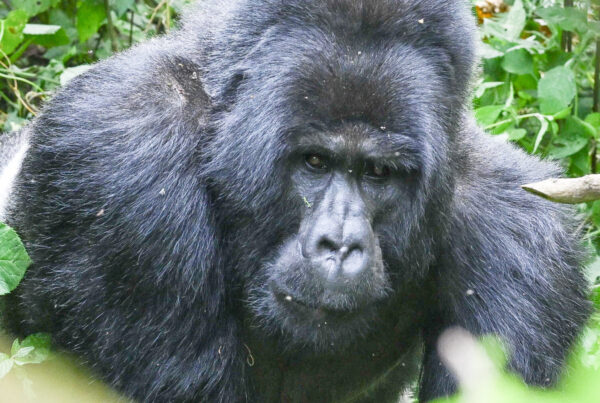
Each mountain gorilla has unique fingerprints and nose prints. Field researchers use photographs of gorillas’ nose ridge patterns — the distinctive folds and wrinkles unique to each individual — to identify specific animals without capture or marking. This individual identification through nose prints is analogous to human fingerprint identification and allows researchers to track specific individuals across decades of observation without ever disturbing them.
2. Gorillas Get Sunburned
Despite their dark colouration, mountain gorillas can get sunburned. Researchers have observed pink, irritated skin on gorillas who have spent prolonged periods in direct sun without the shade cover of the forest canopy. This susceptibility makes sense given that their dark skin evolved for forest conditions rather than direct high-altitude sun exposure.
3. They Share 98% of Our DNA
Mountain gorillas share approximately 98% of their protein-coding DNA with humans — making them our third-closest living relatives after chimpanzees and bonobos. This genetic proximity explains both the eerily familiar quality of the trekking encounter and the conservation concern about disease transmission from humans to gorillas.
4. Gorilla Groups Have Names in Research
In Bwindi, habituated gorilla families are given names for research and tourism identification. Some names reflect the founding silverback (Mubare group, named after the Mubare Hill area; Habinyanja group) while others reflect group characteristics or discovery circumstances. These names persist across generations as group identity, even as the individual silverback leadership changes over decades.
5. A Silverback Can Eat 30 kg of Food Per Day
A large silverback mountain gorilla may consume 25 to 30 kilograms of vegetation daily — roughly 15 to 20% of his body weight. This enormous food intake is required to meet the caloric needs of a 170-kilogram animal subsisting primarily on low-calorie foliage.
6. Gorillas Don’t Drink Much Water
Mountain gorillas obtain most of their daily water from the food they eat. The leaves and stems that make up most of their diet are 70 to 90% water by weight, meaning a gorilla eating 25 kilograms of vegetation ingests 15 to 20 litres of water through its food. Direct drinking from streams is relatively rare.
7. Baby Gorillas Are Tiny at Birth
Gorilla infants are born weighing approximately 1.8 to 2.2 kilograms — less than half a human infant’s typical birth weight, despite their mothers being six times heavier than an adult woman. Gorillas, like all great apes, are born in a relatively undeveloped state and complete much of their growth and neurological development after birth.
8. They Build New Beds Every Night
Mountain gorillas construct a fresh sleeping nest every single evening, taking 5 to 15 minutes to bend and weave vegetation into a sleeping platform. Over a lifetime of 40 years, a gorilla might build over 14,000 individual nests — never sleeping in the same nest twice.
9. Gorillas Laugh
Great apes including gorillas produce a vocalisation during play that is structurally and acoustically similar to human laughter — a rapid, panting exhalation produced in positive social interaction. Researchers studying great ape vocalisations have argued that gorilla play panting is homologous to human laughter, sharing an evolutionary origin with our own laugh response to play and amusement.
10. They Mourn Their Dead
Mountain gorillas show behaviours consistent with grief responses when group members die. Groups have been observed spending prolonged periods near the body of a deceased member, making contact with the body, and showing subdued behaviour for days following a death. While attributing human emotional states to animals requires caution, the behavioural observations are consistent with an emotional response to loss.
11. Silverbacks Turn Silver Gradually
The silver saddle that gives silverbacks their name develops gradually from approximately 12 to 15 years of age, appearing first as a small grey patch and expanding through the late teens and early 20s to cover the full back and rump. Young males in the blackback stage (8 to 12 years) have not yet developed their silver colouration.
12. Gorilla Families Stay Together for Life
Mountain gorilla family groups are stable associations that persist over years and decades. Individual gorillas remain with the same family throughout their lives in many cases — particularly females in stable groups. Researchers who began monitoring specific families in the 1990s have tracked multiple generations of the same group, documenting grandmothers, mothers, daughters, and granddaughters in continuous family history spanning over 30 years.
13. Juveniles Are Clumsy Climbers
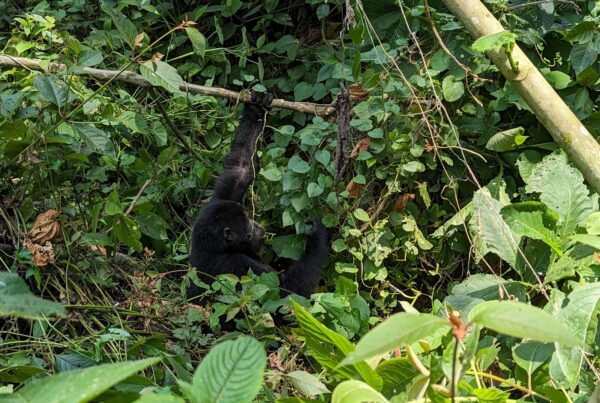
Young mountain gorillas spend considerable time in trees — climbing, playing, and exploring — despite their species’ predominantly terrestrial lifestyle. Juvenile gorillas are more arboreal than adults, partly reflecting that their smaller body size makes tree climbing less energetically costly and more structurally feasible than for a 170-kilogram silverback.
14. Gorillas Don’t Like Rain
Mountain gorillas strongly dislike getting wet. During heavy rain, groups typically seek shelter under dense forest canopy, sitting hunched with arms crossed or heads bowed, waiting for the rain to ease. This rain-avoidance behaviour is consistent with the thermoregulatory challenge of getting a large, heavily-furred animal wet in a cold highland environment.
15. They Have Individual Personalities
Long-term research on habituated gorilla families has documented consistent individual differences in personality — some individuals are reliably bold, curious, and approach-oriented; others are consistently shy, cautious, and avoidant of novelty. These personality differences persist across years and influence social relationships, reproductive success, and responses to novel situations.
16. Mountain Gorillas Were Unknown to Western Science Until 1902
Captain Friedrich Robert von Beringe’s 1902 expedition to the Virunga Mountains and the subsequent formal species description by Paul Matschie in 1903 represent the entry of mountain gorillas into Western scientific literature. Local communities in the region had coexisted with gorillas for centuries, but the species was unknown to European science until less than 125 years ago.
17. They Use Medicinal Plants
Mountain gorillas consume certain plants with apparent medicinal functions — plants with anti-parasitic, anti-bacterial, or anti-inflammatory properties that they selectively consume in quantities and patterns inconsistent with pure nutritional value. This self-medicating behaviour, documented in other great apes as well, represents a form of applied botanical knowledge that has accumulated across generations.
18. Gorilla Groups Sometimes Merge
Although most gorilla family groups maintain stable membership over years, groups do occasionally merge when their silverbacks die or when social circumstances facilitate coalescence. These mergers are typically stressful social events involving significant dominance negotiation between the merging groups’ adult females and any remaining adult males.
19. Their Hearts Beat Slower Than Ours
Mountain gorillas have resting heart rates of approximately 40 to 50 beats per minute — significantly slower than the average human resting heart rate of 60 to 100 beats per minute. This lower heart rate reflects their larger body mass (larger bodies generally have slower heart rates across species) and their low-key metabolic rate during the extended resting periods that constitute much of their daily schedule.
20. A Single Permit Funds Months of Ranger Protection
The $800 gorilla trekking permit fee for foreign visitors funds Uganda Wildlife Authority operations, ranger salaries, and community benefit programmes. A group of eight visitors on a single trek generates $6,400 in permit revenue alone — a sum that funds months of ranger protection work for the family they are visiting. The economics of gorilla conservation make every visitor a direct conservation actor.
Final Thoughts
Mountain gorillas are animals that reward knowing well. The more you understand about their biology, their social lives, their individual personalities, and their evolutionary history, the richer every moment of the trekking encounter becomes. The facts above are starting points — each one opens onto a deeper understanding of an animal that has been studied intensively for decades and still produces new discoveries for those willing to pay attention.
How many mountain gorillas are left in the wild?
The most recent full census (2018) counted approximately 1,063 mountain gorillas across the Virunga massif and Bwindi Impenetrable National Park. This population has grown from fewer than 650 in the 1980s, making mountain gorillas the only great ape species whose wild numbers are currently increasing.
How strong is a mountain gorilla compared to a human?
Mountain gorillas are estimated to be 6 to 15 times stronger than an adult human, based on their muscle density and the physical demands of their diet — breaking apart tough bamboo, tree bark, and dense vegetation daily. A silverback can reportedly lift over 800 kg, though exact figures come from estimates rather than controlled measurements.
Do mountain gorillas communicate with each other?
Gorillas communicate through vocalizations including the famous chest beat, facial expressions, body postures, and touch. Researchers have identified over 25 distinct sounds used in different social contexts — alarm calls, contentment rumbles, play signals, and dominance displays each serve specific functions within the group.
How long do mountain gorillas live?
Mountain gorillas live up to approximately 40 years in the wild. In captivity, no mountain gorilla has survived long-term — the species is too specialized for high-altitude forest conditions and has never been successfully maintained in zoos. Every mountain gorilla alive today lives wild, either in Bwindi or the Virunga massif.
What do mountain gorillas eat every day?
Mountain gorillas eat primarily leaves, stems, bark, and roots, with some fruit when seasonally available. An adult silverback consumes roughly 18–20 kg of vegetation per day. Their entire day is structured around moving between feeding areas, resting, and social bonding — feeding occupies around half of each waking day.
- 20 Fun Facts About Mountains (So Fascinating)
- How Big Is a Mountain Gorilla? Size, Weight and Strength Facts
- 25 Things You Did Not Know About Mountain Gorillas: Illustrated Guide
- L’Hoest’s Monkey Uganda: The Mountain Monkey Facts
- Stripe-Breasted Tit Uganda: Rwenzori Mountain Bird Facts
- Top Mountain Gorilla Facts Every Visitor Should Know Before Trekking
- Meet the conservationist protecting mountain gorillas in the heart of the impenetrable forest.
- Gorilla Myths and Fascinating Facts: Unveiling the Truth About Africa’s Gentle Giants
- Why Adult Male Mountain Gorillas Stay Etched in Your Mind After Gorilla Habituation
- Why You Should Do a Golden Monkey Trek Before Your Mountain Gorilla Trek