The Primate Triangle: Chimps, Gorillas and a Lake — Uganda’s Greatest Safari Circuit
There is a route through western Uganda that safari planners have quietly known about for years but that remains relatively unknown to the wider travelling public. It connects three of Africa’s most extraordinary wildlife experiences in a logical arc through the Albertine Rift landscape, and it can be completed in six to eight days without rushing. The circuit runs from Kibale Forest National Park — home to the highest density of chimpanzees on the continent — through Queen Elizabeth National Park with its tree-climbing lions and Kazinga Channel boat cruise, and ends at Bwindi Impenetrable National Park for mountain gorilla trekking. Along the way, Lake Mutanda provides one of the most beautiful overnight stops in all of East Africa. This is the Primate Triangle, and in 2026, with visitor numbers lower than usual, it is more accessible and more intimate than it has been in years.
Kibale Forest: Where the Circuit Begins
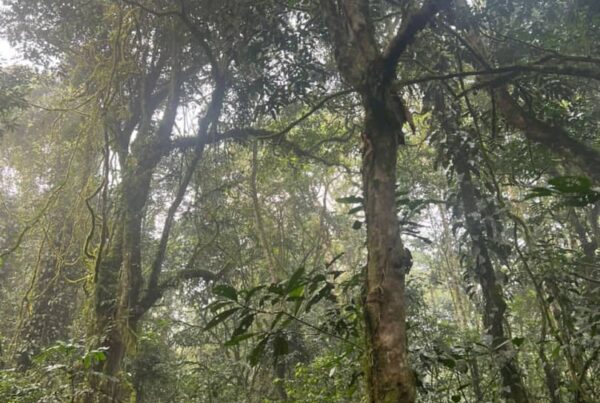
Kibale Forest National Park, located near Fort Portal in western Uganda, is the starting point of the Primate Triangle circuit. The park protects 795 square kilometres of tropical rainforest and harbours approximately 1,500 chimpanzees — the largest concentration of chimps anywhere on earth. The chimpanzee trekking experience at Kibale’s Kanyanchu Visitor Centre is the closest thing to a gorilla trek that exists outside of the gorilla parks themselves. You enter the forest at dawn, track a habituated community of 80 to 150 individuals through dense understorey, and spend one hour in their presence as they feed, call, charge, groom, and interact with extraordinary energy.
Kibale also supports thirteen other primate species including red colobus, L’Hoest’s monkeys, olive baboons, and black-and-white colobus. The Bigodi Wetland Sanctuary at the park’s edge is a community-managed birding area with over 200 species. Fort Portal itself, the gateway town, is one of Uganda’s most pleasant regional centres, sitting at 1,540 metres with views of the Rwenzori Mountains on clear mornings. Most travellers spend two nights near Kibale — one for chimpanzee trekking and one for a forest walk and Bigodi birding — before moving south toward Queen Elizabeth.
Queen Elizabeth National Park: Savanna Meets Forest
The drive south from Kibale to Queen Elizabeth National Park takes you down the Albertine Rift escarpment from highland forest into open savanna — one of the most dramatic landscape transitions in East Africa. Queen Elizabeth is Uganda’s most visited national park, covering 1,978 square kilometres across several distinct ecosystems including savanna, wetland, forest, and lakeshore. The park is famous for its tree-climbing lions in the Ishasha sector in the south, its enormous hippo populations in the Kazinga Channel, and its exceptional birdlife with over 600 species recorded.
The Kazinga Channel boat cruise is one of the essential experiences of the Uganda circuit. This two-hour boat journey along the channel connecting Lake George and Lake Edward passes banks lined with enormous numbers of hippos, buffalo, elephants, and waterbirds. African Fish Eagles, Goliath Herons, and occasionally the rare Shoebill stork are regular sightings. For primates, Kyambura Gorge — a dramatic river gorge cut into the savanna — shelters a small chimpanzee community that offers a completely different kind of chimp encounter from Kibale, set against the extraordinary visual contrast of forest floor and open plains above.
Lake Mutanda: The Hidden Jewel
Between Queen Elizabeth and Bwindi, the route passes through the Virunga foothills and arrives at Lake Mutanda near Kisoro — one of Uganda’s most beautiful and least visited lakes. Mutanda sits at 1,780 metres above sea level, surrounded by volcanic hills and with direct views of the Virunga chain including Muhabura, Gahinga, and Sabinyo. The lake’s surface reflects the sky and the volcanoes in a way that photographers struggle to do justice to. Small wooden canoes can be hired for paddling among the lake’s islands, which hold small local communities maintaining traditional fishing and farming practices.
An overnight at Lake Mutanda adds a night of extraordinary beauty and complete tranquillity to the circuit. Sitting on the shore at dusk as the Virunga volcanoes change colour from green to gold to purple is one of those travel experiences that defies adequate description. It also positions you perfectly for an early morning departure to Bwindi’s Buhoma or Nkuringo sector the following day, with the gorilla trekking briefing typically starting at 7:00 or 8:00 AM.
Bwindi: Where the Circuit Reaches Its Peak
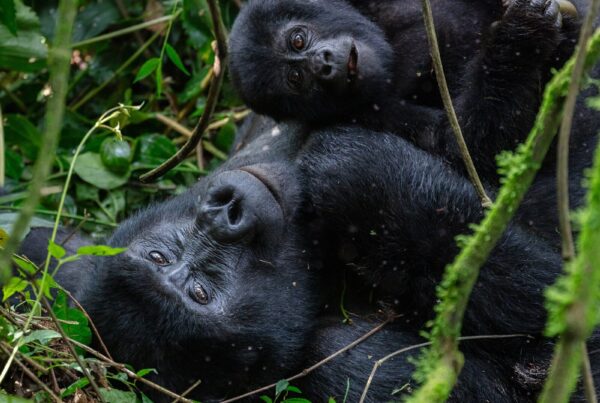
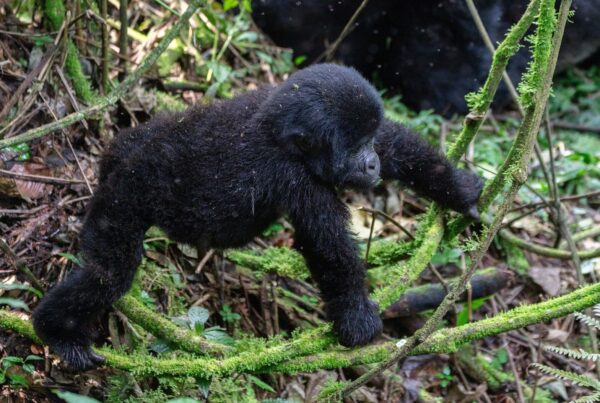
Mountain gorilla trekking at Bwindi Impenetrable National Park is the culmination of the Primate Triangle — and it lives up to the build-up. After two days with chimpanzees in Kibale, savanna wildlife in Queen Elizabeth, and the lake beauty of Mutanda, arriving at Bwindi and entering the ancient forest to spend an hour with a gorilla family is an experience that completes the arc. You have met our closest relatives in the trees, watched savanna Africa from a boat, and now you are sitting in a 25,000-year-old forest while a 200-kilogram silverback feeds ten metres from where you are standing. The contrast — and the cumulative weight of the primate encounters — makes the gorilla moment something that travellers consistently describe as the most profound wildlife experience of their lives.
Most Primate Triangle itineraries allocate two nights at Bwindi — one for the gorilla trek and one for a forest walk, birding, or community cultural experience. The Batwa cultural experience near Buhoma adds a human dimension to the forest encounter that deepens understanding of both the ecosystem and the conservation story.
Planning the Primate Triangle in 2026
The Primate Triangle is typically an 8 to 10 day circuit from Entebbe, with internal transfers by private vehicle. The circuit can be driven efficiently: Entebbe to Fort Portal is approximately five to six hours, Fort Portal to Queen Elizabeth is two hours, Queen Elizabeth to Kisoro is approximately four hours, and Kisoro to Bwindi is one hour. Flying options exist between Entebbe and Kasese (near Queen Elizabeth) or to airstrips near Bwindi, reducing road time significantly. In 2026, with lower visitor numbers, chimpanzee trekking permits at Kibale are readily available, gorilla permits at Bwindi have unusual availability including for peak season dates, and lodges across the circuit are offering better rates and more personalised service than in recent peak years. The Primate Triangle is always Uganda’s premier safari experience — right now it is also its best value.
Frequently Asked Questions
Kibale Forest National Park, near Fort Portal, has the highest density of chimpanzees in Africa and is Uganda’s premier chimpanzee destination. The standard chimp trekking permit costs $300 FNR. The Chimpanzee Habituation Experience at Kibale ($400 FNR) gives 4 hours with a habituated community — Uganda’s only chimp habituation programme.
Yes — the gorilla + chimp combination is Uganda’s most popular primate itinerary. A typical 8-day route: Entebbe → Kibale Forest (2 nights, chimp trekking) → Queen Elizabeth National Park (2 nights, game drives) → Bwindi (2 nights, gorilla trekking) → Entebbe. Charter flights on any leg reduce travel time significantly.
Uganda has 13 primate species. Commonly seen: olive baboon, vervet monkey, red-tailed monkey, black-and-white colobus, L’Hoest’s monkey, grey-cheeked mangabey. Golden monkeys are found at Mgahinga. Kibale Forest has the highest primate diversity of any East African forest. A dedicated primate safari can tick 7–8 species in a single itinerary.
Uganda has over 1,060 recorded bird species — one of the highest counts of any country in Africa. Bwindi alone has 350+ species including 23 Albertine Rift endemics. Murchison Falls, Queen Elizabeth, and the wetlands around Entebbe round out a world-class birding circuit. The African green broadbill and Shelley’s crimsonwing are Bwindi specialities.
Uganda is home to the mountain gorilla (Gorilla beringei beringei), one of two subspecies of eastern gorilla. They live exclusively in the Virunga volcanic highlands (Uganda/Rwanda/DRC) and Bwindi Impenetrable Forest (Uganda only). Mountain gorillas are the only gorilla subspecies that cannot survive in captivity — every individual you can trek is a wild animal.