Updated
lock eyes mountain gorilla Uganda experience is a subject central to Uganda’s wildlife tourism, where mountain gorilla conservation and responsible visitor experiences go hand in hand. Every person who has locked eyes with a mountain gorilla in Bwindi Impenetrable Forest has tried to explain it — and the descriptions are remarkably consistent not in their success but in their acknowledgement that the explanation is insufficient: that whatever happened in that moment of shared attention between a human and a being that shares 98.3% of human DNA in the middle of Africa’s oldest forest produced something that language gets close to but cannot fully capture. Book the experience: gorilla permits Uganda, full cost breakdown, accredited Uganda operators.
- DNA proximity: 98.3% shared with humans; the most closely related species after chimpanzees (98.7%); the social behaviour — grooming, family bonds, play, hierarchy — is immediately legible to human observers
- The encounter: 60 minutes with a habituated family in Bwindi; gorillas continue normal behaviour; the silverback’s proximity is within 7 metres; eye contact is standard, not exceptional
- Permit: USD 800 per person; 8 people per family per day; 4 Bwindi sectors; no mountain gorillas in any zoo
- Conservation: 1,063 mountain gorillas alive; Endangered; growing population; permit revenue funds the ranger programme that maintains the habituated families
Every person who has locked eyes with a mountain gorilla in Bwindi Impenetrable Forest has tried to explain it. The descriptions are remarkably consistent — and they all acknowledge, usually in their first or second sentence, that the explanation is insufficient. That whatever happened in that moment is not fully contained in any words that have been found for it yet. This insufficiency is itself part of the story.
What happens when you look into a mountain gorilla’s eyes is not mysterious in a supernatural sense. It is explicable in neurological terms: two visual systems, evolved on separate branches of the great ape lineage, processing each other’s faces using pattern recognition systems that were shaped by the same evolutionary pressures that operated on a common ancestor millions of years ago. The recognition is genuine. The circuits that produce it are ancient. What is harder to explain is what it feels like from the inside — the specific quality of that recognition, the sense of something landing in you that had no equivalent before.
The Moment You Lock Eyes With a Mountain Gorilla: It Cannot Be Explained
What the Eyes Convey
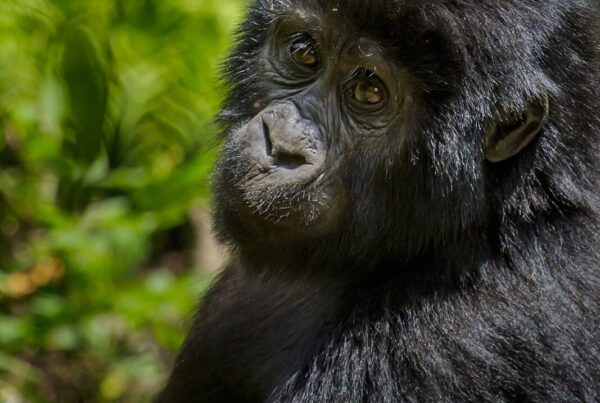
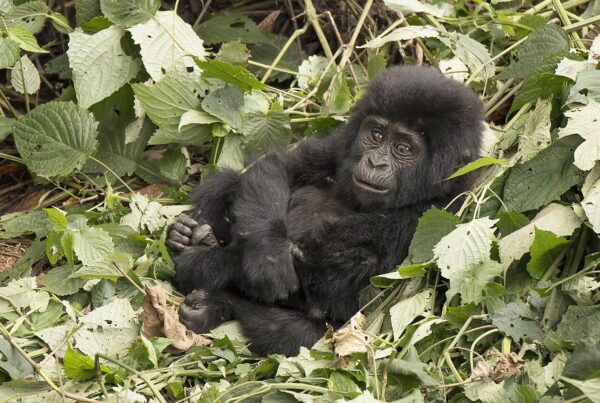
A mountain gorilla’s eyes are brown. They are embedded in a face that, in structure, is recognisably related to the human face — the brow ridge, the flattened nose, the mobile lips, the ears set at the sides of the head. The eyes themselves have the quality of attention that most animal eyes lack. They are tracking something specific. When they track you, you feel tracked in a way that distinguishes this encounter from any other wildlife encounter.
What the eyes convey — and this is the part that resists explanation — is not emotion in the human sense, but something that precedes emotion. An assessment. A registration. A judgment about what you are and whether you represent threat, interest, or indifference. Most gorillas, most of the time, conclude: indifference. They look at you, register your presence, and return to what they were doing. But in the moment of that assessment, there is an exchange that visitors describe — almost universally, in almost identical language — as the most intense moment of the encounter.
Why This Moment Is Different From All Other Wildlife
Wildlife encounters in Africa are full of visual contact with animals. A lion assesses you from a distance. An elephant registers your vehicle’s presence and decides whether to move away. A chimpanzee in the canopy above you looks down with what seems like curiosity. These encounters are genuine and memorable. What is different about the mountain gorilla is not the fact of the eye contact but its quality.
The gorilla’s gaze is intelligent in a way that the lion’s gaze is not — not more intelligent in any absolute sense, but intelligent in a way that is closer to what we recognise as intelligence from the inside. The gorilla appears to be thinking about you. The processing that the gorilla’s gaze registers is more cognitively complex, or appears to be, than the processing you see in other animals’ responses to your presence. This appearance of complexity — the sense that something is actually happening in there, that there is a someone looking — is what produces the effect that people cannot explain adequately.
The Thirty-Six Hours After
The effect of the encounter does not end when you leave the forest. Most gorilla trekking veterans report a specific quality of the thirty-six to forty-eight hours after the encounter: a heightened perceptiveness, a quietness, a tendency to find ordinary things more interesting than usual. The encounter has recalibrated something. You are looking at the world slightly differently, because you have just been looked at by something that challenged your ordinary categories for what “looking” means.
This recalibration is temporary in its acute phase but permanent in its underlying effect. You will not walk around for the rest of your life in the specific state of heightened awareness that the gorilla encounter produces. But the framework shift — the correction to the assumption that humans occupy a uniquely observant position in the natural world — tends to persist. You have been assessed by another intelligence and found — the conclusion of most gorilla assessments — not particularly interesting. This is strangely liberating.
The Encounter Is Available
The moment that cannot be explained is available to you in 2027 for $800 per permit. It requires a flight to Uganda, a long drive to Bwindi, a morning walk through the forest, and an hour of presence with a gorilla family that has learned to tolerate and ignore human visitors. The explanation of what happens in that hour will still elude you when you try to describe it to people who have not been there. That is exactly as it should be. Some things are preserved by being incommunicable. Contact us to book yours.
Why is the gorilla eye contact moment so consistently described as significant?
The consistency of the response across cultures and individuals suggests it has a real basis rather than being produced by expectation. The biology: gorillas are highly social animals; gaze is a primary social signal in gorilla society; when a gorilla makes direct eye contact with a human, it is doing what it does with other gorillas — processing a social entity; the human brain, evolved for social gaze processing over millions of years, responds to this as it is meant to. The recognition: what visitors describe as “almost human” is not projection — the gorilla’s face is genuinely close to human in structure, the social expressions (curiosity, assessment, attention) are genuinely shared; this is not anthropomorphism but recognition of real evolutionary continuity. The rarity: in most wild animal encounters, the animal is aware of you and moves away or ignores you; a mountain gorilla in Bwindi that looks back at you with sustained attention is something that has no equivalent in other wildlife encounters.
What is the silverback’s behaviour during a gorilla trek and how does the ranger manage it?
The silverback is central to the experience and the ranger’s role with him is specific. Normal behaviour: a habituated silverback during a well-managed visit typically feeds, rests, grooms, or moves through the group’s range; he is aware of the human group but does not treat it as a threat. Display: silverbacks occasionally display (chest-beating, vocalisation, bluff charge) — this is normal dominance behaviour and occurs whether humans are present or not; when it happens during a trek at Bwindi, the ranger interprets the signal and directs the group to move back or lower their positions; the display is addressed to the group as a whole and passes quickly. Eye contact: the ranger advises against prolonged direct staring at the silverback in a dominant way; casual eye contact is normal; the visitors who describe the “locking eyes” moment are describing the silverback’s direct attention rather than a challenging stare. The ranger’s role: rangers know the individual silverbacks by personality and read their behaviour throughout the visit; the briefing at the start includes what to expect from today’s specific silverback.
What is the biggest mistake first-time gorilla trekkers make?
The most common avoidable mistakes are practical. Wrong footwear: Bwindi trails are steep, muddy in wet season, and uneven; waterproof ankle boots with grip are the requirement; trail runners are marginal; city shoes and sandals are inadequate; this is the most common equipment mistake. Not hiring a porter: the porter service at Bwindi (USD 15-20) provides physical support, carries your bag, and is direct income for adjacent community members; visitors who skip it often regret it on descent. Checking in with cold/flu symptoms: respiratory illness bars you from the trek on the day; gorillas are susceptible to human respiratory diseases; no exceptions are made; if you have symptoms, you will not go; travel insurance should cover this. Full list: 5 gorilla trekking mistakes and 30 things to know.
Is it possible to see gorillas more than once on the same Uganda trip?
Multiple gorilla treks in one Uganda visit are possible and done. Multiple permits: there is no rule against booking more than one permit per person; you can trek different families on different days; each permit is USD 800. Different sectors: trekking Buhoma sector one day and Rushaga another day in Bwindi gives two different family encounters in two different parts of the forest; this is a very different experience from repeating the same sector. Habituation plus standard: one standard trek (60 minutes, USD 800) plus one gorilla habituation experience (4 hours, USD 1,800) at Rushaga in the same visit is the most popular double-encounter combination. Bwindi plus Mgahinga: trekking at Bwindi and Mgahinga in one Uganda trip accesses two different populations in two different habitats. For most visitors: one trek is sufficient for a first visit; repeaters and serious wildlife enthusiasts often do two.
What is the gorilla trekking experience like for someone who has difficulty walking long distances?
Mobility limitations do not necessarily exclude gorilla trekking. The range: trek duration at Bwindi ranges from 30 minutes (if gorillas are close to the gate) to 5+ hours (if they have moved deep into the forest); the ranger cannot predict which it will be the day before. For limited mobility: request assignment to a family known to remain close to the forest edge (rangers and operators know which families have smaller ranges); hire a porter and a hand-carry chair service (available at some sectors); go at the slowest comfortable pace. The “easy” treks: the shortest treks at Buhoma sector to the Mubare family (when they are in their usual range) have been completed by visitors with significant mobility limitations. Honesty: not all gorilla trek days are accessible to people with serious mobility limitations; discuss your specific situation with an accredited operator before booking.
- Mountain Gorilla Scientific Name: Gorilla beringei beringei Explained
- Mountain Gorillas Never Leave Bwindi or Virunga: Why They Cannot Migrate
- The 5 Gorilla Trekking Moments That Go Viral Every Year: Explained
- Meet the conservationist protecting mountain gorillas in the heart of the impenetrable forest.
- Why Adult Male Mountain Gorillas Stay Etched in Your Mind After Gorilla Habituation
- Why You Should Do a Golden Monkey Trek Before Your Mountain Gorilla Trek
- Can I Touch a Mountain Gorilla
- Real Difference Between Mountain Gorillas in the Forest and Gorillas in Zoos
- Carl Akeley and the Mountain Gorillas of 1926
- What To Do When a Mountain Gorilla Charges Toward You