Updated
The 5 Gorilla Trekking Moments That Go Viral Every Year: Explained
Viral gorilla trekking moments and why they spread so reliably
Viral gorilla trekking moments follow patterns that wildlife communications researchers and social media managers have now studied in enough detail to make some reliable predictions. Each year, certain types of gorilla encounters are photographed or filmed in ways that achieve wide circulation across social platforms — not because they are the rarest encounters, but because they hit a combination of visual quality, emotional resonance, and narrative simplicity that drives sharing behaviour. Understanding why these moments go viral is interesting in itself, but it also tells us something important about what makes gorilla trekking uniquely powerful as an experience and as a conservation communication tool.
1. The infant approaching a trekker
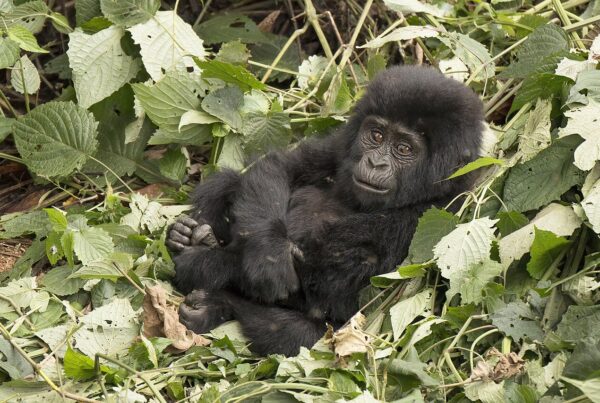
A juvenile or infant gorilla approaching a human trekker — moving towards the group with curiosity, examining the visitors at close range — is the single most reliable category of viral gorilla content. These encounters occur regularly in Bwindi’s habituated family groups, particularly with younger animals who have not yet fully internalised the wariness of humans that adult gorillas maintain even after habituation. The videos and photographs of these moments go viral for reasons that are easy to identify: the animal is small and appealing, the human reaction is genuine and unperformed, and the implied question — “what is it thinking?” — is one that every viewer asks themselves.
The ranger’s role in these moments
What the viral content rarely shows is the ranger’s response — a trained professional who ensures that if an infant approaches too closely, the situation is managed safely and the appropriate distance is restored. The ranger’s calm expertise is the invisible infrastructure that makes these moments possible without endangering either the gorillas or the trekkers. Without habituated gorillas, trained rangers, and careful management of encounters, these moments could not occur at all.
2. The silverback charge
A silverback gorilla performing a mock charge — rising to his feet, vocalising, and moving towards an obstacle before veering away — is a display behaviour performed to establish dominance and intimidate perceived threats. In habituated family groups, these displays are occasionally directed towards trekking groups, and the resulting footage — trekkers frozen in the undergrowth, the silverback approaching at speed before stopping short — generates enormous engagement on social media. The combination of apparent danger, the trekkers’ frozen responses, and the silverback’s sudden stop creates a narrative arc of threat and resolution that is structurally satisfying and emotionally intense.
Why charges are not what they appear
Gorilla guides are at pains to explain, in the briefing before every trek, that a silverback charge in a habituated group is a display, not an attack. The silverback stops. The instruction to trekkers — crouch down, avoid eye contact, stay still — is not a survival strategy but a communication strategy: it tells the silverback that the humans acknowledge his dominance and pose no threat. This context — invisible in the viral footage but essential to understanding what is happening — is one reason why gorilla trekking operators are sometimes ambivalent about the viral spread of charge footage, which can create misimpressions about the safety of the experience.
3. The gorilla doing something human
Any footage or photograph of a gorilla performing a behaviour that has an obvious human parallel — using a tool, sharing food, comforting a distressed infant, playing a game that resembles a human game — achieves reliable viral spread. These moments work because they activate the same cognitive response as the face-to-face similarity between gorillas and humans: they make the evolutionary relationship between the two species viscerally real in a way that statistics and facts cannot. A gorilla using a stick to measure water depth, a mother gorilla covering her infant’s head with a leaf in the rain, two juveniles playing a game that looks structurally identical to tag — these images spread because they answer a question that every thoughtful person has about their relationship with the natural world.
4. The large group of trekkers dwarfed by the silverback
A photograph that shows the full group of eight trekkers and their ranger in the same frame as the silverback of the group — demonstrating the scale of the animal relative to the humans surrounding him — achieves consistent viral spread because it resolves the question that every person who has not done a gorilla trek asks: how big are they, really? The silverback, standing upright for a chest beat or moving through the group on his way to a feeding site, provides immediate and visceral scale information that no written description can match. When the photograph also captures the trekkers’ expressions — a mixture of awe, frozen calm, and barely suppressed excitement — it tells the complete story of what gorilla trekking feels like from the inside.
5. The unexpected moment of connection
The fifth category of reliably viral gorilla content is the hardest to define and the most powerful when it occurs: a moment that appears to show genuine, individual connection between a gorilla and a human. A gorilla placing its hand briefly on a trekker’s arm before moving away. A silverback meeting a returning visitor’s gaze and holding it longer than seems random. An infant settling to sleep in a position that mirrors the sleeping position of a nearby trekker. These moments — which rangers and researchers interpret with careful scientific caution, noting that apparent connection can reflect many different behavioural processes — achieve viral spread because they speak to something fundamental about how humans relate to non-human animals, particularly great apes. The possibility that a wild mountain gorilla might recognise, remember, or choose to engage with a specific human individual is one that generates intense emotional response in audiences worldwide.
Why virality matters for conservation
The consistent virality of high-quality gorilla trekking content is not simply a curiosity of social media behaviour. It is, wildlife conservation organisations have increasingly recognised, one of the most powerful tools available for building the global public support that mountain gorilla protection requires. Each viral gorilla moment reaches audiences who have no prior engagement with gorilla conservation, introduces them to the existence and accessibility of mountain gorillas, and creates the emotional investment that turns passive awareness into active support — for conservation organisations, for gorilla trekking tourism, and for the political conditions that make long-term gorilla protection possible.