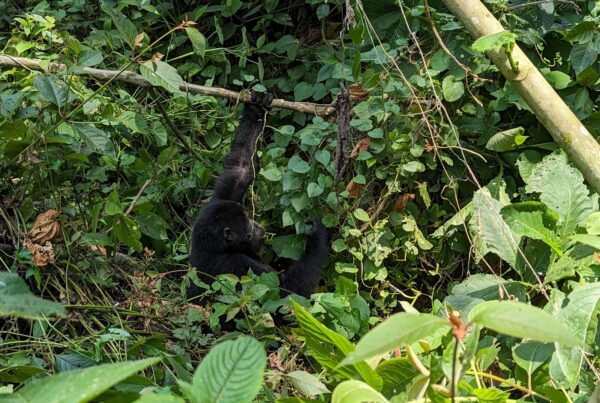
Mountain gorillas never leave Bwindi or the Virunga massif, and understanding why they cannot migrate to new habitats is one of the most important facts in mountain gorilla conservation. These animals are not confined to their two forest habitats by choice or preference — they are confined by the specific biological and ecological requirements of their species, which have evolved over millions of years to fit a very narrow environmental niche. When that niche is reduced — when the forest shrinks, when the climate shifts, when the habitat quality declines — there is nowhere else to go. The mountain gorilla’s world has fixed edges, and those edges are the conservation challenge in its simplest form.
The Two Habitats
Mountain gorillas exist in exactly two populations. The Bwindi population occupies Bwindi Impenetrable National Park in southwestern Uganda, covering approximately 321 square kilometres. The Virunga population occupies the Virunga massif — a chain of eight volcanoes across the borders of Uganda, Rwanda, and the Democratic Republic of Congo, covering approximately 450 square kilometres of protected forest.
These two habitats are separated by approximately 25 kilometres of unforested land — agricultural areas, villages, and infrastructure that mountain gorillas cannot cross. The populations are genetically isolated from each other, though recent genetic analysis has identified some historical gene flow and a small degree of ongoing exchange through individuals that occasionally traverse the gap. But this exchange is minimal, and the effective separation of the two populations has significant conservation implications.
Why Mountain Gorillas Cannot Live Elsewhere
The specific requirements of mountain gorilla life are not met by most of Africa’s remaining forest habitats.
Altitude Requirement
Mountain gorillas have evolved specifically for high-altitude montane forest — between 1,000 and 4,000 metres above sea level. The physiology, anatomy, and dietary ecology of the species are adapted to this environment. Lowland rainforest, which exists in much larger areas across Central and West Africa, does not support mountain gorilla populations. The animals have never been successfully translocated to lowland forest, and the ecological differences between montane and lowland forest are too great for adaptation to occur on any human-relevant timescale.
Temperature Dependence
The cool, moist climate of high-altitude forest maintains the vegetation moisture that mountain gorillas depend on for their dietary water intake. Warmer, drier environments — even if they are otherwise forested — do not support the specific plant communities or the specific water-in-diet balance that mountain gorilla physiology requires.
Plant Community Specificity
The 200+ plant species in the mountain gorilla diet are largely specific to the montane forest community — they are not present in lowland forest, grassland, or other African biomes. A mountain gorilla relocated to a different forest would not recognise the available food plants, would not have the dietary knowledge to use them effectively, and would face nutritional deficiencies that previous generations had never encountered.
Social and Cultural Factors
Beyond the direct biological constraints, mountain gorillas have cultural knowledge of their specific habitats — knowledge of food plant locations, water crossing points, inter-group boundary areas — that is transmitted across generations and is specific to particular areas of their home ranges. This cultural knowledge is not transferable to a new habitat. A gorilla family relocated to an unfamiliar forest would be ecologically naive in ways that could be fatal.
The Captivity Impossibility
Unlike western lowland gorillas, which have been kept in zoos with some success (though not without significant welfare concerns), mountain gorillas have never survived in captivity. Every attempt to keep captured mountain gorillas in zoo conditions has ended in relatively rapid death. The animals refuse to eat unfamiliar foods, decline in condition, and die. This captivity impossibility is the most dramatic demonstration of the mountain gorilla’s habitat specificity: they are not just ecologically adapted to Bwindi and the Virungas, they are physiologically dependent on conditions that only those habitats provide.
The practical implication is significant: there is no backup population. There is no gene bank that can be used to reintroduce mountain gorillas to a restored habitat after extinction. There is no zoo population that could serve as a source for future wild reintroduction. The only mountain gorillas in the world are the ones in Bwindi and the Virungas. If those populations are lost, they cannot be recovered.
What This Means for Conservation Urgency
The impossibility of migration or captive backup means that mountain gorilla conservation has no margin for error in its primary mission: keeping Bwindi and the Virunga habitats intact, high-quality, and protected. A species that can migrate to new habitats or that has captive backup populations has a buffer against local habitat failure. Mountain gorillas have neither buffer. Every hectare of Bwindi, every ranger patrol, every veterinary intervention, every community program that reduces pressure on the park boundaries — all of it is operating at the conservation frontier with no fallback position.
This is not a counsel of despair. The conservation success of the last thirty years demonstrates that the right interventions, consistently applied, produce real population growth. But it is a counsel of urgency: the interventions must be maintained, consistently, without the complacency that sometimes attaches to conservation success stories.
The Fixed World You Visit
When you trek to see mountain gorillas in Bwindi, you are visiting a species whose world has fixed edges. The forest around you is not a sample of a larger habitat — it is the habitat, all of it, in this corner of the world. The gorillas you will see have never been anywhere else and cannot go anywhere else. They are as specific to this forest as the forest itself is specific to this valley, this altitude, this climate.
That specificity — the absolute fit between these animals and this place — is part of what makes Bwindi irreplaceable. It is not just any forest. It is the only forest in the world where these specific animals are possible.
Uganda gorilla trekking permits are $800 per person. Contact Uganda Gorilla Trekking to book your permit. The world you visit is the only one the gorillas have.
Frequently Asked Questions
Yes. Mgahinga Gorilla National Park hosts the Nyakagezi gorilla family — one habituated family issuing up to 8 trekking permits per day. The permit costs $800 (same as Bwindi). Mgahinga also offers golden monkey trekking and the Batwa Cultural Trail.
Bwindi has 20+ habituated families and more daily permit availability. Mgahinga has one family and fewer permits per day, but adds golden monkey trekking and dramatic Virunga volcano scenery. Mgahinga is closer to Kisoro town and Rwanda’s border, making it easier to combine with a Rwanda leg.
Golden monkeys (Cercopithecus kandti) are a rare and strikingly coloured primate found only in the Virunga volcanic highlands. Mgahinga has the only habituated golden monkey troop in Uganda. The trekking permit costs $100 per person. The trek typically takes 2–4 hours and the hour with the troop is very similar in format to gorilla trekking.
The Mgahinga park gate is approximately 14km from Kisoro town — about 30 minutes by vehicle. Kisoro Airstrip connects to Entebbe by charter or scheduled light aircraft in under an hour. The Rwanda border at Cyanika is 8km from Kisoro, making Mgahinga the most convenient Uganda option if you are already in Rwanda.
Uganda is home to the mountain gorilla (Gorilla beringei beringei), one of two subspecies of eastern gorilla. They live exclusively in the Virunga volcanic highlands (Uganda/Rwanda/DRC) and Bwindi Impenetrable Forest (Uganda only). Mountain gorillas are the only gorilla subspecies that cannot survive in captivity — every individual you can trek is a wild animal.