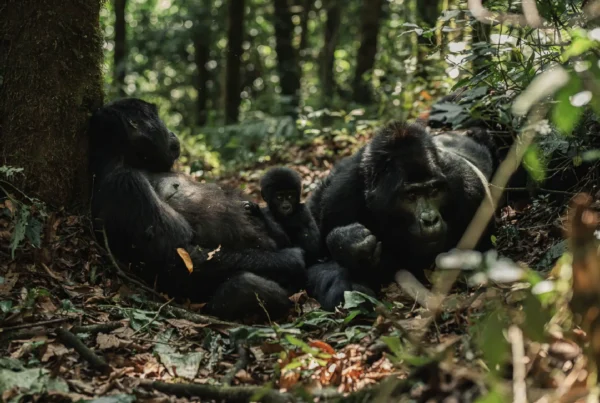
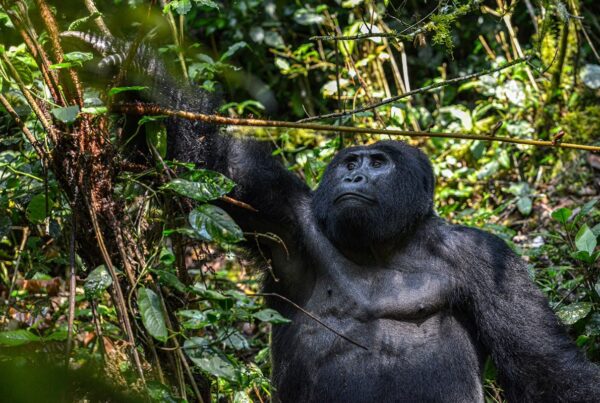
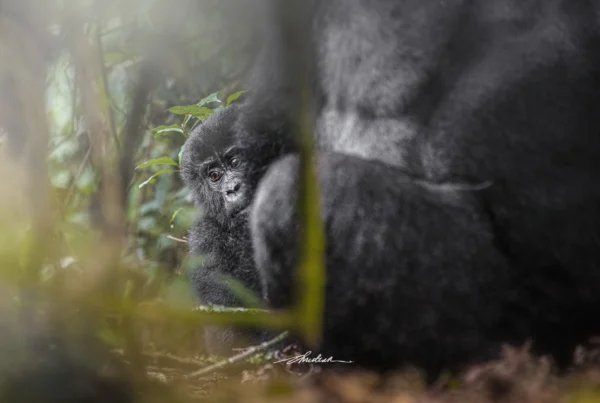
The gorillas you see in zoos worldwide — western lowland gorillas, a distinct subspecies — are not mountain gorillas, because mountain gorillas (Gorilla beringei beringei) have never survived in captivity: every attempt to maintain them outside their specific highland forest environment has ended in their deaths, which means that every living mountain gorilla on earth exists in the wild, in a 790-square-kilometre forest corridor spanning Uganda, Rwanda, and DRC, and that seeing a mountain gorilla requires going to that forest — there is no zoo exhibit that provides a proxy for what gorilla trekking visitors see at Bwindi, because the animal they are watching in Bwindi does not exist anywhere else. This comparison guide examines the specific biological, behavioural, and ecological differences between mountain gorillas in their natural forest habitat and the lowland gorillas in zoo environments: body condition, social complexity, ranging behaviour, emotional expression, diet, and the fundamental difference between an animal whose life is shaped entirely by the forest and an animal whose life is managed by human keepers. The comparison illuminates why the gorilla trekking encounter has the quality it has — you are seeing an animal living exactly as its species evolved to live, not an approximation of that life. For the specific families you will see at Bwindi, see the gorilla families guide.
Wild Mountain Gorillas vs Zoo Gorillas: Key Distinctions
- Can mountain gorillas be kept in zoos? No — no mountain gorilla has survived in captivity; all live in the wild
- Zoo gorillas are: western lowland gorillas (Gorilla gorilla gorilla) — a different subspecies entirely
- Range: wild mountain gorilla family ranges 3–15 km² per day; zoo gorillas occupy enclosures measured in hundreds of square metres
- Diet: wild gorillas eat 34+ kg of vegetation daily from 200+ plant species; zoo gorillas eat managed commercial diets
- Social structure: wild family groups of 5–40 with full dominance hierarchy; zoo groups are managed by keepers
- Wild mountain gorillas display full natural emotional, social, and cognitive behaviour — zoos provide only partial context
Understanding the Wild Soul of Mountain Gorillas
When we talk about mountain gorillas—those majestic, soulful creatures that roam the mist-shrouded rainforests of Uganda, Rwanda, and the Democratic Republic of Congo—we’re referring to a rare and highly endangered subspecies of the eastern gorilla known scientifically as Gorilla beringei beringei. These gorillas live deep within the dense forests of Bwindi Impenetrable National Park and the Virunga Massif, and everything about their lives is governed by nature—untamed, unpredictable, and poetic in its rawness. Observing a mountain gorilla in the wild is like witnessing a masterpiece in motion: the way it moves, forages, and interacts with its family is dictated entirely by natural instinct and the rhythm of the forest.
In the forest, mountain gorillas live in cohesive family groups led by a dominant silverback—a towering male who ensures the safety, coordination, and emotional well-being of his troop. They wake with the sunrise, journey miles through dense foliage in search of food, communicate through complex vocalizations, and build fresh nests each evening to sleep in. Their diets consist almost entirely of wild plants: bamboo shoots, stinging nettles, wild celery, and fruits gathered in seasonal abundance. Their bodies are muscular, strong, and lean—shaped by constant movement across rugged terrain, climbing steep slopes, and surviving natural weather extremes.
Mountain Gorillas in the Forest and Gorillas in Zoos — What makes wild mountain gorillas especially unique is the level of emotional intelligence they display. Researchers and trekkers often describe moments of intense eye contact as deeply moving—like connecting with something ancient and reflective. These gorillas display grief when they lose a family member, playfulness during social interactions, and tenderness between mothers and their young that mirrors our own maternal instincts. This raw emotion, witnessed in their natural environment, makes the experience unforgettable and authentic—far beyond what any zoo can replicate.
Gorillas in Zoos: A Life of Structured Captivity
Now compare this to gorillas found in zoos across Europe, North America, or Asia. First and foremost, these are not mountain gorillas. Mountain gorillas have never successfully been kept or bred in captivity due to their specific dietary and environmental needs. Instead, zoos typically house western lowland gorillas (Gorilla gorilla gorilla), a more widespread and slightly smaller cousin of the mountain gorilla. They differ not just genetically, but also in behavior, physiology, and habitat preferences.
Gorillas in zoos live highly structured lives designed around human schedules and containment needs. While many modern zoos have evolved into conservation-centric institutions offering enriched environments, there is no denying that a zoo enclosure—even a beautifully designed one—is a world apart from the freedom of the forest. Here, everything from their meals to their sleep routines is managed. Gorillas are typically fed a regulated diet of fruits, vegetables, and special nutritional biscuits. Their physical activity is limited to the space of their enclosures, which often lack the complexity and scale of a wild jungle ecosystem.
Socially, zoo gorillas form groups but lack the dynamic range of wild troops. The silverbacks do not need to protect their families from leopards, humans, or rival males. There is less urgency in their existence. Veterinary care is readily available, but the psychological cost of captivity can be seen in certain behaviors—such as repetitive movements or unnatural aggression—that rarely, if ever, occur in the wild. Though zoos aim to provide intellectual stimulation through puzzles and toys, nothing compares to the sensory overload of navigating a living, breathing rainforest filled with sounds, scents, and natural surprises.
Behavioral and Emotional Contrasts
Emotionally, both wild and zoo gorillas are sentient beings, but the way they express and develop those emotions is often shaped by their environments. In the forest, mountain gorillas nurture deep familial bonds forged through shared hardship, survival, and constant mobility. Their eyes carry the wisdom of generations, passed down not through human intervention but through instinct and lived experience.
Zoo gorillas, on the other hand, may develop bonds with their caretakers and fellow enclosure mates, but these relationships are altered by the lack of risk, freedom, and variety. Some gorillas even develop attachment to their audience, watching people as intently as they are being watched—leading to a sort of mirror reality where they behave differently simply because they know they are under observation.
The emotional fulfillment of a wild gorilla is driven by autonomy and challenge, while captive gorillas rely on enrichment activities and human-provided routines. Over time, this affects everything from their mental health to their physical development. Captive gorillas may live longer due to veterinary care, but wild mountain gorillas, despite their tougher conditions, live fuller, freer, and more purpose-driven lives.
Conservation Realities and Public Perception
There is also a significant conservation angle in this contrast. Seeing a gorilla behind glass may spark interest in wildlife, but it does not replicate the urgency and sacredness of encountering them in the wild. Gorilla tourism—especially in Uganda and Rwanda—has proven to be a powerful conservation tool. Every permit sold funds park protection, anti-poaching patrols, veterinary support, and community projects. This intimate, respectful form of ecotourism provides jobs and directly connects local communities to the well-being of the gorillas they live alongside.
Zoos, on the other hand, serve a different role: they educate the urban population, offer a backup population for certain species, and raise funds for global conservation. But no matter how well a zoo replicates forest life, it cannot mimic the pulse of the jungle, the unpredictability of life in the wild, or the true essence of a mountain gorilla.
The Experience: Why It Matters Where You Meet Them
Standing a few meters away from a wild mountain gorilla in Bwindi or Volcanoes National Park is not merely sightseeing. It’s an awakening. You’re enveloped in a living ecosystem, with birds overhead, forest elephants nearby, and layers of ancient trees all around. The gorilla you watch is not performing for you—it’s simply existing, living a life as it has for thousands of years. The silence, broken only by the rustling leaves or a low grunt, makes you feel like a guest in their kingdom. You become part of a story that began long before humans knew how to write one.
Meeting a gorilla in a zoo is, by contrast, a curated experience. It may be fascinating, even emotional, but it is always controlled. The spontaneity of the moment is absent, replaced by observation windows, feeding times, and educational plaques. You may learn facts, but you rarely feel the primal connection that wild gorillas offer—a connection that humbles you, grounds you, and often, changes you.
Frequently asked questions about wild versus captive gorillas
Why are there no mountain gorillas in any zoo?
Mountain gorillas have never survived in captivity, and no zoo currently holds or has held a living mountain gorilla. The failures of all captivity attempts are attributed to the species’ extreme ecological specialisation: mountain gorillas are adapted for cold highland temperatures (their range sits at 1,500–3,700 metres where temperatures can drop to 2–3°C), a specific high-volume diet of highland forest plant species that cannot be replicated in a zoo nutritional programme, and a social and ranging complexity that requires several square kilometres of home range for psychological wellbeing. Zoo gorillas — all western lowland gorillas — are more physiologically adaptable, tolerating warmer temperatures and accepting commercially managed diets. The conservation consequence of mountain gorillas’ captivity failure is that there is no ex-situ population insurance: unlike rhinoceros or lowland gorillas, where zoo breeding programmes provide backup genetic material, the entire mountain gorilla population exists exclusively in the wild, making in-situ habitat protection the only viable conservation strategy.
What is the difference between mountain gorillas and the gorillas in zoos?
Zoo gorillas are almost exclusively western lowland gorillas (Gorilla gorilla gorilla), a different subspecies from mountain gorillas (Gorilla beringei beringei). The two subspecies have been separated by evolutionary divergence for long enough to produce measurable physical and physiological differences. Mountain gorillas are generally larger-bodied, have longer and thicker fur suited to cold highland temperatures, have relatively shorter arms and broader chests adapted for terrestrial movement over steep rocky terrain, and have specific dental adaptations for processing the tough stems and bark of highland forest vegetation. Western lowland gorillas are smaller, have shorter brown hair suited to warmer lowland temperatures, more arboreal in behaviour, and have different dietary preferences reflecting the lowland forest’s fruit availability. The behavioural differences are even more pronounced — mountain gorillas in the wild display the full social complexity of a species that has never been managed, shaped, or constrained by human keepers.
How different is wild gorilla behaviour from zoo gorilla behaviour?
Wild gorilla behaviour differs from zoo gorilla behaviour in both scope and authenticity. Wild mountain gorillas in a habituated group at Bwindi engage in behaviours that are physically impossible in any zoo environment: daily ranging movements of 3–15 kilometres through complex vertical terrain, foraging sequences across 200+ plant species with precise seasonal selection, inter-group territorial encounters involving vocalisation and physical display across large forest areas, and full social hierarchies with the behavioural complexity that comes from unmanaged natural group dynamics. Zoo gorillas, even in the best facilities with enrichment programmes, live in environments that can approximate but not replicate these conditions. The foraging behaviour of zoo gorillas reflects managed food delivery; wild gorillas’ foraging reflects 60,000 years of evolved botanical knowledge about their specific forest. The difference the gorilla trekking visitor notices most immediately is that wild gorillas are doing what they choose to do rather than adapting to what a managed environment allows them to do.
Do gorillas in zoos display the same emotions as wild mountain gorillas?
Both captive and wild gorillas display what primatologists classify as emotional behaviour — grief responses to loss, affectionate bonding between mothers and infants, playful interaction among juveniles, and anxiety responses to perceived threats. These capacities are biological and not contingent on whether the gorilla lives in a zoo or a forest. However, the range, context, and depth of emotional expression differ significantly. Wild mountain gorillas experience the full social and environmental stimuli that gorilla emotional life evolved in response to — the complexity of a large family group’s dominance hierarchies, territorial encounters with other groups, genuine predator vigilance (leopards and forest buffalo are present in Bwindi), and the physical challenge of daily ranging. Captive gorillas experience a simplified version of these stimuli. The “something ancient and reflective” quality that gorilla trekking visitors frequently describe in wild mountain gorilla eye contact is their encountering an animal whose emotional landscape was shaped by the same evolutionary pressures as their own, without the buffering of a managed environment.
Is seeing gorillas in the wild better than a zoo — is gorilla trekking worth the cost?
Seeing western lowland gorillas in a zoo and seeing mountain gorillas in Bwindi’s forest are not directly comparable experiences competing for the same visitor decision — they are different species in different contexts for different purposes. Zoo gorillas are accessible, affordable, and provide conservation education value to millions of urban visitors who would never otherwise encounter a great ape. Wild mountain gorilla trekking is expensive, physically demanding, requires international travel, and produces an entirely different category of encounter: you are seeing an animal species that exists nowhere else except this specific forest, living exactly as its species evolved to live, in a context that cannot be manufactured or replicated. The visitor who has seen western lowland gorillas in a zoo before going to Bwindi consistently reports that the two experiences are so fundamentally different that zoo exposure does not prepare them for the quality of the encounter — and vice versa, that the Bwindi encounter reconfigures how they understand what a zoo gorilla is actually representing.
See mountain gorillas where they actually live
- Uganda Gorilla Families — the wild families living exactly as their species evolved to live
- Gorilla Permit Guide — book the permit to see mountain gorillas in the only environment they exist in
- Bwindi Sector Guide — the 790 km² forest that is the mountain gorilla’s entire world
- Rwanda Gorilla Families — the Virunga volcano population as an alternative
- Safari Itineraries — full Uganda itinerary in the gorilla’s home forest
- Meet the conservationist protecting mountain gorillas in the heart of the impenetrable forest.
- Eastern Lowland Gorilla vs Mountain Gorilla: Key Differences
- Mountain Gorilla Adaptations to Cold Highland Forests
- Mountain Gorilla Tracks and Signs: Reading the Forest
- Mountain Gorilla Habitat: The Forests Gorillas Call Home
- Western Lowland Gorilla vs Mountain Gorilla: Key Differences
- 6 Ways to Tell the Difference Between a Silverback and a Blackback at a Glance
- Hagenia abyssinica: the giant tree that defines the mountain gorilla’s forest
- Bamboo forests and mountain gorillas: the ecology of an essential resource
- Mountain gorilla vocalisations: what the sounds in the forest mean