Uganda’s standard gorilla trekking circuit — Bwindi, Kibale, Queen Elizabeth, Murchison Falls — is excellent and genuinely worth every day spent on it, but it misses an entire second layer of the country: the glaciated Rwenzori summit above 5,000 metres, Kidepo Valley’s semi-arid Karamoja savannah that rivals Samburu for remoteness, Lake Bunyonyi’s terraced hillside crater lake with no malaria-carrying mosquitoes, and Sipi Falls’ three-waterfall Elgon escarpment that most itineraries drive straight past. These seven hidden gems are not off-the-beaten-track inconveniences — most can be integrated into an existing gorilla safari itinerary as a day or two of extension, and several sit directly on the road between parks already in your itinerary. The gorilla permit anchors the trip; these are the experiences that make the trip unforgettable in the conversations years later.
7 Hidden Gems at a Glance
- Rwenzori Mountains: Africa’s 3rd highest peak, permanent glaciers, fewer than 2,000 visitors/year
- Kidepo Valley NP: Uganda’s remotest park — cheetah, caracal, greater kudu, vast savannah
- Lake Bunyonyi: terraced hillside crater lake near Bwindi — malaria-free, excellent post-trek relaxation
- Sipi Falls: triple waterfall on Mount Elgon’s escarpment — coffee farm tours, 2 hours from Mbale
- Mabamba Swamp: world’s most reliable Shoebill sighting — 45 min from Entebbe by boat
- Mgahinga Gorilla NP: less-visited than Bwindi, one gorilla family (Nyakagezi), golden monkey trekking
Uganda’s mainstream safari circuit — Bwindi for gorillas, Kibale for chimpanzees, Queen Elizabeth for the Kazinga Channel boat cruise, and Murchison Falls for the Nile — is excellent, well-justified, and genuinely worth doing. But concentrating exclusively on these headline destinations misses a layer of Uganda that many returning visitors describe as the most memorable part of their experience. The country’s geography — from the volcanic crater zone of the southwest to the semi-arid savanna of the northeast, from the Congo Basin lowland forest of the west to the Nile headwaters at Jinja — conceals places, encounters and experiences that the tourism industry has not yet packaged into standard itineraries. These are the seven hidden gems that most Uganda tourists miss entirely.
1. Rwenzori Mountains National Park — The Mountains of the Moon
- East Africa’s highest mountain range — only Kilimanjaro and Mount Kenya are taller
- Permanent glaciers above 4,500m; giant lobelias and groundsels in the afro-alpine zone
- Fewer than 2,000 visitors per year — the most uncrowded mountain experience in East Africa
- Short day hikes accessible from Kilembe; full summit treks take 7–9 days
- Home to Rwenzori turaco and other Albertine Rift endemic birds in the montane forest zone
The Rwenzori Mountains — Ptolemy’s “Mountains of the Moon,” the source of the Nile’s headwaters in ancient geographical imagination — are East Africa’s most undervisited major mountain range. While Kilimanjaro attracts forty thousand climbers annually and Mount Kenya tens of thousands more, the Rwenzori’s summit zone sees fewer than two thousand visitors per year despite holding the third-highest peak in Africa (Margherita Peak at 5,109 metres), permanent glaciers that are among the last equatorial glaciers in the world, and one of the most botanically extraordinary landscapes on the continent. The afro-alpine zone above 4,000 metres — where giant lobelias stand three to four metres tall, giant tree heathers create cathedral-like open forest, and endemic Rwenzori groundsels grow as trees rather than the small shrubs they form at lower altitudes — is unlike any other landscape in East Africa.
The multi-day summit circuit (seven to nine days via the Kilembe or Nyakalengija trailheads) requires genuine mountain fitness and acclimatisation time; this is not a walk-up mountain and the combination of altitude and equatorial precipitation makes the Rwenzori technically challenging. But the Kilembe trail’s lower sections — accessible as day hikes without the full summit commitment — deliver the montane forest and bamboo zones where the birding is exceptional and the mountain’s character begins to reveal itself. The Albertine Rift endemic birds of the Rwenzori zone (including several species not found at Bwindi) are accessible on day hikes from the Kilembe trailhead. Mountain Rwenzori Tours and Rwenzori Trekking Services are the established operators for guided access.
The Rwenzori is naturally combined with Kibale National Park on a western Uganda circuit — Fort Portal, the gateway town for both, is forty-five minutes from Kibale and one hour from the Kilembe trailhead. A three-day Rwenzori day-hiking addition to a Kibale-Bwindi-Queen Elizabeth circuit produces the most geographically and biologically complete Uganda itinerary available without venturing to the far north.
Plan your visit: Day hikes in the Rwenzori’s lower zones require no special acclimatisation and can be arranged through the Mountain Rwenzori Tours office in Kilembe or Kasese. The park entry fee applies; guides are mandatory. Pack for cold and wet conditions at all altitudes — the Rwenzori’s nickname “the cloud mountains” reflects its near-permanent cloud cover. Rain gear, warm layers and waterproof footwear are essential even for short lower-zone day hikes.
2. Lake Mutanda — The Virunga Mirror
- A crater lake in the volcanic zone between Kisoro and Mgahinga, with the Virunga volcanoes directly overhead
- Fewer than 100 visitors per week — one of the most uncrowded scenic landscapes in Uganda
- Dawn canoe on the lake with volcanoes reflected in the water is one of East Africa’s best sunrise experiences
- Basic lodge accommodation on the eastern shore; accessible on rough track from the Kisoro-Kabale road
- 2 hours from Bwindi’s Nkuringo sector; natural addition to a Bwindi-Mgahinga itinerary
Lake Mutanda sits in the volcanic crater landscape between Kisoro and Mgahinga Gorilla National Park, with the three Virunga volcanoes — Mounts Muhavura, Gahinga and Sabyinyo — rising directly above its southern shore. The lake occupies a position of extraordinary visual drama: the volcanic cones, the deep blue water of the crater lake, and the terrace-farmed hills of the Kisoro basin create a landscape composition that reminds visitors of the Virunga volcanic zone’s unique geographic character. On clear mornings, the volcanoes are reflected perfectly in the lake surface — a photograph that experienced Africa photographers describe as one of the most striking natural compositions in the entire region.
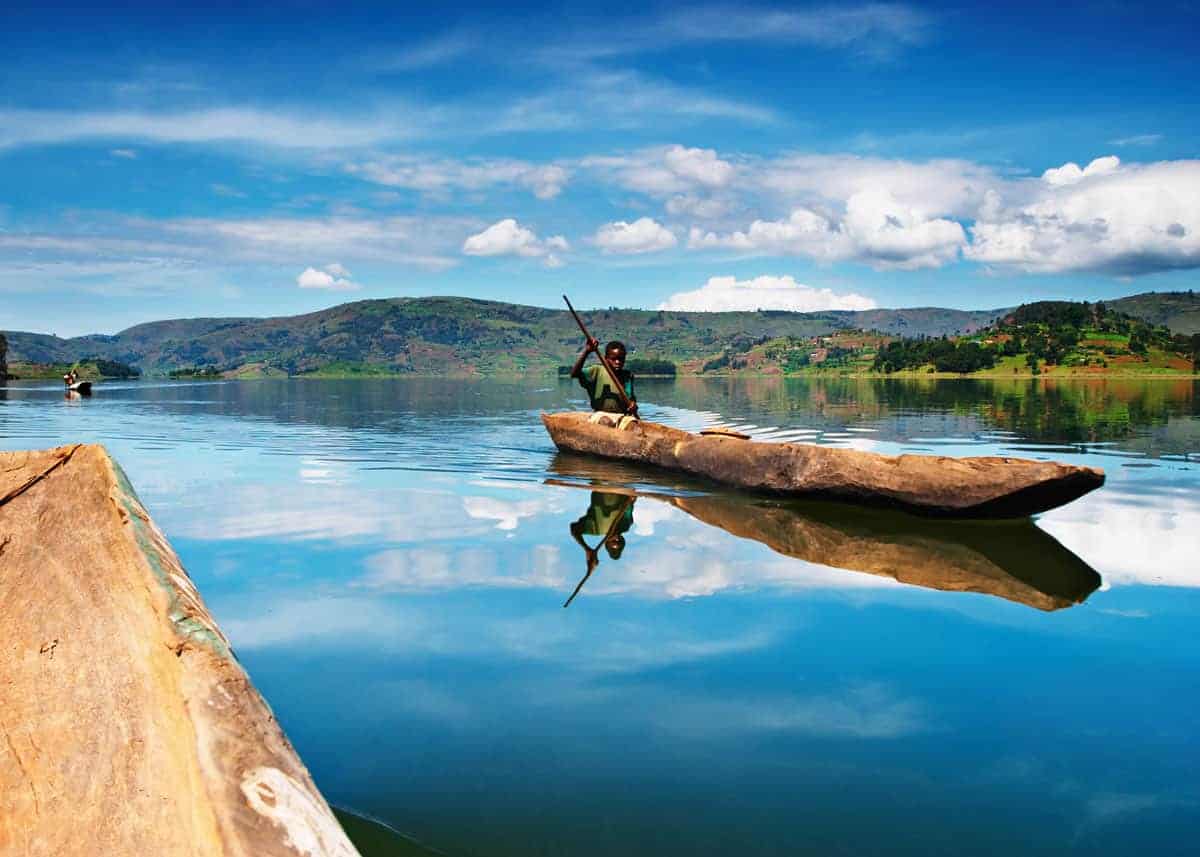
The practical experience of Lake Mutanda is most powerfully concentrated in the dawn canoe. Departing from the eastern shore lodge before sunrise, paddling into the centre of the lake as the sky lightens, and watching the volcanic peaks emerge from the dawn cloud with their reflections appearing in the water below is one of the most genuinely moving natural experiences available in Uganda — and it happens with almost complete privacy, in a location that fewer visitors reach in a year than visit Bwindi in a single week. The canoe trip lasts two to three hours; the lodge serves breakfast on return.
The Mutanda Lake Resort on the eastern shore provides the primary accommodation option — comfortable banda-style rooms with lake views, kayaks and canoes available for hire, and a dining area with a direct volcano-and-lake view that makes it one of the best lodge settings in southwestern Uganda. The lodge’s community connections include fishing boat excursions with local families and guided walks to nearby Batwa communities. A two-night stay at Lake Mutanda, positioned between Bwindi and Mgahinga in a five to six day itinerary, transforms a standard gorilla trekking trip into something architecturally different from every other visitor’s experience.
Plan your visit: Lake Mutanda is 30 minutes from Kisoro on a rough track — a high-clearance vehicle is required after rain. The Mutanda Lake Resort handles all bookings directly; availability is rarely an issue. Factor two nights into your itinerary: one night after driving from Bwindi, a full day on the lake (dawn canoe, fishing, Batwa visit, afternoon kayaking), and a morning departure to Mgahinga or Kisoro. The cost — approximately USD 80–120 per night per person — represents exceptional value for the visual and experiential quality delivered.
3. Echuya Forest Reserve — Uganda’s Rarest Birds
- A small community-managed montane forest reserve between Lake Bunyonyi and the Rwanda border
- Grauer’s rush warbler — one of the world’s rarest birds — found here and virtually nowhere else in Uganda
- Fewer than 500 visitors per year despite being 2 hours from Bwindi
- Community ranger programme; the reserve’s income goes directly to the management community
- Best combined with a Lake Bunyonyi stay on the Bwindi-Kabale route
Echuya Forest Reserve — a small pocket of montane forest on the ridge between Lake Bunyonyi and the Rwanda border — is Uganda’s most undervisited Important Bird Area and one of the most important bird sites in the entire Albertine Rift. The reserve’s primary claim to birding significance is the Grauer’s rush warbler — one of the world’s rarest birds, with a total population estimated at only a few thousand individuals distributed across a small number of high-altitude papyrus and sedge swamp sites in Uganda, Rwanda and DRC. Echuya is one of the most reliable sites in Uganda for this species, which means it attracts specialist listers willing to make the effort — but the total annual visitor count remains under five hundred, giving Echuya a solitude quality that Bwindi, with its forty thousand annual visitors, cannot provide.
Beyond the Grauer’s rush warbler, Echuya holds a full suite of Albertine Rift endemic birds in a more accessible, less steep environment than Bwindi. The forest’s single trail system — manageable for any moderately fit visitor — passes through bamboo zones, montane forest interior and the forest-grassland transition where endemic forest birds are often more visible than in dense canopy. A four-hour guided walk in Echuya with an experienced birding guide produces fifteen to twenty Albertine Rift endemic or near-endemic species on a good morning. The reserve’s community management model directs all entry fees and guide fees to the community organisation that maintains the trails and employs the rangers — a conservation funding model more directly connected to the community than the national park permit system.
Echuya is positioned on the Kabale-Kisoro road, twenty minutes from Kabale town — which means it is naturally accessible on the drive between Bwindi and Lake Bunyonyi without significant detour. A three to four hour Echuya morning visit, departing from Lake Bunyonyi and continuing to Bwindi or Kabale, adds the Grauer’s rush warbler and the Echuya endemic bird list to an itinerary that previously had only Bwindi’s forest bird list. For birders, this is one of the most impactful single add-ons available on the standard southwest Uganda circuit.
Plan your visit: Contact the Echuya community management office through your Lake Bunyonyi lodge to arrange a ranger guide. Entry fees and guide fees are modest — approximately USD 15–20 per person — and payable at the reserve entrance. Bring the same footwear and clothing you use for Bwindi: the forest is similarly cool and can be muddy. The reserve’s altitude (approximately 2,400m) is slightly higher than Bwindi’s briefing points, so the birding community is subtly different from the lower Buhoma sector trails.
4. Ssese Islands — Lake Victoria’s Forgotten Archipelago
- 84 islands in Lake Victoria’s northwest — a tropical forest island archipelago
- Accessible by 90-minute ferry from Entebbe or speedboat from Nakiwogo landing
- Forest walks, freshwater beaches, exceptional bird diversity and genuine remoteness
- Bilharzia-free swimming in designated areas around the main islands
- Best as a 2-night addition on a Kampala arrival or departure
The Ssese Islands — eighty-four forested islands in the northwest quadrant of Lake Victoria, ranging from large inhabited islands with local communities to tiny uninhabited forest islets — represent one of Uganda’s most genuinely overlooked destinations. The islands are accessible by the MV Kalangala ferry from Entebbe (ninety minutes) or by speedboat from Nakiwogo landing (thirty to forty minutes), yet they receive a fraction of the visitors who pass through Entebbe annually. The primary inhabited island, Bugala Island, has a network of dirt tracks connecting fishing communities, farms, and the forested interior; the shoreline alternates between sandy beaches, rocky outcrops and dense lakeside vegetation. The combination of forest walks, swimming, boat trips between islands and genuine cultural contact with the island’s fishing and farming communities provides a texture of experience entirely different from the national park circuit.
The birding on the Ssese Islands is exceptional and largely unexploited. The islands’ forest interior holds species associated with the Lake Victoria basin that are absent from Uganda’s highland parks — African grey parrots are regularly heard and sometimes seen in the forest canopy, palm-nut vultures soar along the lake margins, and the African fish eagle population is dense enough that calling birds are audible constantly from any point on the main island. The lake itself produces African skimmers (seasonal), various terns and kingfishers, and the occasional shoebill in the swampy sections of the larger islands’ interiors.
The Brovad Sands Lodge on Bugala Island’s eastern shore is the primary quality accommodation option — comfortable rooms, a lake view restaurant, kayaks and bicycles available for hire, and a helpful staff team that can arrange island boat trips and forest walk guides. Two nights at Brovad Sands before an Entebbe departure provides a genuine decompression after the intensity of a Uganda safari — the quiet lake, the slow pace of island life and the contrast with the more demanding national park experiences create a memorable final chapter to any Uganda trip.
Plan your visit: The MV Kalangala ferry departs Entebbe on a schedule that varies by season — confirm departure times through the Brovad Sands Lodge, which can also arrange speedboat transfers for visitors who prefer flexibility over the ferry’s schedule. A bicycle hire from the lodge is the best way to explore Bugala Island’s interior tracks at your own pace. The island’s fishing communities welcome visitors to the landing sites; fish meals are available from the beach vendors adjacent to the main landing for under USD 5.
5. Toro-Semliki Wildlife Reserve — The Albert Nile Delta
- A small, rarely visited wildlife reserve at the foot of the Rwenzori escarpment near Fort Portal
- The Semliki River — the outlet of Lake Albert — flows through the reserve’s western section
- Chimpanzees, hippos, crocodiles and exceptional waterbird diversity along the river
- One of Uganda’s best sites for Nile-system waterbirds not found in the highland parks
- Accessible as a day trip from Fort Portal on the Kibale–Murchison Falls drive
Toro-Semliki Wildlife Reserve at the foot of the Rwenzori escarpment near Fort Portal is one of Uganda’s most ecologically interesting and least visited protected areas — a landscape where the Rwenzori Mountains’ drainage system meets the floor of the Albertine Rift, creating a mosaic of forest, savanna, wetland and riverine habitat that supports an unusually diverse wildlife community for its small area. The Semliki River — one of the main water sources for Lake Albert and from there the Albert Nile — flows through the reserve’s western section, creating the linear waterway habitat where hippos, Nile crocodiles and a rich waterbird community are concentrated.
Chimpanzees are present in the reserve’s forest sections; they are not fully habituated for tourism but are regularly encountered on guided walks, producing the kind of brief, wild-quality sighting that many visitors find more exciting than the controlled habituation encounter. The reserve’s road network is basic and the accommodation infrastructure is limited — a Uganda Wildlife Authority banda camp and a small private lodge near the entrance — which contributes to the low visitor numbers and the resulting wilderness quality of the experience. A day visit from Fort Portal, positioned on the Kibale-to-Murchison Falls driving route, adds a landscape and wildlife type not found on the standard western Uganda circuit without requiring a significant detour.
Plan your visit: Toro-Semliki is accessible from Fort Portal via a roughly one-hour drive on the road toward Bundibugyo. Uganda Wildlife Authority park entry fees apply. Arrange a guide at the reserve entrance for the river walk and forest sections; the guide fee contributes to the reserve’s community ranger programme. Combine with a visit to the Sempaya Hot Springs in the adjacent Semuliki National Park for a full-day exploration of the Fort Portal area’s protected landscape.
6. Kabaka’s Lake — Kampala’s Secret Wildlife Water
- An artificial lake excavated by Kabaka Mutesa I in the 1880s — the largest man-made lake in Africa at the time
- Located in the Rubaga district of Kampala, within the city limits
- Hippos, monitor lizards and waterbirds in an urban setting
- Part of the Lubiri (Kabaka’s Palace) compound — accessible on guided tours
- One of the most surprising wildlife encounters available in any African capital city
Kabaka’s Lake in the Rubaga district of Kampala is one of the most surprising wildlife locations in any African capital — a genuinely large body of water excavated by order of Kabaka Mutesa I of the Buganda kingdom in the 1880s as a defensive feature and a symbol of royal power. The lake, now surrounded by urban Kampala, supports a resident hippopotamus population visible from the shore path that runs along the lake’s western margin within the Lubiri Palace compound. Nile monitor lizards — some exceeding two metres in length — sun themselves on the banks. African fish eagles call from the large trees at the lake’s edge. The combination of a genuinely historical site (the lake is part of Uganda’s most important royal estate), surprising urban wildlife and a quiet atmosphere entirely at odds with the surrounding city makes Kabaka’s Lake one of Kampala’s most memorable and most overlooked experiences.
Access is through the Lubiri Palace grounds on guided tours organised by the Buganda Kingdom Tourism Board. The tour covers the lake shore walk alongside the palace grounds, the palace museum (with exhibits on Buganda kingdom history and royal regalia), and the Twekobe (the main palace building). The hippos are reliably visible in the early morning and late afternoon when they are most active near the water’s edge. The lake circuit takes approximately forty-five minutes to one hour as part of the palace tour; the total palace and lake visit is typically two to two and a half hours.
Plan your visit: The Lubiri Palace tours operate Tuesday to Sunday; book through the Buganda Tourism Board or arrange through your Kampala hotel. The palace is in Mengo, Rubaga district — a twenty-minute drive from central Kampala. Combine with a visit to the Kasubi Tombs (fifteen minutes further along the same road) for a half-day of Buganda kingdom heritage and urban wildlife in the same district.
7. Kidepo Valley National Park — Uganda’s Best-Kept Safari Secret
- Uganda’s most remote national park — in the far northeast near the South Sudan border
- Cheetahs, wild dogs, ostriches, Rothschild’s giraffes and striped hyenas found nowhere else in Uganda
- Fewer than 5,000 visitors per year — game drives feel completely private
- Consistently rated by returning visitors as their most memorable Uganda wildlife experience
- Accessible by charter flight from Entebbe (90 minutes) or by road (8–10 hours from Kampala)
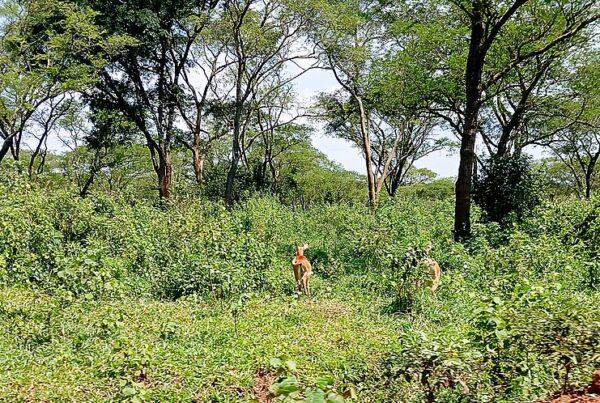
Kidepo Valley National Park — Uganda’s most remote major wildlife destination, positioned in the semi-arid valley of the far northeastern corner of the country near the South Sudan border — is the destination that Uganda safari veterans most frequently cite when asked about their single most memorable experience. The park receives fewer than five thousand visitors annually, which means a game drive on the Narus Valley circuit encounters no other vehicles — the solitude of the classic African safari, which has been engineered out of more accessible parks by visitor management success, is simply a natural consequence of Kidepo’s remoteness. The wildlife is extraordinary: lions, elephants, buffaloes, zebras and Uganda kob alongside species found nowhere else in Uganda — cheetahs, African wild dogs, ostriches, Rothschild’s giraffes, striped hyenas, beisa oryxes and Burchell’s zebras in a semi-arid savanna landscape utterly different from western Uganda’s forest parks.
The cultural dimension of a Kidepo visit adds something that no other Uganda park provides. The Karamojong people of northeastern Uganda — one of East Africa’s last semi-nomadic pastoralist communities, maintaining a cattle-herding culture that has been their identity for centuries — live around and within the park’s buffer zone. A visit to a Karamojong manyatta (cattle enclosure community) arranged through the park lodges provides contact with a way of life that is genuinely unlike anything available in the more extensively touristed parts of Uganda. The interaction — sitting with elders in the shade of an acacia, watching the cattle herds return in the late afternoon dust, hearing the cultural history explained through translation — is one of Uganda’s most substantive cultural encounters.
The charter flight from Entebbe to Apoka (ninety minutes) eliminates the practical barrier of the long overland drive and makes a three-to-four-night Kidepo visit feasible as a genuine component of a Uganda itinerary rather than an expedition. Apoka Safari Lodge — within the park, on a hill above the Narus Valley — is one of the best-positioned lodges in Uganda for game drive access, with the valley’s wildlife literally visible from the lodge terrace at breakfast. Combined with Bwindi gorilla trekking on a longer fourteen-day Uganda itinerary (flying between the parks), Kidepo and Bwindi together represent the full range of Uganda’s wildlife character — from mountain gorilla forest in the southwest to semi-arid cheetah savanna in the northeast.
Plan your visit: Aerolink Uganda operates scheduled and charter services to Apoka airstrip from Entebbe; book flights and Apoka Safari Lodge simultaneously as both have limited capacity. A minimum of three nights is recommended to fully experience the Narus Valley game drives, the Narus waterhole, a cultural visit and a night game drive. Kidepo is best positioned as a separate northern Uganda trip from Bwindi rather than combined on the same overland loop — the geographical distance makes flying the practical option for most itineraries.
Frequently asked questions about Uganda’s hidden gems
How do I add Kidepo Valley to a Uganda gorilla trekking itinerary?
Kidepo Valley National Park is 700 kilometres northeast of Kampala — 10–12 hours by road, or 1.5 hours by domestic flight from Entebbe to Apoka or Kidepo airstrip. Adding Kidepo to a gorilla trekking itinerary adds 3–4 days and requires a domestic flight to make it practical. The most efficient routing is: fly Entebbe → Kidepo for 2–3 nights, then fly Kidepo → Entebbe, then drive or fly to the western parks (Murchison → Kibale → Queen Elizabeth → Bwindi). On a 14-day Uganda safari this is entirely achievable. On a 7-day trip, Kidepo is impractical without sacrificing the western parks — choose based on your priorities. Kidepo is consistently rated by returning Uganda visitors as the park they most regret not having visited on their first trip.
Can I visit Lake Bunyonyi as part of a gorilla trekking trip?
Yes — Lake Bunyonyi is 30 kilometres from Kisoro, making it a natural pre- or post-gorilla trekking add-on for visitors using Bwindi’s southern sectors (Rushaga, Nkuringo) or Mgahinga. Many visitors spend 1–2 nights at Bunyonyi after their gorilla trek as a scenic and relaxing counterpoint to the physical demands of Bwindi. The crater lake is ringed by terraced hillsides, contains no malaria-transmitting mosquito species (unusual for Uganda), and has canoeing, island hopping, and swimming. Budget guesthouses and mid-range lodges cluster around Bunyonyi’s shores. The drive from Kisoro takes approximately 45 minutes on good tarred roads — an easy add-on requiring no extra domestic flight.
Is it worth visiting Mgahinga instead of Bwindi for gorilla trekking?
Mgahinga Gorilla National Park has one habituated gorilla family — Nyakagezi — compared to Bwindi’s 24+ habituated families. Permits are available in smaller numbers and sometimes easier to secure last-minute for low-season dates. The gorilla trekking experience at Mgahinga is the Virunga volcanic landscape rather than Bwindi’s primary rainforest — more open, with the backdrop of the Virunga volcano cone, and connected to the same range as Rwanda’s Volcanoes NP. Mgahinga also offers golden monkey trekking (a second primate only found here and in a few Rwanda/DRC locations), the Batwa Cultural Trail, and the option of a multi-day mountain hike on Mount Sabinyo across the Uganda-Rwanda-DRC tripoint. For a combined gorilla + golden monkey + cultural experience, Mgahinga is a unique option. For permit availability, Bwindi’s scale makes it more reliable for advance bookings.
What makes Kidepo Valley different from Uganda’s other national parks?
Kidepo Valley in Uganda’s semi-arid northeast is the only park in Uganda with a Sahel/northern savannah ecosystem — a completely different landscape and wildlife set from the western parks. Kidepo has cheetah, caracal, aardwolf, and greater kudu — species not found in Queen Elizabeth or Murchison Falls. The Karamojong agro-pastoral communities surrounding the park are among East Africa’s most culturally distinct. The park sees fewer than 5,000 visitors per year, making it one of the least-visited major safari parks in East Africa — no traffic, no crowds, entirely personal game drives. Two lodges (Apoka Safari Lodge, Nga Moru Wilderness Camp) set the standard for remote luxury. Visiting Kidepo is the experience most Uganda safari veterans say transforms their understanding of what Uganda is beyond the western primate circuit.
Can I see the Shoebill stork near Entebbe on the same trip as gorilla trekking?
Yes — Mabamba swamp is approximately 45 minutes by boat from Entebbe on Lake Victoria’s northern shore, making it accessible as a half-day activity on arrival day or departure day of any Uganda trip. The papyrus canoe excursion typically lasts 2–3 hours and produces Shoebill sightings on the vast majority of visits. For visiting birders or wildlife enthusiasts, Mabamba adds a world-class tick to the Uganda trip at minimal time cost — no overnight required, no domestic flight, and the activity works even on a tight itinerary. The Shoebill is listed on most serious Africa birders’ life lists as a priority species, and Mabamba’s sighting reliability far exceeds any alternative East African location.
Extend your Uganda safari
- Uganda Gorilla Families — the anchor that the rest of these gems orbit
- Gorilla Permit Guide — book the permit first; add hidden gems around it
- Bwindi Sector Comparison — southern sectors put you closest to Bunyonyi and Mgahinga
- Full Safari Cost Guide — budget for hidden gem extensions
- Safari Itineraries — 10 to 14-day trip shapes including hidden gem stops
- Why Gorilla Trekking in Uganda Is Africa’s Most Unforgettable Wildlife Adventure
- Mgahinga Gorilla National Park – Uganda’s Hidden Gem for Gorilla Trekking 2025
- OMG!! If It’s Safari, I’ve Been Missing Out: How This 5-Day Uganda Primate Safari Made Me Feel It All
- 3 Days in Queen Elizabeth Uganda Safari: A Hidden Gem Compared to Serengeti & Masai Mara
- The World’s Most Famous Gorilla Tracking Experience: Why the USA Chooses Uganda
- Uganda Gorilla Trekking for Couples: The Most Romantic Safari on Earth
- Uganda Gorilla Trekking Mgahinga: The Volcano Park Hidden Gem Guide
- Uganda Gorilla Trekking Nkuringo Sector: The Hardest and Most Dramatic
- Is It Safe to Travel to Uganda? Safety Advice for Tourists
- What Languages Are Spoken in Uganda? Communication Tips for Tourists