Gorilla Conservation Success Stories: How Tourism Saved the Mountain Gorilla
Mountain gorillas were, in living memory, considered almost certainly doomed — a critically endangered primate on a trajectory toward extinction that conservation scientists in the late 1970s viewed with deep pessimism. The combination of habitat destruction, poaching, civil conflict across the Virunga range, and complete absence of community economic incentive to protect rather than convert forest created conditions in which survival before the century’s end seemed genuinely unlikely. That the mountain gorilla population has instead grown from approximately 620 individuals in 1989 to over 1,000 in 2018 is one of conservation biology’s most extraordinary reversals — a story of how targeted intervention, community economics, dedicated research, veterinary care, and gorilla tourism combined to change a species’ trajectory from decline to recovery. These are the conservation success stories behind the mountain gorilla’s survival.

1. Dian Fossey’s Research at Karisoke — The Foundation of All That Followed
- Dian Fossey established Karisoke Research Center in Rwanda’s Virunga range in 1967
- Her long-term behavioural research produced the first comprehensive documentation of gorilla social life
- Fossey’s advocacy and anti-poaching work raised international awareness driving global conservation investment
- Gorillas in the Mist (1983) and the 1988 film adaptation transformed public consciousness about mountain gorillas
- Fossey’s murder in 1985 galvanised international funding for the gorilla conservation programmes that followed
Dian Fossey’s 18 years of field research at Karisoke Research Center in Rwanda’s Virunga range, from 1967 until her murder in 1985, established the scientific and emotional foundation for all mountain gorilla conservation efforts that followed. Fossey was not the first gorilla researcher — George Schaller had conducted important early fieldwork in the Virungasbefore her arrival — but her long-term commitment to individual gorilla identification, behavioural documentation, and personal relationships with specific family members produced the depth of understanding that made gorilla habituation scientifically credible and emotionally persuasive to the global public that gorilla conservation required as its constituency. Her naming of individual gorillas — Digit, Uncle Bert, Peanuts — created the foundation for the tourism model that followed, in which habituated gorillas with known identities became subjects of encounters generating conservation-critical permit revenue decades after her death.
Fossey’s active anti-poaching work — trap destruction, snare confiscation, direct confrontation with poachers — established an early precedent for ranger-based habitat protection at a time when governments lacked resources and political will for adequate independent protection. Her murder at Karisoke in December 1985, attributed to poachers whose operations she had disrupted, transformed her from scientist to global conservation symbol. The subsequent success of her book and the 1988 Sigourney Weaver film generated unprecedented international interest, funding, and political pressure for mountain gorilla protection that directly accelerated the institutional investment in the species’ survival across the three range countries in the decade that followed.
Visit Karisoke in Rwanda for the complete Fossey story: The Dian Fossey Gorilla Fund’s Karisoke Research Center in Rwanda maintains a visitor programme providing access to the research station where Fossey worked and where mountain gorilla research continues today. Visiting Karisoke alongside a Volcanoes National Park gorilla trek provides the historical and scientific context for the conservation programme visitors are actively supporting through their permit purchase.
2. The Gorilla Doctors Veterinary Programme — Saving Individuals to Protect the Population
- Gorilla Doctors established 1986 — the first wildlife veterinary programme specifically for mountain gorillas
- Life-saving interventions on dozens of individual gorillas across four decades of operation
- Snare removal, respiratory treatment, and wound care have prevented deaths in a critically small population
- Every individual gorilla saved represents a measurable contribution to species viability
- Operates across Uganda, Rwanda, and DRC — the full mountain gorilla range
The Gorilla Doctors programme — established in 1986 with Morris Animal Foundation funding — represents one of the most practically impactful conservation interventions in the mountain gorilla recovery story. In a wild population of fewer than 1,000 individuals, the death of any single animal from a treatable cause represents a measurable reduction in population viability. The Gorilla Doctors’ mandate to provide veterinary care to wild gorillas has prevented deaths that would otherwise have occurred — snare removal from hands and feet causing fatal infections without treatment, respiratory illness treatment preventing outbreak spread through family groups, and emergency care for individuals injured through poaching encounters. Documented interventions include hundreds of snare removals from habituated animals and multiple respiratory treatment events preventing community-level disease events following exposure to human pathogens at the gorilla-human interface created by trekking programme proximity.
The programme’s tri-national operational structure maintaining veterinary field teams in Uganda, Rwanda, and the DRC reflects the mountain gorilla’s trans-boundary range — families that trek between Uganda and Rwanda or Rwanda and the DRC require monitoring programmes functioning effectively regardless of which country the animals currently occupy. The long-term health database maintained by Gorilla Doctors, tracking individual animal health histories across decades of monitoring, provides the most comprehensive longitudinal health record for any wild great ape population and informs both veterinary intervention decisions and broader population management policy recommendations for the three governments managing the mountain gorilla’s future.
Support Gorilla Doctors directly: Gorilla Doctors accepts donations allowing supporters to sponsor specific veterinary field activities with programme impact reporting. For gorilla trekking visitors wanting their conservation contribution to extend beyond the permit fee, a direct Gorilla Doctors donation provides the most targeted investment in the individual animal health protection that the species’ small population size makes particularly critical for long-term viability.
3. Community Conservation Economics — Tourism Revenue Changed the Forest’s Value
- Before gorilla tourism, forest land was worth more converted to agriculture than protected as wildlife habitat
- Gorilla tourism revenue flowing to adjacent communities changed the economic calculation fundamentally
- Uganda Wildlife Authority allocates 20% of gorilla permit revenue directly to communities adjacent to Bwindi
- Communities receiving tourism income now have economic incentives to protect rather than encroach upon the forest
- The community conservation economic model is the most important systemic factor in the gorilla’s survival
The fundamental challenge of mountain gorilla conservation was always economic before it was biological — the gorilla’s forest habitat is surrounded by some of East Africa’s most densely populated highland agricultural land, where population pressure on adjacent farming communities creates constant incentive to convert forest margin into additional cultivated land. In the absence of economic alternatives, the rational land use decision for a subsistence farming family is to clear forest for crops regardless of conservation consequences. The breakthrough insight of community conservation economics — demonstrated first at Bwindi and replicated across mountain gorilla range countries — was that channelling gorilla tourism revenue directly to adjacent communities could change this calculation by making the gorilla’s living presence in the forest worth more to community households than the agricultural land it occupies.
Uganda Wildlife Authority’s formal community revenue sharing programme allocates 20 percent of gorilla permit revenue to communities adjacent to Bwindi and Mgahinga — funding school construction, health centre facilities, water system installation, and microfinance access in the villages whose land-use decisions directly shape gorilla habitat integrity. Organisations including the Bwindi Impenetrable Community Trust have extended this model through targeted community development investments creating additional tourism-linked income streams — porter employment at sector gates, craft cooperative sales, community lodge revenue sharing, and guided walk fees. The cumulative economic impact has been documented in research showing correlations between community tourism income levels and reduced forest encroachment rates in the Bwindi buffer zone.
Your permit purchase drives community conservation: Every USD 800 gorilla permit generates approximately USD 160 in direct community benefit through UWA’s revenue sharing alongside additional community income from porter fees, craft purchases, and community walk participation. This financial architecture transforms the permit from a tourism admission fee into a conservation investment with measurable outcomes in the community economic wellbeing that sustains the gorilla habitat.
4. Ranger Patrol and Anti-Poaching Infrastructure
- Uganda Wildlife Authority maintains 365-day ranger patrols in Bwindi — conservation’s front line
- International Gorilla Conservation Programme coordinates trans-boundary anti-poaching across all three range countries
- Smart park technology including ranger GPS tracking, snare detection, and forest boundary monitoring
- Community informant networks in adjacent villages provide intelligence about snaring and incursion activity
- Mountain gorilla poaching has been reduced to near-zero in Uganda and Rwanda through sustained patrol investment
The daily reality of mountain gorilla conservation is ranger patrol — Uganda Wildlife Authority rangers walking Bwindi’s forest perimeter and interior trails every day of the year, removing snares, monitoring gorilla family movements, recording illegal activity, and providing the physical presence deterring forest incursion by poachers and organised wildlife crime networks. The snare removal programme is particularly critical: wire snares set for small mammals frequently trap gorillas whose ranging behaviour brings them through snare fields, causing hand and foot injuries that Gorilla Doctors treats and that would cause fatal infections without medical intervention. The patrol-remove-treat cycle connecting UWA rangers, the Gorilla Doctors veterinary team, and habituated family research monitors is the operational core of on-the-ground gorilla protection that the tourism permit revenue finances and sustains.
The International Gorilla Conservation Programme coordinates anti-poaching across the tri-national range — a trans-boundary collaboration between Uganda, Rwanda, and the DRC whose effectiveness depends on intelligence sharing, coordinated patrol scheduling in border areas, and mutual recognition of law enforcement authority across borders that national sovereignty considerations sometimes complicate. The relative stability of the Uganda and Rwanda portions of the gorilla range — both maintaining effective park authority throughout the recovery period — contrasts with ongoing security challenges in the DRC’s Virunga National Park, where rebel activity has periodically reduced patrol effectiveness and created gorilla security gaps. The resilience of the population despite ongoing DRC instability demonstrates the redundancy value of protecting gorilla populations simultaneously across multiple national park systems rather than relying on any single country’s conservation architecture for the species’ survival.
Support ranger welfare programmes: Uganda Wildlife Authority ranger welfare — housing, medical coverage, equipment, and salary reliability — directly determines patrol effectiveness and ranger retention in a profession involving daily physical risk and remote deployment. Organisations including the African Wildlife Foundation operate ranger welfare support programmes translating directly into improved patrol quality and reduced poaching pressure on the gorilla families trekking visitors encounter during their forest permits.
5. The Population Recovery Trajectory — 1,063 Gorillas and Growing
- 1981 census: approximately 242 mountain gorillas in the Virunga range alone — the species’ lowest recorded point
- 1989: approximately 620 mountain gorillas across the complete range — slow recovery beginning
- 2010: approximately 786 mountain gorillas — recovery trajectory clearly established
- 2018 census: approximately 1,063 mountain gorillas — critically endangered but unmistakably recovering
- Mountain gorilla is the only great ape subspecies whose wild population is currently growing not declining
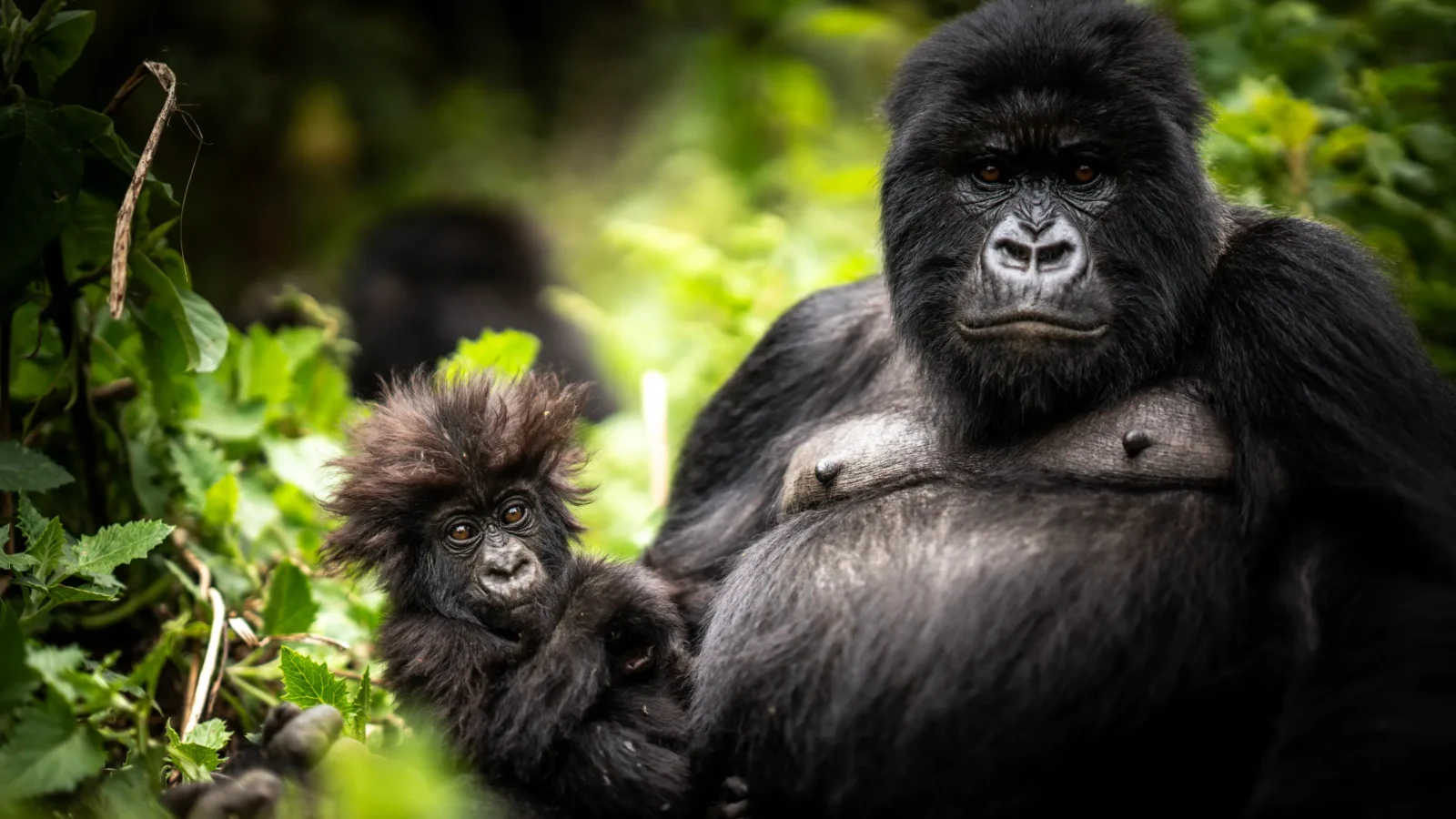
The mountain gorilla population trajectory from the crisis years of the early 1980s to the 2018 census figure of 1,063 individuals represents the most encouraging population recovery story available in great ape conservation — a trajectory moving against the global trend of great ape population decline across Africa and Asia and demonstrating that targeted, well-funded, and community-integrated conservation can reverse a species’ trajectory from near-extinction to cautious recovery even in a geographically small and politically complex range area. The 1981 Virunga figure of approximately 242 gorillas represents the species’ lowest documented point — a number that had scientists predicting extinction by the century’s end. The 70 percent population increase from 620 in 1989 to 1,063 in 2018, achieved against the backdrop of civil war and ongoing human population pressure on the habitat margins, is a conservation achievement of extraordinary significance in global wildlife conservation history.
The mountain gorilla holds a unique distinction among the world’s great apes — it is the only subspecies whose wild population is currently growing rather than declining. While chimpanzee, bonobo, western gorilla, orangutan, and gibbon populations across Africa and Asia continue declining under deforestation and hunting pressure, the mountain gorilla’s recovery trajectory reflects the specific combination of interventions sustained and funded across three decades. This distinction makes mountain gorilla conservation one of conservation biology’s most cited success models — a demonstration that species recovery is possible with sufficient commitment, appropriate economic mechanisms, and community integration even in densely populated developing country contexts where habitat protection competes directly with legitimate subsistence agricultural needs that cannot be dismissed without providing credible economic alternatives.
The recovery is fragile, not secured: The mountain gorilla’s recovered population of over 1,000 individuals remains critically endangered — small enough that a single disease outbreak, political disruption to park management, or sustained reduction in tourism revenue undermining community conservation programmes could reverse the recovery trajectory significantly. The 1,063 gorillas alive in 2018 are evidence of a conservation trajectory maintained, not a problem solved — one requiring continued financial support, institutional commitment, and the ongoing economic engine of gorilla trekking permit revenue that every permit-purchasing visitor provides with each booking made.
The mountain gorilla’s survival story is ultimately about what becomes possible when conservation science, community economics, veterinary medicine, international attention, and individual human dedication converge on a single achievable objective. From Dian Fossey’s solitary field research on the Virunga slopes in 1967 to the coordinated tri-national programme managing over 1,000 wild gorillas today, the conservation effort behind the gorilla encounter that international visitors experience in one extraordinary permitted hour represents decades of accumulated work, sacrifice, and commitment by researchers, rangers, veterinarians, community workers, and the tourism visitors whose permit payments have funded a significant portion of the entire programme. Every gorilla trekking visit adds another contribution to the conservation success story — and the gorilla that turns to look at the visiting group in the forest will outlive us all if the programmes sustaining its protection remain funded and committed for the generations ahead.