TALK TO AN EXPERT +256 716 068 279 WHATSAPP OPEN NOW.
Wildlife Beyond Gorillas

Waterbuck Uganda: The Swamp-Dwelling Antelope Facts

Home / Travel News, Stories & Tips / Tales from the Mist / Waterbuck Uganda: The Swamp-Dwelling Antelope Facts

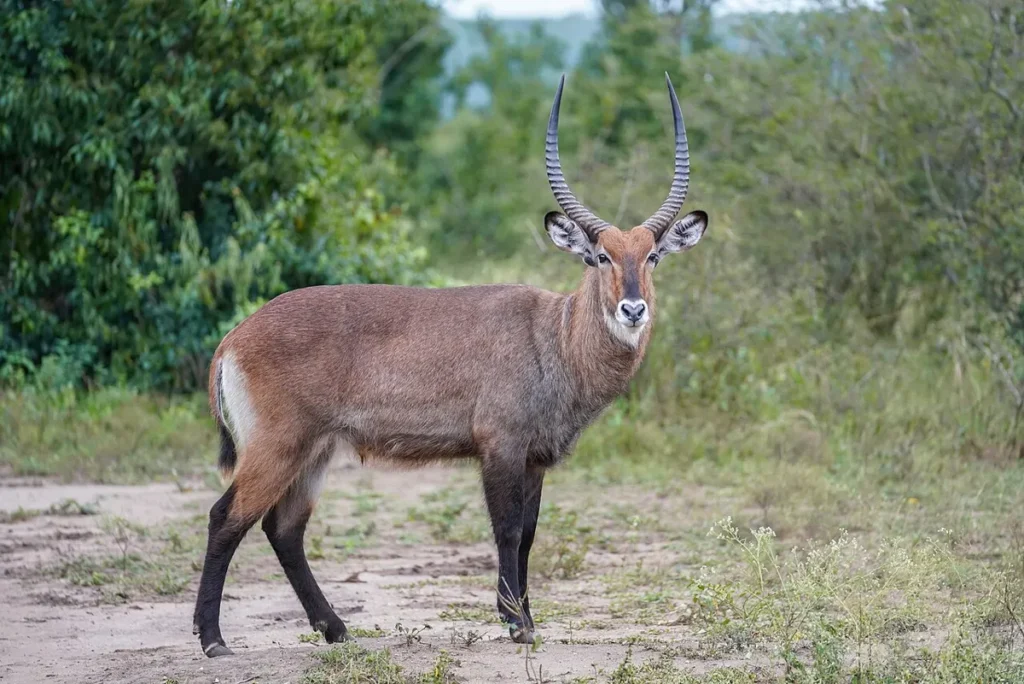
The waterbuck is one of Africa’s most distinctive large antelopes, instantly recognisable by the white ring on its rump — a bold circular marking that looks, in older descriptions, like the animal has sat in a freshly painted toilet seat. This marking, combined with the shaggy, coarse grey-brown coat and the long, forward-sweeping horns of the males, makes the waterbuck unmistakable. In Uganda, waterbuck are found in Queen Elizabeth, Murchison Falls, and Lake Mburo national parks, always in proximity to water. Here is everything you need to know about them.

Physical Characteristics

The defassa waterbuck (Kobus ellipsiprymnus defassa) — the subspecies found in Uganda and most of East Africa — weighs 160 to 300 kilograms, making it one of the larger savanna antelopes. Males are substantially heavier than females. The coat is shaggy and coarse, grey-brown in colour, and the skin produces an oily, musky secretion that waterproofs the coat and is detectable by humans as a distinctive smell — particularly noticeable in areas with high waterbuck density. Only males carry horns: long, heavily ridged, sweeping forward and upward in a distinctive arc, reaching 75 to 99 centimetres in large individuals.

The white rump ring of the common waterbuck (found in southern Africa) is replaced in the defassa subspecies with a broader white patch — diffuse rather than a sharply defined ring. The distinction is most visible at close range, though both forms have the same fundamental biology and behaviour.

Habitat and Water Dependency

Waterbuck are never found far from water. They drink daily and will enter water to escape predators — a strategy that works because the musky secretion in their coat is reputed to be unpalatable to lions, though this claim is debated among researchers. What is not debated is the waterbuck’s willingness to stand chest-deep in water when threatened, which provides a genuine obstacle to pursuit.

In Uganda, waterbuck concentrate along riverbanks, lake shores, and in papyrus-edge habitats. The Kazinga Channel area of Queen Elizabeth National Park supports a substantial population that is regularly seen on boat trips. Murchison Falls National Park’s Nile-side areas also hold good numbers. Lake Mburo, being a smaller, more intimate park with open water throughout, offers particularly reliable waterbuck sightings at close range.

Social Structure and Behaviour

Waterbuck social organisation centres on male territorial defence. Adult males hold territories of 100 to 600 hectares, which they defend through displays and, when necessary, physical combat. Horn clashes between males can be severe and injuries are common in areas with high male density. Non-territorial males form bachelor herds that roam more widely.

Females and young form separate herds that move through male territories, selecting mates from among the territorial males they encounter. Female group sizes vary from 5 to 30 individuals, depending on habitat productivity. Calves are hidden in dense vegetation for their first few weeks of life — a behaviour called “hider” strategy — before joining the female herd.

Predation

Waterbuck are preyed upon primarily by lions. Their size makes them a significant food source for large prides, and their predictable association with water concentrates them in areas where lion ambush is effective. Leopards take calves and young animals. The waterbuck’s defense strategy — entering water, using riverine vegetation for cover, and the apparent deterrent of their scent — is moderately effective but does not prevent significant predation in areas with high lion density.

Conservation Status

The defassa waterbuck is classified as Near Threatened on the IUCN Red List, with populations declining in some parts of its range due to habitat loss and hunting. Uganda’s populations within national parks are stable. The species’ strong dependence on water makes it particularly vulnerable to droughts and to habitat modification that reduces access to permanent water sources. In Uganda’s well-watered national parks, however, waterbuck remain abundant and ecologically functional.

Seeing a male waterbuck at the edge of the Kazinga Channel — shaggy coat, sweeping horns, that musky smell carried on the breeze, standing utterly still while watching the boat pass — is one of the characteristic sensory experiences of a Queen Elizabeth National Park boat trip. The waterbuck is not glamorous in the way of a lion or a leopard, but it has a quality of presence — substantial, deliberate, rooted in its landscape — that makes it one of Uganda’s most satisfying wildlife encounters.

Ready to experience Uganda’s mountain gorillas in 2026? Secure your gorilla permits early and let us craft a seamless safari tailored to your travel style, preferred trekking sector, and accommodation level. From luxury lodges to well-designed midrange journeys, every detail is handled for you. Every itinerary is carefully planned to maximize your time in the forest while ensuring comfort, safety, and unforgettable encounters.

Have questions about gorilla permits, travel dates, or the best itinerary for you? Speak with a safari expert and get clear, honest guidance to plan your trip with confidence.

When is the last time you had an adventure? African Gorillas!!! Up Close With Uganda’s Wild Gorillas Touched by a Wild Gorilla: An Unforgettable Encounter Inside Gorilla Families: Bonds, Hierarchies & Jungle Life Face to Face With a Silverback: The Wild Encounter You’ll Never Forget