TALK TO AN EXPERT +256 716 068 279 WHATSAPP OPEN NOW.
Wildlife Beyond Gorillas

Sitatunga Antelope Uganda: The Swamp Specialist Complete Guide

Home / Travel News, Stories & Tips / Tales from the Mist / Sitatunga Antelope Uganda: The Swamp Specialist Complete Guide

The sitatunga is the most aquatic of all African antelopes — a species so thoroughly adapted to swamp and papyrus habitat that it can walk through water a metre deep, swim freely between reed islands, and stand submerged to its neck to avoid predators. Uganda’s extensive papyrus swamps and wetlands provide ideal sitatunga habitat, and the species is present in significant numbers around Lake Victoria’s shores, in Mabamba Swamp, and in the wetlands of the Albertine Rift. It is rarely seen because of the density of its habitat, but it is more common than most people realise.

Physical Adaptations for Wetland Life

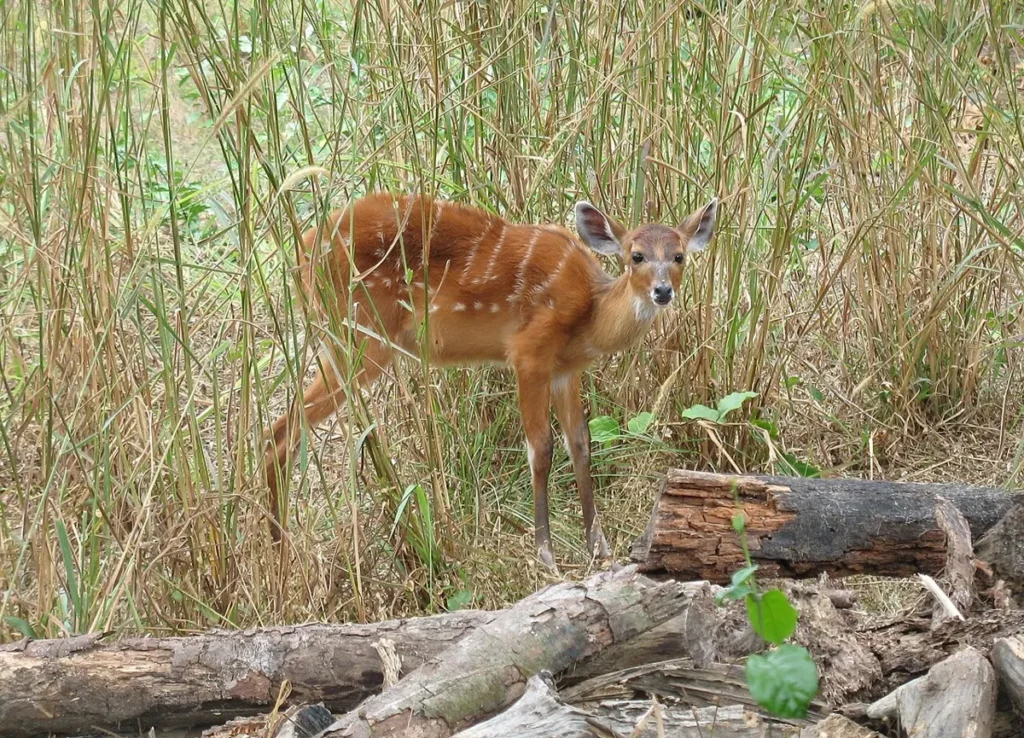
The sitatunga (Tragelaphus spekii) has a suite of physical adaptations specific to wetland living. Adults weigh 50 to 125 kilograms, with males considerably heavier. The hooves are long, splayed, and flexible — providing a broad base that prevents sinking in soft mud and allows stable movement across floating vegetation mats. The pasterns are more flexible than other antelopes, allowing the feet to angle for stability on irregular substrates. The coat is oily and somewhat water-repellent — an adaptation to spending extended time in water.

Males carry long, spiralling horns reaching 60 to 90 centimetres. The sexual dimorphism is pronounced: males are significantly larger and darker — dark brownish-grey with white spots and stripes — while females and young are bright reddish-chestnut. Both sexes have elongated, somewhat unkempt-looking coats that trap air, providing thermal insulation and additional buoyancy in water. The overall appearance is of an animal designed by committee to deal with very specific conditions, with no regard for conventional antelope aesthetics — and it works perfectly.

Habitat and Behaviour

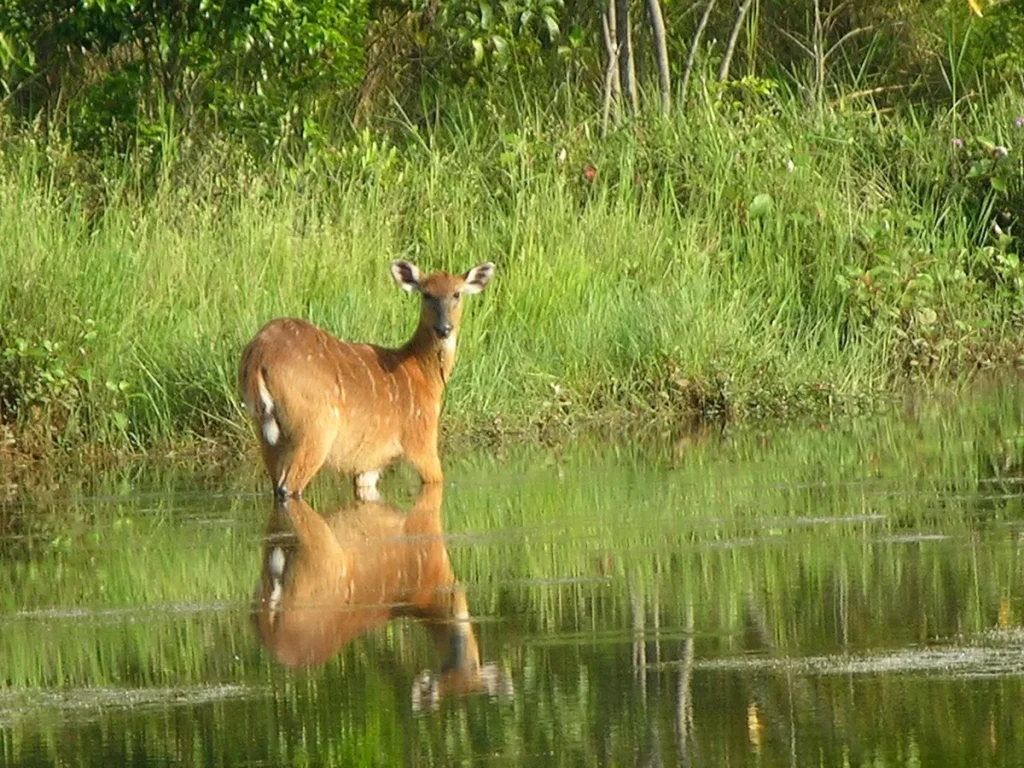
Sitatungas inhabit dense papyrus swamps, reed beds, and riparian forest throughout their range. They are almost entirely confined to wetland habitat and are essentially helpless in open savanna — their specialised legs, designed for soft substrate, make them vulnerable on firm ground where they move awkwardly. When alarmed, sitatungas move deeper into the swamp, often wading or swimming. They can submerge almost completely, leaving only the nostrils visible above the waterline — a predator avoidance strategy of considerable effectiveness.

Sitatungas are browsers and grazers, consuming aquatic vegetation, reeds, papyrus shoots, and fallen fruits from overhanging trees. They are most active at dawn and dusk and spend the heat of the day resting in dense reed beds. Their paths through papyrus create a network of trails that concentrates other wetland wildlife and shapes the structure of the papyrus community over time.

Social Structure

Sitatungas are largely solitary or live in small groups — typically a female with her offspring, or temporary associations of two or three individuals. Males are territorial and mark their areas with scent from preorbital and pedal glands. Home ranges in dense swamp habitat are small — often less than a square kilometre — because the productivity of papyrus swamps supports high animal density in limited space. Unlike savanna antelopes, sitatungas do not form large herds and do not perform mass migrations.

Sitatunga in Uganda

Uganda’s papyrus swamps are among the best sitatunga habitat in East Africa. Mabamba Swamp — the main shoebill site near Entebbe — has a resident sitatunga population that is occasionally seen from canoes during shoebill searches. Lake Mburo National Park has sitatunga in its extensive wetlands and lake margins, and boat trips on the lake offer realistic sighting opportunities. The wetlands of the Albert Nile and the lake shores of western Uganda also hold populations.

Seeing a sitatunga — particularly a male with his dramatic spiral horns standing in chest-deep water with the papyrus rising around him — is one of Uganda’s quieter wildlife highlights. It is not the animal that appears on bucket lists, but it is the animal that surprises people who encounter it: unexpected in its size, striking in its wetland-specific beauty, and a reminder that Uganda’s biodiversity extends well beyond the savanna species that dominate wildlife photographs.

Ready to experience Uganda’s mountain gorillas in 2026? Secure your gorilla permits early and let us craft a seamless safari tailored to your travel style, preferred trekking sector, and accommodation level. From luxury lodges to well-designed midrange journeys, every detail is handled for you. Every itinerary is carefully planned to maximize your time in the forest while ensuring comfort, safety, and unforgettable encounters.

Have questions about gorilla permits, travel dates, or the best itinerary for you? Speak with a safari expert and get clear, honest guidance to plan your trip with confidence.

When is the last time you had an adventure? African Gorillas!!! Up Close With Uganda’s Wild Gorillas Touched by a Wild Gorilla: An Unforgettable Encounter Inside Gorilla Families: Bonds, Hierarchies & Jungle Life Face to Face With a Silverback: The Wild Encounter You’ll Never Forget