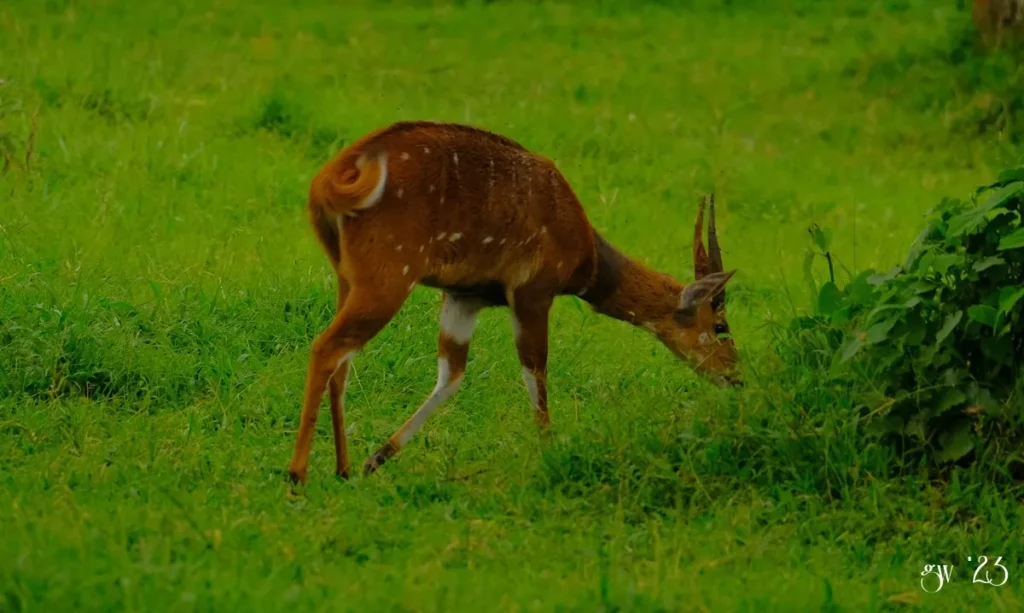
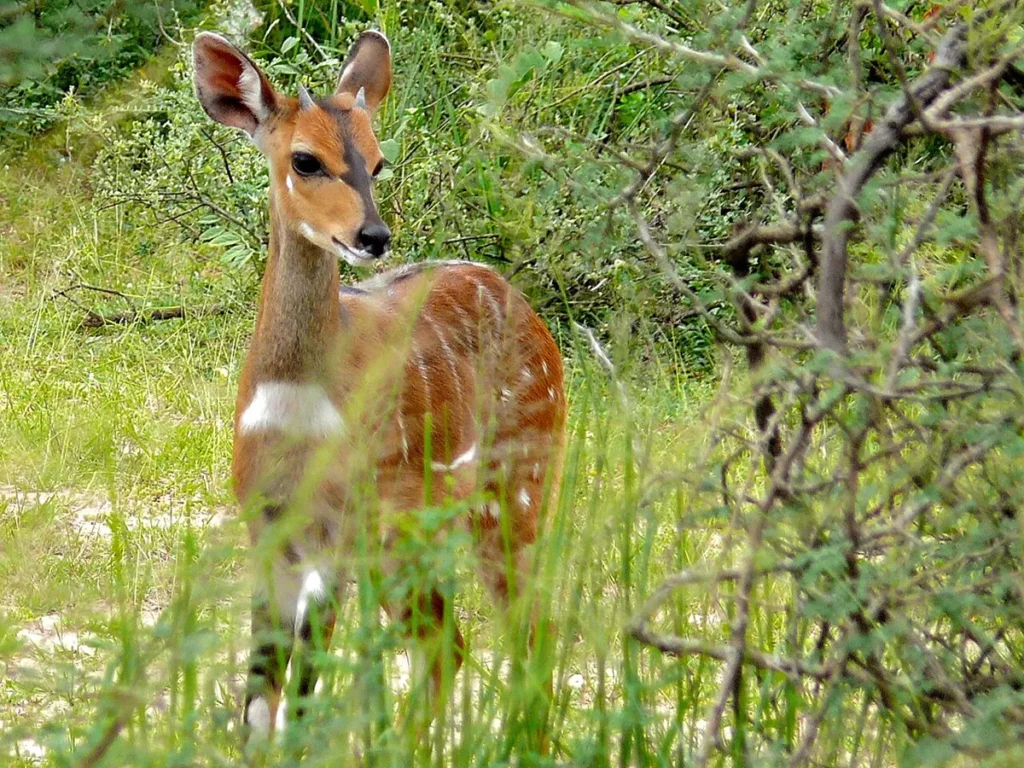
The bushbuck is one of Uganda’s most widespread and most habitat-flexible antelopes — and one of the most secretive. Found from coastal thickets to montane forest edges, from riverine bush to the margins of cultivated land, the bushbuck’s ability to survive in dense cover and its extreme wariness of humans makes it far more common than most visitors to Uganda’s parks realise. It is heard more often than seen: the sharp, dog-like bark alarm call from deep bush is a reliable indicator of bushbuck presence even when the animal itself is invisible.
Physical Description
The bushbuck (Tragelaphus scriptus) is a medium-sized spiral-horned antelope weighing 25 to 80 kilograms — females considerably lighter than males. Males carry twisted, keel-shaped horns that rise nearly vertically, reaching 35 to 57 centimetres. The colouration varies significantly with region and habitat: Uganda’s forest populations tend toward darker chestnut-brown with white spots and vertical stripes on the body sides, white patches on the throat, and white leg patches. The spots and stripes break up the animal’s outline in dappled forest light with remarkable effectiveness — a motionless bushbuck in sunlit undergrowth is genuinely difficult to see even at ten metres.
Males and females differ significantly in appearance: males are darker, more heavily built, and carry horns; females are lighter in colour, hornless, and more delicately proportioned. The sexual dimorphism is pronounced enough that inexperienced observers sometimes fail to recognise males and females as the same species.
Habitat and Behaviour
Bushbuck are browsers, consuming leaves, shoots, flowers, and fallen fruit. They are predominantly nocturnal and crepuscular, feeding actively in the hour before and after sunrise and sunset, and spending the heat of the day resting in dense cover. Their home ranges are small — typically 0.5 to 1.5 square kilometres — and they use the same areas repeatedly, developing intimate knowledge of every cover patch, escape route, and food source within their range.
Unlike most antelope, bushbuck are essentially solitary — adults are rarely seen in groups larger than a mother and offspring. This solitary lifestyle, combined with their dependence on cover and their acute predator awareness, makes them extremely difficult to approach. A startled bushbuck produces its distinctive bark and vanishes into vegetation with a speed that seems physically impossible for an animal its size.
The Bushbuck’s Unusual Defence
Unlike most antelope that rely on flight, male bushbuck occasionally stand and fight when cornered. Their vertical spiral horns are effective weapons in close combat, and there are documented cases of large male bushbuck injuring and even killing dogs, baboons, and occasionally humans who came too close in dense cover. This willingness to fight — unusual in an animal of its size in an ecosystem with leopards and lions — may reflect the bushbuck’s forest habitat, where flight is not always possible and holding ground sometimes produces better outcomes than attempting to run.
Bushbuck in Uganda
Bushbuck are present throughout Uganda wherever suitable dense cover exists. They are common in Bwindi Impenetrable Forest, Kibale National Park, Mabira Forest, Budongo Forest, and in the riverine vegetation along waterways in all of Uganda’s savanna parks. Lake Mburo has a good bushbuck population that is easier to observe than in denser forest due to the park’s more open vegetation structure. Dawn game drives along the forest edges of Queen Elizabeth and Murchison Falls frequently produce bushbuck sightings — the animals caught feeding in open areas before retreating to cover as light increases.
The bushbuck is not the headline act on any Uganda wildlife itinerary. It is the animal you notice on your third or fourth day, when your eye has learned to read the forest edge — the rustle of something withdrawing, the flash of spotted chestnut in the undergrowth, the dog-like bark from deep in the riverine bush. It is one of Uganda’s consistent, understated pleasures, found everywhere and overlooked until you learn to see it.