The green mamba is Africa’s most arboreal venomous snake — a slender, vividly coloured predator of forest canopy and dense bush that moves through its arboreal habitat with a speed and precision that makes it one of the most visually striking and genuinely dangerous snakes on the continent. In Uganda, the eastern green mamba inhabits the forested areas of the country, particularly along the coast of Lake Victoria and in the forest patches of southern and western Uganda. Here is what you need to know about this extraordinary snake.
Physical Description
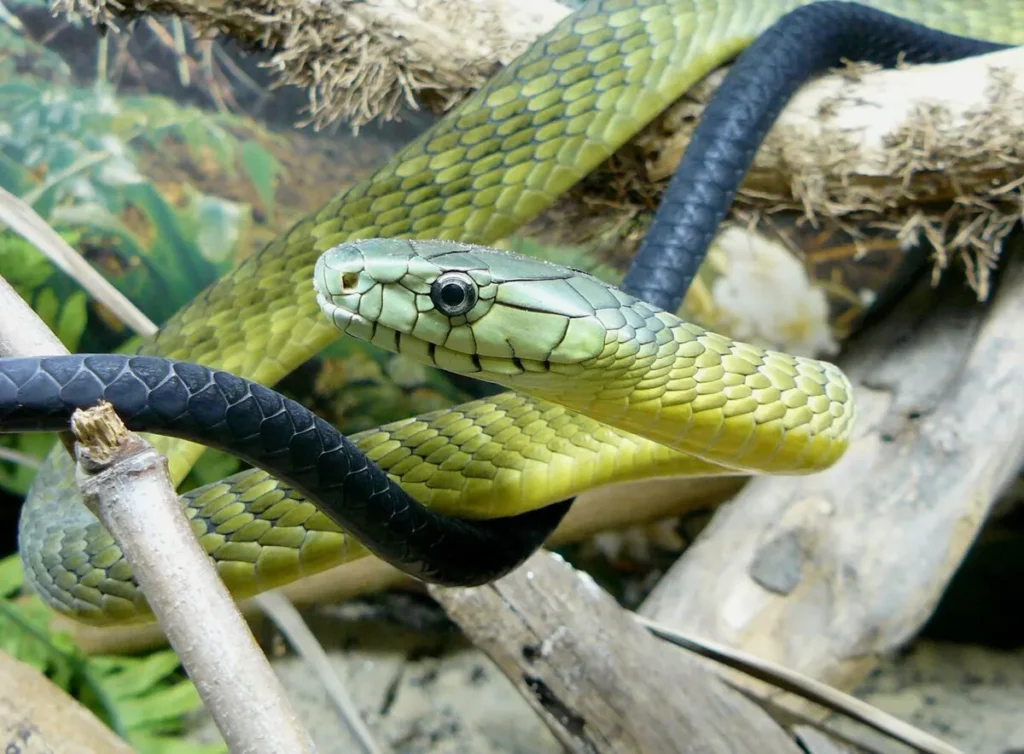
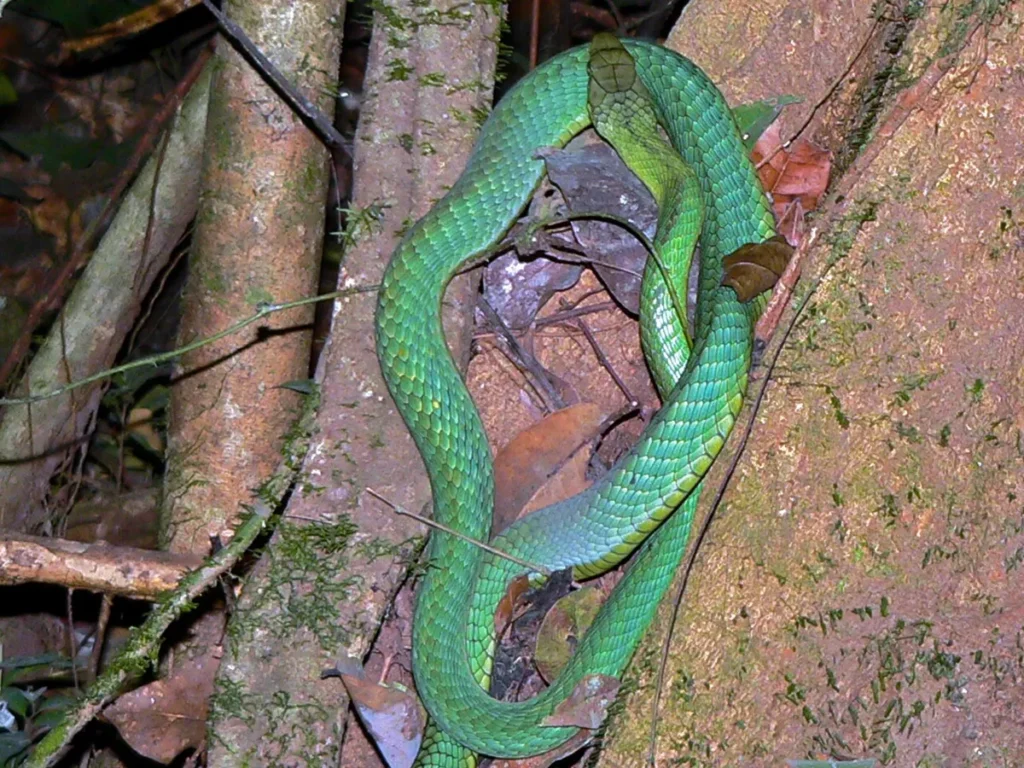
The eastern green mamba (Dendroaspis angusticeps) is a long, slender snake reaching 1.8 to 2.5 metres. The body is brilliant green — not the yellow-green of many tree snakes but a vivid, saturated green that provides near-perfect camouflage in leafy vegetation. The scales are smooth and slightly keeled, and the belly is pale yellow-green. The head is elongated and coffin-shaped — a typical mamba characteristic — with large eyes and a distinctive appearance that experienced observers learn to recognise. Young green mambas are similar in appearance to adults but with slightly different scale texture as juveniles.
The green mamba should not be confused with the black mamba (Dendroaspis polylepis), which is larger, darker, and found primarily in savanna rather than forest. The two species overlap in some areas but occupy different habitats. In Uganda’s forests, the green mamba is the mamba species most likely to be encountered.
Venom and Behaviour
The green mamba’s venom is potently neurotoxic — interfering with nerve signal transmission and causing progressive paralysis, respiratory failure, and cardiac arrest without treatment. The venom is delivered through a pair of fixed front fangs (mambas are proteroglyphous — fixed-fang front-fanged snakes, not retractable-fang vipers). A bite delivers a relatively small venom volume compared to the black mamba, but the venom is fast-acting and without antivenom treatment, a significant envenomation can be fatal within hours.
Despite their fearsome reputation, green mambas are shy and non-aggressive. They avoid human contact whenever possible and only bite defensively when cornered, grabbed, or stepped on. The vast majority of encounters — which are themselves rare — end with the snake retreating rapidly into vegetation. Mamba bites on humans are uncommon and almost invariably involve handling or cornering the snake. In Uganda’s forests, the appropriate response to seeing a green mamba is to observe it from a safe distance and allow it to move away undisturbed.
Feeding Ecology
Green mambas eat primarily birds and their eggs, small mammals, and tree-dwelling lizards. They hunt by active search through the canopy — moving rapidly through dense vegetation, using their forked tongue to detect chemical traces of prey. When prey is located, they strike and inject venom, then follow the prey until it becomes immobilised and can be swallowed head first. Their slender, lightweight build allows movement through vegetation too thin to support heavier snake species.
Green Mambas in Uganda
Eastern green mambas are found in Uganda’s coastal and lakeside forests — particularly around Lake Victoria’s shores and in the forest areas of the Ssese Islands and south-western Uganda. Encounters are uncommon and typically brief. The snake’s brilliant green colouration can occasionally make it conspicuous against the brown stems of forest interior, and it is sometimes seen basking in a shaft of sunlight before retreating as an observer approaches. Guides experienced in snake identification consistently point out that green mambas in the wild are beautiful, fast, and entirely uninterested in human interaction — a useful context for an animal whose reputation often precedes it.