Updated
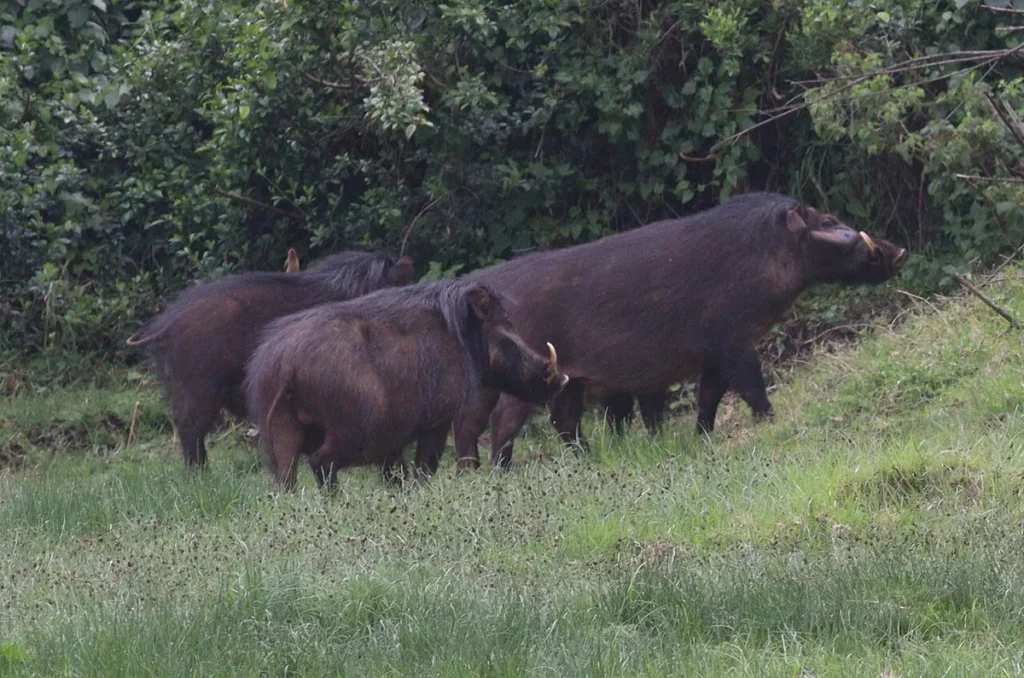
The giant forest hog is the world’s largest wild pig, with big boars weighing up to around 275 kg, long coarse black hair and large swellings below the eyes. It was not described by science until 1904. In Uganda it lives in Bwindi, Kibale and Queen Elizabeth, and the Mweya peninsula in Queen Elizabeth is the best place in Africa to see it, where some groups are used to vehicles.

Habits
Giant forest hogs live in family groups of a boar, several sows and young, called sounders. They are mainly grazers and browsers, feeding on grass, leaves and fallen fruit rather than rooting like bushpigs. They are most active at dawn and dusk, rest in dense thickets, and wallow in mud. Boars fight by charging and clashing heads, and the skull has a hollow that absorbs impact.
In the forest
In Bwindi and Kibale, giant forest hogs are shy and rarely seen, and most trekkers only find tracks and wallows. They are hunted by leopards and, in savannah areas, by lions and hyenas. Hunting by people with snares is a problem outside protected areas.
Where to see it
Mweya, around the lodges and on the Kazinga Channel shore, gives the best chances, especially early morning and evening. The gorilla permit costs US$800, or US$600 in April, May and November. See our guides to Queen Elizabeth, Bwindi, the leopard and Kibale animals.
Frequently asked questions
Most easily on the Mweya peninsula in Queen Elizabeth.
Large boars can weigh up to around 275 kg.
Yes, it is the largest wild pig species.
Yes, but they are shy and rarely seen there.