

Updated
Kibale Forest National Park is best known for chimpanzees, but it holds 13 primate species, around 70 other mammals and about 375 bird species in roughly 795 km² of rainforest in western Uganda. Beyond chimps, the animals you are most likely to see are red colobus, black-and-white colobus, grey-cheeked mangabeys, red-tailed and l’Hoest’s monkeys, and forest birds such as the great blue turaco. Elephants and other large mammals live here too but are seen less often.
Kibale’s primates
Alongside about 1,500 chimpanzees, Kibale has one of the largest populations of the endangered Ugandan red colobus, which live in noisy groups and are seen on most chimp treks. Grey-cheeked mangabeys here are now classed as the Uganda mangabey, a species found only in Uganda. See our guides to the red colobus and the grey-cheeked mangabey.
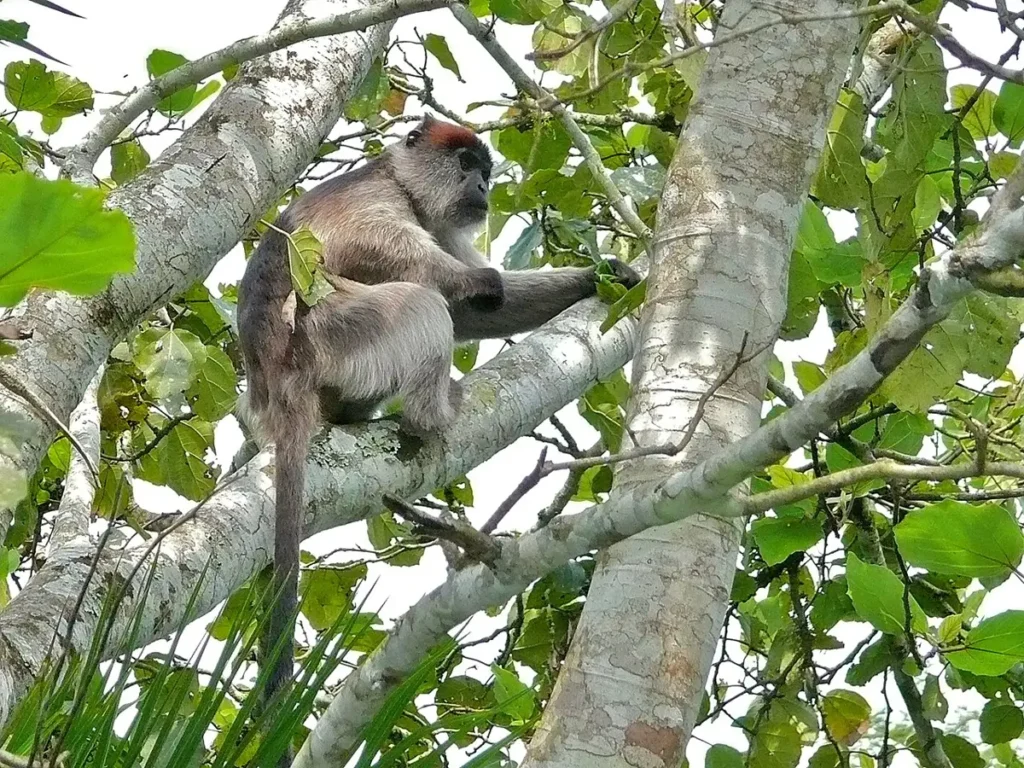
The other daytime primates are black-and-white colobus, red-tailed monkeys, blue monkeys, l’Hoest’s monkeys, olive baboons and vervets on the forest edges. At night, pottos and bushbabies come out, and you may see them on a guided night walk from Kanyanchu.
Other mammals
Forest elephants and buffaloes move through Kibale and its corridor to Queen Elizabeth, and their dung and footprints are common on trails even when the animals stay hidden. Bushpigs, giant forest hogs and red and blue duikers live in the forest, and sitatungas use the swamps. Leopards and African golden cats are present but very rarely seen. Squirrels, including the giant forest squirrel, are easy to spot.
Birds
Kibale is a good birding forest, with the green-breasted pitta as the most sought-after species, usually found with a specialist guide. Others include the great blue turaco, African grey parrot, black bee-eater, yellow-spotted barbet and several Albertine Rift endemics. The swamp at Bigodi, next to the park, is easier for birds than the dense forest. Read our great blue turaco guide.

How to see more
Chimp trekking starts from Kanyanchu in the morning or afternoon. The chimp permit is US$250, rising to US$300 from 1 January 2027, and the gorilla permit is US$800, or US$600 in April, May and November. Add the Bigodi swamp walk and a night walk to see more species. Our guides to Kibale National Park and things to do near Kibale help with planning.
Frequently asked questions
Thirteen, including chimpanzees, red colobus and the Uganda mangabey.
Yes, forest elephants live there, though they are seen less often than primates.
The green-breasted pitta, which is shy and best found with a specialist guide.
Two nights lets you trek chimps, walk Bigodi and do a night walk.










