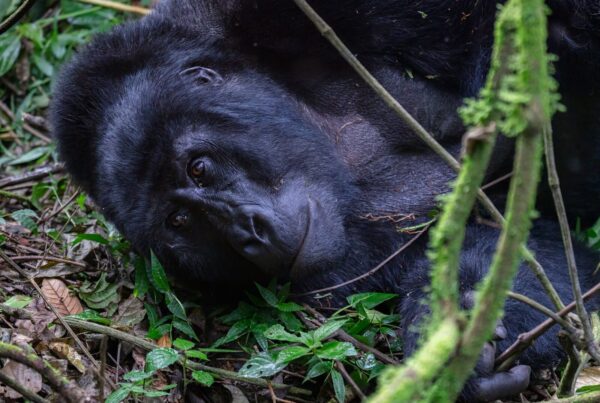
What would happen if all mountain gorillas disappeared is not a hypothetical that conservation scientists avoid — it is a question they have examined carefully, because understanding what gorillas contribute to their ecosystem is part of the case for protecting them beyond the obvious ethical and cultural arguments. The answer is both specific — the gorillas play identifiable roles in the Bwindi and Virunga ecosystems that would be affected by their absence — and systemic, touching on the cascading effects of losing a keystone species from an ecosystem and the consequences for the biodiversity that depends on the same forest.
Gorillas as Seed Dispersers
Mountain gorillas eat fruit when it is available, and the seeds of the fruits they consume are dispersed across the forest in their dung. This seed dispersal service — depositing viable seeds away from the parent tree, often in a nutrient-rich dung packet that aids germination — is an important ecological service in any forest ecosystem. The movement patterns of gorilla family groups, which cover significant daily distances across their home ranges, mean that seeds are dispersed more widely than they would be if they fell only beneath the parent tree.
The specific contribution of mountain gorillas to seed dispersal in Bwindi is less studied than that of forest elephants or chimpanzees, both of which are also present in the ecosystem and which also contribute to seed dispersal. But the gorillas’ role as one of several dispersers for specific plant species is real, and the loss of any disperser in a complex ecosystem shifts the competitive balance between plant species whose regeneration depends on animal dispersal.
Gorillas as Forest Shapers
The feeding activity of mountain gorillas — consuming large quantities of vegetation, manipulating plants, breaking branches, and moving through dense undergrowth — physically shapes the forest in ways that influence other species. The clearings created by gorilla feeding activity allow light to penetrate the canopy, creating microhabitats that support different plant and animal communities than the closed-canopy forest around them.
This “ecosystem engineering” function is subtle but real. Studies of areas with and without large herbivore activity have consistently found that the presence of large herbivores maintains a mosaic of vegetation types — some opened and disturbed, some intact — that supports higher overall biodiversity than the uniform closed-canopy forest that develops in their absence. The specific contribution of gorillas to this function in Bwindi is not precisely quantified, but the principle is well-established from studies of comparable ecosystems.
The Cascade: What Losing Gorillas Would Mean for the Forest
Beyond the direct ecological services, the loss of mountain gorillas would trigger a conservation cascade with significant consequences for Bwindi’s broader ecosystem.
The Funding Cascade
This is the most immediate and most impactful cascade. Mountain gorilla tourism generates the revenue that funds virtually all conservation activity in Bwindi — ranger salaries, anti-poaching patrols, community programs, park management. Without the gorillas, the primary driver of tourism disappears. Without tourism, the funding base collapses. Without funding, the conservation infrastructure that protects not only gorillas but the entire Bwindi ecosystem — its 350 bird species, its 120 mammal species, its 220 butterfly species, its 1,000+ plant species — would be severely compromised.
The gorillas are the financial keystone of Bwindi conservation in a way that goes beyond their ecological role. They are the funding mechanism for the protection of an entire ecosystem. Their loss would not be the loss of one species from a protected ecosystem; it would likely trigger the effective unprotection of the ecosystem itself.
The International Attention Cascade
Mountain gorilla conservation attracts international conservation funding, research attention, and political support that extends well beyond direct tourism revenue. The loss of the gorillas would reduce Bwindi’s profile in international conservation discourse, reducing the flow of supplementary funding and research activity that currently supports the ecosystem’s protection.
The Ethical Dimension
The ecosystem services argument — what gorillas do for the forest — is one argument for their conservation. It is not the only one or, for many people, the most compelling one. The ethical argument — that a species with this cognitive complexity, these social bonds, this evolutionary heritage, has intrinsic value independent of its utility to ecosystems or economies — is equally valid and for many people more compelling.
The mountain gorilla is not valuable because it disperses seeds. It is valuable because it is what it is: a socially complex, cognitively sophisticated, ecologically specific animal that is the product of millions of years of evolution and that exists, now, in only 1,100 individuals. The loss of the last 1,100 mountain gorillas would be an extinction event comparable in its quality, if not its scale, to any extinction in recorded history.
Why the Question Is Worth Asking
The question “what would happen if all mountain gorillas disappeared” is worth asking not to contemplate despair but to understand what the conservation work is protecting. It is not just protecting 1,100 animals. It is protecting an ecosystem function, a funding mechanism, a political symbol, a research programme, and a species whose loss would be mourned across the world in a way that very few extinctions have been. The work that prevents the question from having an answer is the work that has grown the population from 268 to 1,100. It must continue.
Uganda gorilla trekking permits are $800 per person. Contact Uganda Gorilla Trekking to book your permit. The ecosystem impact of their loss is worth understanding. So is the joy of their presence, which is available now, in Bwindi, for anyone who chooses to come.
Frequently Asked Questions
The global mountain gorilla population is approximately 1,100 individuals — one of the smallest populations of any great ape. They exist in two separate populations: one in the Virunga Massif spanning Uganda, Rwanda, and DRC; and one in Bwindi Impenetrable Forest (Uganda only). The population has grown from approximately 620 in the 1980s, largely due to tourism-funded conservation.
Uganda Wildlife Authority directs 20% of every gorilla permit fee to communities adjacent to Bwindi and Mgahinga. These funds pay for school construction, healthcare programmes, borehole maintenance, and community microfinance. Permit revenue also funds ranger salaries, anti-poaching patrols, and the research teams that monitor gorilla health daily.
The Batwa (also called Twa) are an indigenous forest people who lived inside Bwindi for thousands of years until it was gazetted as a national park in 1991. Conservation displaced them from their ancestral forest. Gorilla tourism revenue now funds Batwa cultural programmes and livelihoods. The Batwa Cultural Trail at Buhoma sector is run by the Batwa community and is one of the most authentic cultural experiences near Bwindi.
Mountain gorillas are classified as Endangered on the IUCN Red List — one step down from Critically Endangered, which they held until 2018. Their population has grown consistently since the 1980s, making them one of the few great ape populations increasing in number. This recovery is directly attributed to the conservation funding generated by gorilla tourism.
Uganda is home to the mountain gorilla (Gorilla beringei beringei), one of two subspecies of eastern gorilla. They live exclusively in the Virunga volcanic highlands (Uganda/Rwanda/DRC) and Bwindi Impenetrable Forest (Uganda only). Mountain gorillas are the only gorilla subspecies that cannot survive in captivity — every individual you can trek is a wild animal.