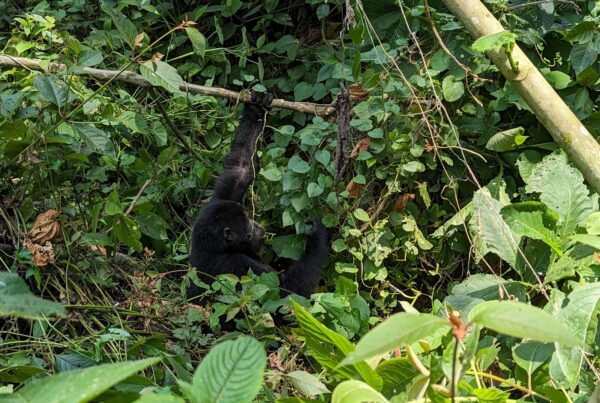
A Specific World: The Montane Forest
Mountain gorillas are not generalist animals capable of surviving across a range of habitat types. They are exquisitely adapted to a specific ecological niche — the high-altitude montane forest of East Africa’s Albertine Rift region — and their survival depends entirely on the integrity of that habitat. Understanding the specific characteristics of mountain gorilla habitat, and why those characteristics matter, is fundamental to understanding both the gorilla’s ecology and the conservation challenges facing the species.
The Albertine Rift: Africa’s Biodiversity Hotspot
Mountain gorillas are found within one of the most biodiverse regions of Africa: the Albertine Rift, a valley system formed by the western branch of the East African Rift. This region, extending from Uganda and Rwanda in the south through eastern DRC, contains exceptional concentrations of endemic species — animals and plants found nowhere else on Earth — and supports the largest number of endangered species of any region in mainland Africa.
The biodiversity richness of the Albertine Rift is partly a product of the region’s geological history. The Rift Valley’s formation created a complex mosaic of highlands, valley floors, and mountain systems that isolated populations and promoted speciation over millions of years. The mountain gorilla is one of the products of this evolutionary history: a primate lineage that colonised high-altitude montane forest and adapted to conditions unlike those of any other great ape habitat.
Bwindi Impenetrable National Park
Bwindi Impenetrable National Park in southwestern Uganda is home to approximately half the world’s mountain gorilla population — over 500 individuals in more than 50 family groups. The park covers 331 square kilometres of montane and lowland forest at elevations ranging from 1,160 to 2,607 metres above sea level. Its four sectors — Buhoma, Ruhija, Rushaga, and Nkuringo — each host multiple habituated gorilla families available for trekking, with additional groups protected for research and non-tourism purposes.
Bwindi’s exceptional plant diversity — over 1,000 flowering plant species, including approximately 163 tree species — reflects its history as a refugium: an area that retained humid forest conditions through the Pleistocene climatic cycles that dried and fragmented forests across much of Africa. This long continuity of forest cover has produced a botanical community of extraordinary diversity that supports the gorillas’ varied diet and the complex ecological community they are part of.
The park’s name — impenetrable — reflects the density of its vegetation at lower elevations. In the higher forest zones where gorilla habitat is concentrated, the vegetation is somewhat more open, with a mix of montane forest, bamboo zones, and forest edges. The combination of forest types within a single park provides habitat diversity that supports multiple gorilla family home ranges with varying resource profiles.
The Virunga Massif
The other mountain gorilla population inhabits the Virunga Massif — a chain of eight volcanic mountains straddling the borders of Uganda, Rwanda, and DRC. The Virungas host approximately 480 to 500 mountain gorillas across three contiguous national parks: Mgahinga Gorilla National Park (Uganda), Volcanoes National Park (Rwanda), and Virunga National Park (DRC). Together these parks protect approximately 434 square kilometres of protected forest.
The volcanic geology of the Virungas creates somewhat different vegetation communities from Bwindi — more bamboo and Hagenia woodland at middle elevations, dense Senecio and Lobelia at the highest zones. The altitude range extends higher in the Virungas, with some gorilla family home ranges reaching above 3,500 metres — the highest elevation mountain gorilla habitat documented. The cold and thin atmosphere at these elevations represents the extreme end of the gorillas’ physiological tolerance.
Vegetation Zones Within Gorilla Habitat
Mountain gorilla habitat is not uniform. Within the elevation range occupied by gorillas, several distinct vegetation zones offer different resource profiles that gorillas exploit seasonally and opportunistically. The bamboo zone, where it occurs, provides periodic high-protein food during shoot emergence. The Hagenia-Hypericum woodland at middle elevations in the Virungas provides the thick herbaceous ground cover that mountain gorillas feed on intensively. The mixed montane forest of higher Bwindi elevations provides dense food-plant diversity year-round.
Forest edges — the zones where forest meets grassland, farmland, or swamp — are frequently used by gorilla families, particularly for feeding on the regenerating vegetation and high-quality herbs that thrive in the increased light of edge environments. This edge use brings gorillas into proximity with human-occupied land, creating both the human-wildlife conflict of crop raiding and the disease transmission risks of close human contact that conservation management must address.
Why Habitat Loss Is the Core Threat
The mountain gorilla’s dependence on a specific, limited habitat type makes habitat loss fundamentally threatening in ways that more generalist species do not face. Every hectare of forest cleared at the park boundary is a reduction in effective habitat. Every degraded forest zone — whether from charcoal production, selective logging, or invasive species colonisation — reduces the quality of remaining habitat. And every barrier between the two gorilla populations (Bwindi and Virungas) reduces the long-term viability of each by preventing the gene flow that maintains genetic health.
The forests surrounding Bwindi and the Virungas support some of the most densely populated rural communities in Africa. Uganda’s southwestern highlands have population densities above 200 people per square kilometre in some areas adjacent to gorilla parks. The pressure on forest resources from fuel wood, building material, and agricultural land is relentless. Park boundary management — ensuring that boundaries are marked, respected, and that communities adjacent to boundaries have economic alternatives to forest encroachment — is one of the highest priorities in mountain gorilla conservation management.
Final Thoughts
The forest that gorillas call home is not just their habitat — it is their entire world. Mountain gorillas cannot relocate to alternative habitat; there is no ecologically equivalent alternative available to them. The 331 square kilometres of Bwindi and the 434 square kilometres of Virunga parks are all the world they have. Protecting those forests — intact, connected, and free from encroachment — is the single most fundamental act of mountain gorilla conservation. Everything else builds on the foundation of healthy forest that the gorillas require to survive.