The Most Common Gorilla Trekking Decision
For travellers planning their first mountain gorilla encounter, the choice between Uganda and Rwanda is the defining planning question — two neighbouring countries, sharing the same gorilla population across their common border, offering fundamentally similar wildlife experiences but packaged, priced, and contextualised in distinctly different ways. There is no objectively correct answer; the right choice depends on your budget, your broader travel priorities, your available time, and what you want the gorilla trekking experience to be embedded within. This guide examines the Uganda-Rwanda comparison honestly across every dimension that matters for planning.
Cost Comparison
The most visible difference between Uganda and Rwanda gorilla trekking is permit cost. Uganda charges $800 USD per person for foreign non-residents. Rwanda charges $1,500 USD per person. This $700 difference per person is significant for individual travellers and substantial for couples or families: a couple trekking gorillas in Uganda pays $1,600 in permits; the same couple in Rwanda pays $3,000 — a difference of $1,400 that might represent the cost of two additional nights of accommodation, a second gorilla trek permit in Uganda, or a significant portion of the flight cost.
The price difference extends beyond permits. Lodge accommodation in Uganda’s gorilla trekking area is generally less expensive than equivalent-category accommodation in Rwanda’s gorilla trekking area, where the luxury lodge market has attracted premium investment and prices accordingly. A mid-range lodge in Buhoma might cost $250 to $400 per person per night. An equivalent-category lodge near Volcanoes National Park in Rwanda might cost $350 to $600 per person per night. At the luxury end, the gap is even wider: Uganda’s finest forest lodges cost $400 to $800 per person per night; Rwanda’s best gorilla trekking lodges cost $800 to $1,500+ per person per night.
For budget-conscious travellers, Uganda is unambiguously the better-value option. For those for whom budget is secondary and luxury accommodation is a significant part of the trip’s appeal, Rwanda’s investment in premium lodge infrastructure gives it an edge at the high end of the market.
Access and Logistics
Rwanda’s strongest practical advantage is access. Kigali International Airport is 2 hours by road from Volcanoes National Park — a straightforward transfer on excellent sealed roads. Visitors can fly into Kigali, sleep one night, trek gorillas the following morning, and be back in Kigali for an evening flight if the itinerary demands it. This compactness makes Rwanda ideal for business travellers, those with limited time, or visitors combining gorilla trekking with other Sub-Saharan African stops who cannot afford 8-10 days in Uganda.
Uganda’s gorilla parks are 8 to 10 hours by road from Entebbe, or approximately 1 hour by charter flight to the nearest airstrip. The journey is significant regardless of method: for those who drive, it requires a full day each way. For those who fly, charter flights are weather-dependent, operate to small airstrips, and add meaningful cost ($250 to $500 per person each way). Uganda’s access challenge is a genuine logistical consideration that Rwanda does not share.
Wildlife and Destination Context
Uganda’s greatest advantage is its wildlife diversity and the broader destination context within which gorilla trekking is embedded. Bwindi Impenetrable National Park is not just a gorilla trekking site — it is one of the most biodiverse forests in Africa, with 347 bird species (23 of them Albertine Rift endemics), 120 mammal species, and the full range of Afrotropical montane forest biodiversity. Gorilla trekking in Bwindi takes place in a complete forest ecosystem rather than in a single-species access zone.
Beyond Bwindi itself, Uganda offers Kibale Forest (best chimpanzee trekking in the world), Queen Elizabeth National Park (tree-climbing lions, Kazinga Channel hippos, Kyambura Gorge chimps), Murchison Falls (Nile boat safaris, savannah game drives), Lake Bunyonyi, and the Rwenzori Mountains — all of which can be incorporated into a Uganda itinerary that extends beyond gorilla trekking alone. Rwanda’s national parks, while excellent, are fewer and less varied: Volcanoes National Park (gorillas), Akagera National Park (savannah wildlife), and Nyungwe Forest (chimpanzees) form a smaller portfolio than Uganda’s western circuit.
Quality of Gorilla Encounter
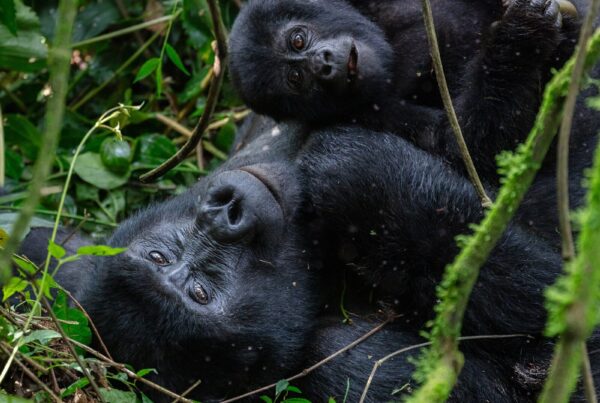
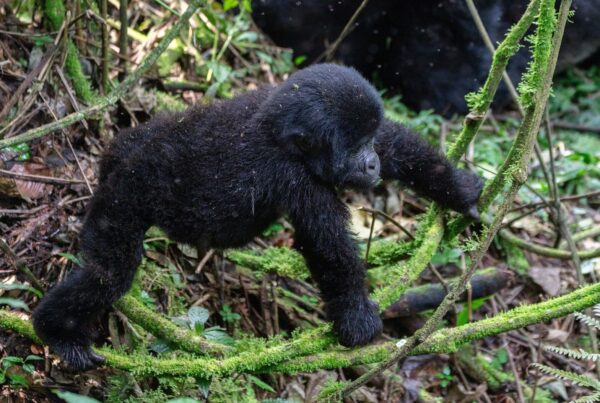
The gorilla encounter itself is functionally similar in both countries: ranger-guided trek in the Virunga Massif or Bwindi forest, one hour with a habituated gorilla family, close-range observation with strict protocols. The gorilla families are different (different habituated groups in each country) but the fundamental experience — the physical scale of the animals, their behavioural complexity, the proximity of encounter — is essentially equivalent.
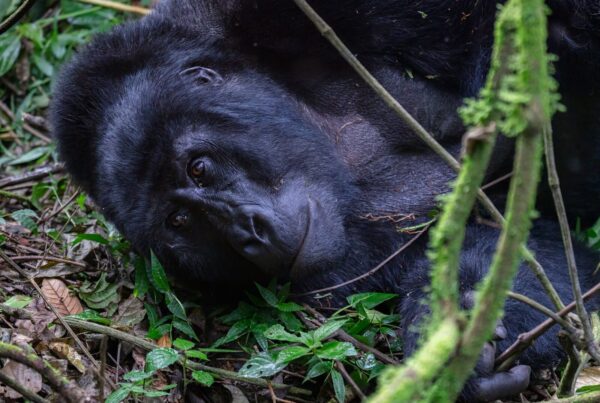
Some differences exist in encounter conditions. Rwanda’s Virunga forest has more open sections of Hagenia-Hypericum woodland and bamboo than Bwindi’s denser canopy forest, giving different light conditions that many photographers prefer for clarity. Bwindi’s forest is denser and darker, creating a more atmospheric and immersive encounter setting that some visitors find more dramatic. Neither condition is objectively superior — it is a matter of preference.
Safety and Travel Environment
Both Uganda and Rwanda are among the safer countries in East Africa for international tourists. Rwanda is widely considered one of Africa’s most politically stable and visitor-friendly countries — a model of post-conflict transformation whose capital Kigali is one of the cleanest and safest cities on the continent. Uganda has a more complex political context but is generally safe for tourists in the western Uganda gorilla trekking areas, with established infrastructure and a long track record of safe tourism operations at Bwindi and Mgahinga.
The Combined Option
Many experienced gorilla trekkers argue that the Rwanda-Uganda comparison is a false choice: the two countries are so close, the border crossing so straightforward, and the experiences so complementary that combining both in a single itinerary is the obvious answer for visitors with 9 or more days available. The Cyanika crossing between Kisoro (Uganda) and Musanze (Rwanda) is one of East Africa’s most convenient tourist borders, with straightforward procedures and reasonable crossing times. A combined itinerary that treks gorillas in both countries gives the full perspective of the Virunga-Bwindi gorilla range and the contrasting landscape and service contexts of Africa’s two primary gorilla destinations.
The Verdict
If you have limited time and budget is not the primary concern: Rwanda. If you have 8 to 10 days and want to combine gorillas with a wider Uganda wildlife experience at lower total cost: Uganda. If you have 12 or more days and want the complete experience: combine both. The gorillas themselves are equally spectacular on either side of the border — the choice is really about what you want surrounding the encounter, and how you want to invest your budget and time in getting to it.