Two Safari Giants, Two Very Different Experiences
Uganda and Kenya are both world-class safari destinations, but they offer fundamentally different wildlife experiences. Kenya is the land of open savanna, big cats, and the Great Migration. Uganda is the land of primates, dense forests, and extraordinary biodiversity packed into a smaller area. Choosing between them depends on what kind of wildlife experience you want, how much time you have, and what your budget allows. This comparison breaks down the key differences to help you decide.
The Big Five
Kenya: Excellent
Kenya is one of the best countries in Africa for Big Five viewing. The Masai Mara delivers all five, lion, leopard, elephant, buffalo, and rhino, in a single park with high visibility on open plains. Amboseli offers elephants against the backdrop of Kilimanjaro. Lake Nakuru has white and black rhinos. Tsavo has some of the largest elephant herds in Kenya. The probability of seeing all Big Five on a five-day Kenya safari is very high.
Uganda: Good but Not Primary
Uganda has all Big Five species, but they are harder to spot and spread across multiple parks. Lions and leopards are present in Queen Elizabeth National Park, with the famous tree-climbing lions of Ishasha being a unique highlight. Elephants are found in Queen Elizabeth and Murchison Falls. Buffalo are common in several parks. Rhinos are only found in Ziwa Rhino Sanctuary, a reintroduction project. Uganda is not primarily a Big Five destination; its strength lies elsewhere.
Primates
Uganda: World-Class
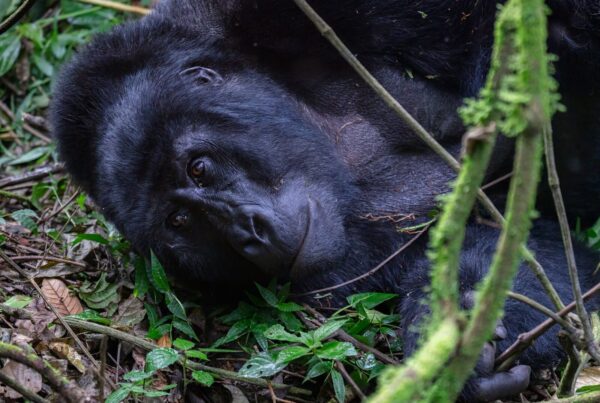
This is Uganda’s unbeatable advantage. Uganda is home to roughly half of the world’s remaining mountain gorillas in Bwindi Impenetrable Forest and Mgahinga Gorilla National Park. It also offers chimpanzee trekking in Kibale Forest, which has the highest density of chimpanzees in Africa, and twelve other primate species including red colobus, L’Hoest’s monkeys, and grey-cheeked mangabeys. No other country offers this depth of primate diversity.
Kenya: Limited
Kenya has baboons, vervet monkeys, and colobus monkeys, but no great apes. There is no gorilla trekking in Kenya, and chimpanzee populations are confined to a few small sanctuaries. If primates are your priority, Uganda wins by a massive margin.
The Great Migration
Kenya: July to October in the Masai Mara
The Great Migration is one of the most spectacular wildlife events on Earth. Between July and October, over two million wildebeest, zebra, and gazelle cross from Tanzania’s Serengeti into Kenya’s Masai Mara, navigating crocodile-infested river crossings and lion ambushes along the way. It is dramatic, visceral, and available nowhere else on Earth during this period.
Uganda: No Migration
Uganda does not have a migration event comparable to the Mara-Serengeti. Its wildlife is resident year-round, which means good viewing in all seasons but no single dramatic spectacle.
Bird Watching
Uganda: Over 1,000 Species
Uganda has recorded over one thousand bird species in an area smaller than the UK, making it one of the most bird-dense countries on the planet. The Albertine Rift endemics in Bwindi, the shoebill stork in Mabamba Swamp, and the diverse waterbirds of Queen Elizabeth make Uganda a birder’s paradise. Serious birders can record three hundred to four hundred species on a two-week trip.
Kenya: Over 1,100 Species
Kenya also boasts over one thousand one hundred bird species across its diverse habitats, from highland forests to coastal mangroves. Lake Nakuru’s flamingos, the raptors of the Masai Mara, and the endemic birds of the coast make Kenya excellent for birding.
Landscapes and Scenery
Kenya
Kenya’s landscapes are iconic: the golden plains of the Masai Mara, the snow-capped summit of Mount Kenya, the turquoise waters of the Indian Ocean coast, the Great Rift Valley lakes, and the desert landscapes of the north. Kenya offers extreme variety from coast to mountain to savanna.
Uganda
Uganda is greener and more lush, earning its nickname “The Pearl of Africa.” The mist-covered mountains of Bwindi, the thundering Murchison Falls on the Nile, the crater lakes of Fort Portal, Lake Bunyonyi’s terraced islands, and the Rwenzori Mountains’ glacial peaks create a landscape of extraordinary beauty. Uganda feels more intimate and less touristy than Kenya.
Cost Comparison
Uganda
A four-day gorilla trekking safari costs approximately two thousand to four thousand dollars per person. The gorilla permit alone is seven hundred dollars. Accommodation ranges from forty dollars per night (budget) to five hundred dollars per night (luxury). Uganda generally offers better value for money than Kenya at the mid-range and budget levels.
Kenya
A five-day Masai Mara and Amboseli safari costs approximately one thousand five hundred to five thousand dollars per person. There is no equivalent of the gorilla permit cost, so the baseline is lower. However, Kenya’s luxury lodges and conservancies can be extremely expensive, with some camps charging over one thousand dollars per person per night.
Crowds and Tourism Infrastructure
Kenya
Kenya receives significantly more tourists than Uganda. The Masai Mara can feel crowded during migration season, with dozens of safari vehicles surrounding a lion kill. The tourism infrastructure is more developed, with better roads, more lodge options, and more domestic flight routes.
Uganda
Uganda receives far fewer tourists, creating a more exclusive and intimate experience. Gorilla trekking groups are limited to eight people, and many of Bwindi’s trails see only one group per day. The roads are rougher, the lodges are fewer, and the experience feels more adventurous and authentic.
Safety
Both countries are generally safe for tourists in 2026. Kenya has occasional security concerns in the northeast (near the Somali border) and in parts of Nairobi, but tourist areas are well-policed. Uganda’s tourist areas are equally safe, with the main risk being road safety rather than crime or political instability.
The Verdict
Choose Uganda If:
- Gorilla trekking is your priority
- You want primate diversity (gorillas, chimps, and twelve other species)
- You prefer fewer crowds and a more intimate experience
- You want exceptional birding
- You are looking for better value at mid-range and budget levels
Choose Kenya If:
- The Great Migration is on your bucket list
- Big Five viewing is your top priority
- You want classic open-savanna safari photography
- You prefer well-developed tourism infrastructure
- You want to combine safari with a beach holiday on the coast
Choose Both If:
The perfect two-week East Africa trip combines Uganda’s gorillas with Kenya’s Mara. Fly from Entebbe to Nairobi in ninety minutes, and you have the best of both countries. The East Africa Tourist Visa covers both countries for one hundred dollars. This is the ultimate African safari combination.
Final Thoughts
Uganda and Kenya are not competitors; they are complements. Each offers something the other cannot. Kenya gives you the classic African safari with open plains, big cats, and the migration. Uganda gives you the world’s best primate experience in one of the most beautiful and biodiverse small countries on Earth. The right choice depends entirely on your priorities, but the wrong choice does not exist.