I almost did not go. The permit was booked, the flights were booked, the lodge was confirmed, and three weeks before departure I was looking for reasons to cancel. The work was busy. A project had expanded. There were meetings I could attend if I stayed. I have thought many times about what would have happened if I had cancelled — what I would have missed, what would not have changed, what version of myself would have met my friends at that barbecue and said I postponed Uganda because of a project meeting. I did not cancel. Here is what I did instead.
Why We Almost Cancel the Things That Matter
There is a specific psychology to the almost-cancelled trip. You have built the version of yourself who is too busy and too responsible to take time away for something that looks, when you are in the middle of a busy week, like indulgence. The gorilla permit is $800. I had booked it eight months earlier when the busy week was hypothetical and the trip was an exciting future event. By the week before departure the busy week was real and the trip was an interruption. This is the moment when many significant experiences do not happen, because the present urgency defeats the past intention.
I went because my partner said: if you cancel this you will regret it and you will not get the money back. This is not a glamorous reason to go gorilla trekking in Uganda. It is the actual reason I went gorilla trekking in Uganda and I am grateful for it every time I think about what almost happened instead.
The First Day
I arrived at the lodge near Buhoma in the afternoon, having taken a charter flight from Entebbe that morning. I was still checking my email on my phone when the driver stopped the vehicle at the top of a hill to let me look at Bwindi — the forest, the valley, the scale of it. I put my phone in my pocket. I have a clear memory of this specific action. I put my phone in my pocket and I did not take it out again for three days except to take photographs, because the thing in front of me was sufficiently real and present that the things in my phone were not competitive with it.
This was the first signal that cancelling would have been a mistake. I had not been unreachable by my phone for three days since before smartphones existed. The ease with which the forest made unreachability feel natural rather than anxious was, in retrospect, a significant data point about what I needed and had not been getting.
The Trek and the Family
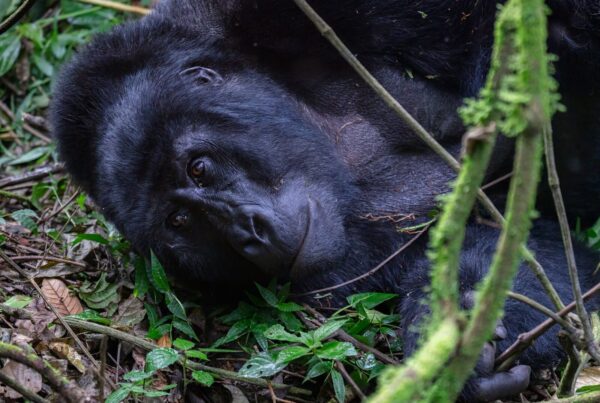
The Mubare group — the oldest habituated gorilla family in Uganda, habituated since 1991 — was feeding in a section of mid-altitude forest when we arrived. Sixteen gorillas. The silverback was the first thing I saw when the guide pointed — enormous, calm, eating methodically from a plant whose name I asked for and immediately forgot. His family was distributed around him in a pattern that suggested both independence and coherence — each animal doing its own thing, but the whole group clearly organised around the silverback’s presence at its centre.
I watched them for an hour. I did not check my phone. I did not think about the project meeting. I thought about the gorillas — who they were, what they were doing, the specific individual personalities that the guide described as he pointed to each animal. I was present in the hour in a way I had not been present in a defined period of time for longer than I could easily calculate.
What I Will Never Stop Talking About
I will never stop talking about the almost-cancellation. Not as a cautionary tale but as evidence for the specific proposition that the things most worth doing are often the things that are most threatening to cancel when the moment arrives. The permit is booked. The flights are non-refundable. Your phone is in your pocket. The forest is waiting. The silverback is in the clearing. Go.
The gorilla permit is $800. The project meeting was rescheduled. I do not remember what it was about. I remember the clearing.
Frequently Asked Questions
Uganda is home to the mountain gorilla (Gorilla beringei beringei), one of two subspecies of eastern gorilla. They live exclusively in the Virunga volcanic highlands (Uganda/Rwanda/DRC) and Bwindi Impenetrable Forest (Uganda only). Mountain gorillas are the only gorilla subspecies that cannot survive in captivity — every individual you can trek is a wild animal.
The standard gorilla trekking permit gives you exactly 1 hour with the gorilla family. This time begins when you make first contact with the family — the ranger signals the start. The Gorilla Habituation Experience gives 4 hours with a semi-wild family. The walk to find the gorillas can take 30 minutes to 5 hours depending on where the family has moved.
Stay calm, crouch down slowly, avoid direct eye contact, and remain quiet. Do not run — running triggers a chase response. Rangers accompanying your group manage close approaches. Habituated gorillas are accustomed to humans and almost never make contact, but a charging silverback is managed by staying still and following ranger instructions immediately.
A maximum of 8 visitors per habituated gorilla family per day for standard trekking. The Gorilla Habituation Experience has a maximum of 4 visitors per family per day. These limits are set by UWA to minimise stress on the gorilla families and maintain the quality of the experience.
Uganda is home to the mountain gorilla (Gorilla beringei beringei), one of two subspecies of eastern gorilla. They live exclusively in the Virunga volcanic highlands (Uganda/Rwanda/DRC) and Bwindi Impenetrable Forest (Uganda only). Mountain gorillas are the only gorilla subspecies that cannot survive in captivity — every individual you can trek is a wild animal.