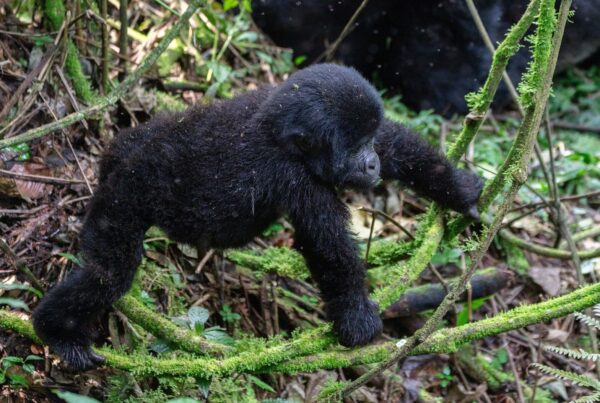
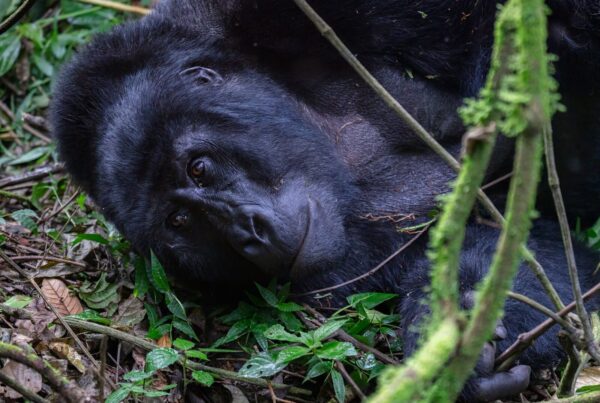
Leopards are the primary natural predator of mountain gorillas in Bwindi Impenetrable National Park, and while adult gorillas — particularly silverbacks — are largely invulnerable to leopard predation, infants represent a genuine vulnerability that the forest’s predator-prey dynamics make real. The documented cases of leopard attacks on gorilla infants are rare, but they illustrate something important about mountain gorilla conservation: even when a population is protected from human threats, the natural dynamics of a functioning ecosystem continue, and infant survival is never guaranteed. Gorilla Doctors respond to injury cases including predator attacks. See the gorilla families overview and the Bwindi ecosystem guide.
- Primary predator: leopard (Panthera pardus) — the only predator capable of taking gorilla infants
- Adults vs leopards: adult gorillas, especially silverbacks, are generally too large and powerful for leopard predation
- Infant vulnerability: gorilla infants are separated from their mothers briefly during active play — the window for predation
- Silverback defence: silverbacks respond aggressively to leopard presence — their size and aggression deter most attacks
- Gorilla Doctors response: veterinary teams respond to predator attack injuries to assess and treat survivors
Leopards and mountain gorillas share the same forest in Bwindi Impenetrable National Park, and while adult gorillas — particularly silverbacks — are largely immune to leopard predation, infants represent a genuine vulnerability. The documented cases of leopard attacks on gorilla groups in Bwindi are rare but real, and each has generated significant research interest. The case of the Rushegura infant in 2017 — a young female who survived a leopard attack that would have killed most animals her size — is one of the most closely studied examples of both gorilla group defence and mountain gorilla infant resilience.
The Vulnerability of Gorilla Infants
Mountain gorilla infants are born at approximately 1.8 kg and reach only around 8 kg by their first birthday. During this period they are entirely dependent on their mothers for protection as well as nutrition. A mother gorilla will hold her infant continuously for the first months of life and maintain close physical contact for years afterwards. Despite this protection, infants remain the most physically vulnerable members of a gorilla group, and leopards — Africa’s most adaptable large predator — are capable of making rapid, targeted attacks that can succeed before adult gorillas can respond.
The Rushegura family is one of Bwindi’s most studied habituated groups. Based at Buhoma sector, they have been receiving trekking visitors since the mid-1990s and are monitored continuously by UWA rangers and researchers. The incident in October 2017 occurred during a period when the group was resting in dense forest approximately two hours from the trekking base.
The Attack and Immediate Aftermath
The attack was not witnessed directly — it occurred in dense undergrowth and was detected by the ranger monitoring team through the alarm vocalisations of the adult females. By the time the rangers reached visual contact with the group, the leopard had withdrawn and the infant — a four-month-old female born to one of the Rushegura group’s younger adult females — had sustained lacerations to her back and right shoulder.
The silverback’s response was documented by the rangers: he had moved rapidly toward the disturbance and his presence had apparently caused the leopard’s retreat. Adult male gorillas will charge and physically confront leopards when infants or females are under threat, and the silverback’s movement toward the attack site was consistent with this documented protective behaviour.
The Gorilla Doctors Intervention
The Gorilla Doctors team was contacted within hours of the incident. Their assessment of the infant found that while the lacerations were significant — one wound on the shoulder reached the muscle layer — no vital structures had been damaged and the infant was nursing and maintaining normal temperature. The team made the decision to monitor rather than intervene immediately, observing that the mother was keeping the infant calm and that the wounds were not actively bleeding.
Over the following ten days the team conducted daily monitoring of the infant. The mother’s care was exceptional — she restricted the infant’s movement, allowing the wounds to close, and the wounds showed no signs of infection. On day twelve the Gorilla Doctors team assessed the infant as not requiring direct medical intervention. The wounds healed over the following weeks, leaving scars that researchers used to identify the individual in subsequent monitoring.
The Infant Today
The female gorilla who survived the 2017 attack is now a juvenile member of the Rushegura group. Trekkers who visit the group in 2027 may observe her — identifiable to experienced guides by the scarring on her right shoulder — as an active, healthy member of a family that continues to be one of Bwindi’s most visited. Her survival is a product of her mother’s care, the Gorilla Doctors’ expertise, and the monitoring infrastructure that gorilla trekking revenue funds. The gorilla permit costs $800. Some of what that pays for is the system that kept her alive.
Do leopards prey on mountain gorillas in Bwindi?
Leopards in Bwindi will prey on gorilla infants if the opportunity arises — an infant that has moved away from its mother and the group, or that is alone during a moment of confusion. Adult gorillas, and particularly silverbacks, are generally too large and dangerous for leopard predation to be viable. A healthy silverback weighing 180kg is more than capable of killing a leopard in defence. The predation risk is therefore concentrated in infants, and the silverback’s role in group protection includes remaining alert to leopard presence and positioning himself as a deterrent.
How do gorilla groups protect infants from leopards?
Group cohesion is the primary defence — infants that remain close to their mothers and within the group’s movement are protected by the collective presence of multiple adults. Silverbacks respond to alarm vocalisations with aggressive displays and movement toward the threat. Females also show defensive behaviour when their infants are threatened. The group’s tendency to nest together and move together during the day reduces the window of vulnerability for infants. Observations from Karisoke and Bwindi suggest that gorilla groups in leopard-populated forest are more vigilant in their movements than groups studied in areas with lower leopard density.
How does Gorilla Doctors treat a gorilla injured in a leopard attack?
When a gorilla sustains injuries from a leopard attack, Gorilla Doctors assess the severity and decide whether intervention is warranted. The intervention threshold requires that the injury is life-threatening and that medical intervention offers a realistic chance of recovery. For lacerations and bite wounds — the typical injuries from a leopard attack — immobilisation, wound cleaning, antibiotic treatment, and suturing may be appropriate. The risks of immobilisation on a wild great ape must be weighed against the injury severity in each case. Not every injured gorilla receives treatment; the decision is made case by case based on clinical assessment in the forest.
Are there other predators that threaten mountain gorillas?
In Uganda’s Bwindi, the leopard is the only wild predator with a realistic capability of preying on gorillas. There are no lions or wild dogs in Bwindi’s forest ecosystem. Hyenas are not present in significant numbers in the park. Pythons represent a theoretical threat to very young infants but documented predation events are not on record. The historical human threat — poaching — was and remains more significant than natural predation in determining mountain gorilla population dynamics, which is why anti-poaching is the primary conservation focus rather than predator management.
Can trekking visitors see leopards in Bwindi during a gorilla trek?
Bwindi does have a healthy leopard population, but leopards are nocturnal and highly elusive — sightings during gorilla treks are rare and not expected. A leopard track, scratch marks on a tree, or the alarm calls of red-tailed monkeys are more common indicators of leopard presence than a visual sighting. If you want to maximise your chance of seeing Bwindi’s full predator ecosystem, night walks in some sectors offer slightly better leopard detection than daytime treks. Leopard sightings during gorilla treks happen, but they are chance encounters rather than a planned component of the experience.
- Bwindi Impenetrable Forest – Gorilla Trekking in Uganda’s UNESCO Jungle
- Top Gorilla Trekking Destinations in Uganda – Bwindi vs. Mgahinga 2025
- Chimpanzees Confirmed in Bwindi Forest
- Bwindi Forest: What Happened to the White-Bellied Duiker?
- Why Americans Choose Bwindi, Mgahinga, and Volcanoes Over the Museum
- Bwindi Forest Gorilla Trekking: An Unforgettable Journey
- Experience 3 Days of Gorilla Tracking in Bwindi
- Uganda Is Safe for Gorilla Trekking Again: Why Now Is the Best Time to Visit Bwindi
- Floresta Impenetrável de Bwindi: O Santuário dos Gorilas da Montanha em Uganda
- Uganda Gorilla Trekking Bwindi Impenetrable Forest: The Complete Guide