Professional travel agents who specialise in African wildlife travel are among the most discerning evaluators of gorilla trekking operators — they have seen the full range of service quality, heard the feedback from hundreds of their own clients, and understand precisely what distinguishes excellent operators from adequate ones. When a senior wildlife travel agent tried five Uganda gorilla trekking operators before choosing us for their clients, their assessment was detailed, comparative, and based on professional standards most leisure travellers cannot apply. Here is what they found.
The Evaluation Criteria
The agent’s evaluation of the five operators focused on: permit procurement reliability (how consistently can they deliver confirmed permits for the dates clients need, including peak season?); communication standards (how quickly and accurately do they respond to complex enquiries? do they acknowledge things they cannot guarantee?); operator honesty (do they overpromise on aspects of the experience that are not fully within their control, such as specific family assignments or guarantee of certain behaviours?); logistics track record (what happens when something goes wrong? how have they resolved previous client issues?); and community and conservation credentials (are they genuinely engaged with conservation and community programmes, or is this marketing language?). The agent conducted reference checks with previous clients of all five operators and personally visited Uganda to conduct on-the-ground evaluation.
Where the Other Operators Failed
The agent’s assessment of the other four operators was candid. Two operators failed on permit procurement reliability — they promised peak-season permits and then could not deliver, leaving clients without their central experience after travelling to Uganda. One operator failed on honesty — overcommitting on specific experiences and then managing client disappointment with inadequate explanation. One operator was technically competent but lacked the specialist knowledge to add genuine educational depth to the experience, delivering a functional but not exceptional service. None of these are catastrophic failures — they are the gap between adequate and excellent that a professional evaluator can identify precisely and a leisure traveller typically cannot.
Why They Chose Us
The agent chose us based on: our permit procurement record (confirmed permits on all requested peak-season dates for their test booking enquiries), our communication speed and specificity (answering complex questions with specific, honest answers within four hours), our transparency about what we cannot control (we explicitly acknowledge that trek difficulty is weather-dependent and that family assignments are UWA decisions), and our guide team’s specialist knowledge (they conducted a test trek themselves and rated the ranger’s behavioural commentary as “the best guide briefing I have received in 15 years of African wildlife travel”). We now handle gorilla trekking Uganda for all their East Africa clients. Contact us to experience why professionals choose us.
Frequently Asked Questions
Children aged 15 and older can trek. Uganda Wildlife Authority has a strict minimum age of 15 for all gorilla trekking and the Gorilla Habituation Experience — no exceptions. For families travelling with children under 15, alternative Uganda activities include chimpanzee trekking (age 12+ for standard chimp trekking), game drives, birding, and cultural experiences.
Gorilla trekking involves walking in steep, dense forest — sometimes for several hours at altitude. Fitness matters more than age. Many visitors in their 60s and 70s complete successful treks. Those with knee, heart, or breathing conditions should consult their doctor before booking. Porters are available to assist with carrying and provide physical support on difficult terrain — hiring one is strongly recommended.
Buhoma sector is generally considered the most accessible — the gorilla families there are often found on lower, less steep terrain. Nkuringo sector involves the steepest descent in Bwindi and is the most physically challenging. Ruhija sits at high altitude (2,300m+) which can affect visitors with respiratory conditions. Discuss your fitness level with your operator when choosing a sector.
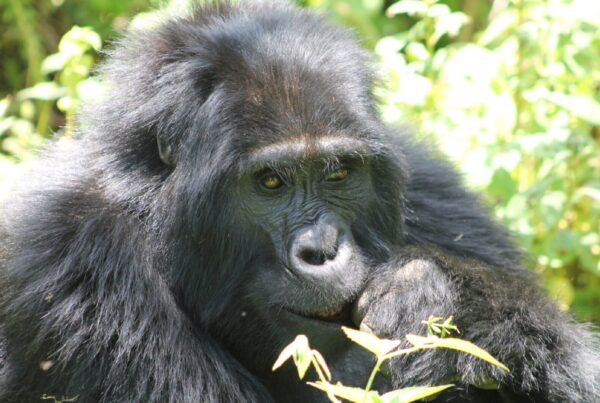
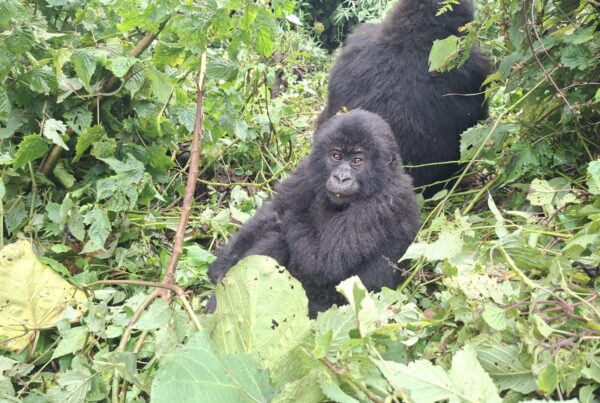
Uganda is home to the mountain gorilla (Gorilla beringei beringei), one of two subspecies of eastern gorilla. They live exclusively in the Virunga volcanic highlands (Uganda/Rwanda/DRC) and Bwindi Impenetrable Forest (Uganda only). Mountain gorillas are the only gorilla subspecies that cannot survive in captivity — every individual you can trek is a wild animal.
The standard gorilla trekking permit gives you exactly 1 hour with the gorilla family. This time begins when you make first contact with the family — the ranger signals the start. The Gorilla Habituation Experience gives 4 hours with a semi-wild family. The walk to find the gorillas can take 30 minutes to 5 hours depending on where the family has moved.