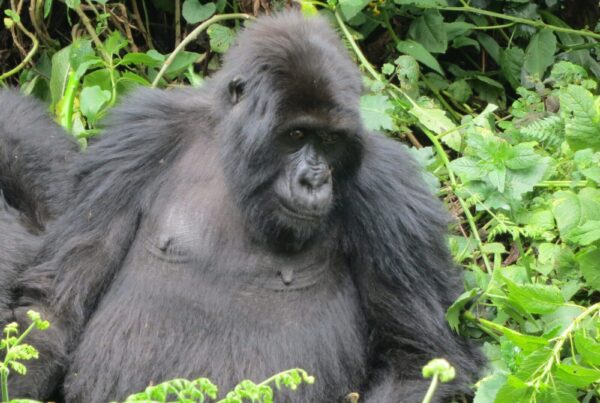
The rules for gorilla trekking at Bwindi are not bureaucratic overhead that experienced travellers can selectively interpret — they are the specific behavioural protocol that makes the encounter possible, that protects the gorilla family from disease transmission and behavioural disturbance, and that maintains the habituation status that gives the families the confidence to tolerate close human presence in the way the encounter depends on. A visitor who uses flash photography despite the prohibition at the briefing, who approaches within 7 metres despite the ranger’s instruction, or who continues to move when the ranger signals stop is not merely breaking a rule — they are disrupting the conservation system that produced the encounter and potentially contributing to a health or safety outcome for the family. This guide covers every encounter rule with the specific reasons behind it, the practical application, and the consequences of violation — because understanding why the rules exist produces better visitor behaviour than rule-following without comprehension. For the permit booking, see the permit guide.
Gorilla Trekking Rules: Quick Reference
- Minimum distance: 7 metres from any gorilla at all times — the primary disease transmission protection
- No flash photography: Prohibited throughout the encounter — flash produces unpredictable startle responses
- Group size maximum: 8 visitors per habituated family per day — the limit that allows natural family behaviour
- Encounter time limit: 60 minutes maximum with the family — enforced by the ranger guide
- No eating or drinking: Food odours attract gorilla approach and can produce food-motivated contact
- Minimum age 15 years — enforced by passport check at the sector gate briefing
Gorilla trekking is not a zoo visit, a theme park ride, or a casual nature walk. It is a privileged encounter with one of the world’s most endangered species in their natural habitat, governed by rules that exist not to constrain your experience but to protect the gorillas, ensure your safety, and preserve the integrity of a conservation system that has taken decades to build. Every rule you follow, every instruction you obey, and every boundary you respect contributes to the survival of mountain gorillas and the sustainability of the tourism that funds their protection.
This guide examines every rule of gorilla trekking etiquette in detail, explaining not merely what the rules are but why they exist and what happens when they are broken. It covers the official regulations enforced by UWA rangers, the unwritten social norms that govern behaviour within trekking groups, and the deeper ethical principles that should guide every visitor’s conduct in the forest. Understanding these rules transforms compliance from obligation into commitment.
The Seven-Metre Rule: Distance Protects Both Species
The minimum seven-metre distance between trekkers and gorillas is the single most important rule of gorilla trekking. It is not a suggestion, a guideline, or a rough estimate. It is a scientifically determined distance that significantly reduces disease transmission risk while allowing clear observation and photography. Rangers enforce this rule strictly, and deliberate violation can result in immediate termination of the encounter.
The seven-metre rule protects gorillas from human diseases to which they have no immunity. Mountain gorillas share ninety-eight percent of their DNA with humans, making them extraordinarily susceptible to respiratory viruses, gastrointestinal infections, and other pathogens that cause only mild symptoms in people but can be fatal in gorillas. At distances closer than seven metres, the concentration of airborne pathogens increases substantially, raising the risk of transmission.
The rule also protects gorillas from psychological stress. While habituated gorillas tolerate human presence, they are still wild animals with personal space requirements. Constant close proximity elevates cortisol levels, which over time can affect immune function, reproduction, and social behaviour. The seven metres provides a buffer that allows gorillas to relax in the presence of observers.
When gorillas approach closer than seven metres, which happens regularly with curious juveniles, the rule inverts. You must retreat to maintain the distance. Do not allow a gorilla’s approach to become an excuse for closer contact. Guides will direct your movement, and your compliance is essential.
No Eating, Drinking, or Smoking Near Gorillas
Food and beverages are strictly prohibited during the gorilla encounter. This rule prevents crumbs, spills, and packaging from attracting gorillas toward human groups, eliminates the risk of food-borne pathogen transmission, and ensures that trekkers remain focused on the encounter rather than on consumption.
Smoking is also prohibited throughout the trek, not merely near gorillas. Cigarette smoke irritates gorilla respiratory systems and poses fire risks in the dry season. The prohibition extends to vaping and any form of inhalable substance. If you are a smoker, plan your nicotine intake around the trek schedule rather than expecting to smoke during the experience.
Your guide will instruct you to leave all food and beverages with your porter before approaching the gorillas. This includes water bottles, energy bars, and chewing gum. The hour without sustenance is brief, and the prohibition ensures that nothing distracts from the encounter or endangers the animals.
Photography Rules: No Flash, No Closer Approach
Flash photography is absolutely prohibited during gorilla encounters. Flash startles gorillas, can trigger defensive behaviour, and causes temporary disorientation that may stress the animals. Ensure your camera flash is disabled before the trek begins, and verify the setting again before approaching the gorillas.
Photography must not be used as justification for rule-breaking. Do not move closer than seven metres for better composition. Do not push past other trekkers for position. Do not extend the encounter by ignoring the guide’s signal that time has expired. The photographs you take are souvenirs of the experience, not the purpose of the encounter.
Selfie sticks are prohibited. Their extended length creates a physical intrusion into gorilla space, and their use often encourages closer positioning than the rules allow. Use your camera or smartphone at normal arm’s length, and accept that some compositions may be tighter than you prefer within the permitted distance.
Health Screening and Self-Exclusion
The mandatory health declaration at the pre-trek briefing is not bureaucratic procedure. It is a critical disease prevention measure that every trekker must take seriously. Answer honestly about any symptoms of illness, particularly respiratory symptoms, diarrhoea, or other contagious conditions.
If you are ill, you will be excluded from the trek without refund. This is not punitive; it is protective. A single sick trekker could introduce a disease that devastates an entire gorilla family. The financial loss of your permit is trivial compared to the potential loss of gorilla lives.
Self-exclusion before the briefing, if you wake with symptoms on trek day, is the responsible choice. Contact your operator immediately, inform them of your illness, and accept that your permit fee is the price of protecting the gorillas. Travel insurance may cover the loss if your policy includes cancellation for illness.
Group Behaviour and Social Etiquette
Your behaviour toward your fellow trekkers matters. The group dynamic significantly affects everyone’s experience, and courteous conduct creates the atmosphere of mutual respect that enhances the encounter for all participants.
Arrive at the briefing point on time. Late arrivals delay the entire group and reduce the time available for the trek. Follow the guide’s pacing without complaint; the pace is set to accommodate the least fit member, and impatience creates tension. Offer assistance to struggling group members, whether by sharing water, offering encouragement, or simply walking alongside them silently.
During the encounter, avoid loud conversation, sudden movements, or gestures that might disturb the gorillas. Whisper if you must speak, and keep observations brief. The forest is quiet, and human noise stands out jarringly against the natural soundscape.
When the guide signals that the hour has ended, comply immediately without argument or negotiation. The time limit is based on research showing that longer visits increase gorilla stress. Your desire for five more minutes is not more important than the gorillas’ wellbeing.
Respecting Guides, Rangers, Trackers, and Porters
The staff who facilitate your trek deserve respect, recognition, and fair treatment. Guides have undergone extensive training and make difficult decisions to ensure safety and compliance. Rangers risk their lives on anti-poaching patrols to protect the gorillas you have come to see. Trackers rise before dawn to locate your assigned family. Porters carry your burdens and assist you through difficult terrain.
Tipping is customary and should be budgeted for. Guides, rangers, trackers, and porters all appreciate recognition of their efforts. Carry small denomination cash and distribute tips discreetly at the end of the trek. The amount is less important than the gesture of appreciation.
Treat staff with the dignity they deserve. Do not bark orders, make unreasonable demands, or express frustration when rules are enforced. They are not obstacles to your experience; they are the professionals who make it possible.
Environmental Responsibility
The leave-no-trace principle applies absolutely in Bwindi. Do not litter, drop food scraps, or leave any trace of your passage. Carry out everything you carry in, including biodegradable items that do not belong in the forest ecosystem.
Do not pick plants, collect souvenirs, or disturb vegetation unnecessarily. The forest is a protected ecosystem, and every plant plays a role in its functioning. Your path through the forest should be invisible after you pass.
Human waste management requires particular attention. There are no toilet facilities during the trek, and if you must address personal needs, do so well away from trails, water sources, and gorilla habitat. Carry toilet paper and a sealable bag for used paper, which you must carry out with you.
Final Thoughts
Gorilla trekking etiquette is not a collection of arbitrary restrictions designed to inconvenience visitors. It is a carefully constructed framework that balances human access with animal welfare, individual desire with collective responsibility, and immediate experience with long-term conservation. Every rule exists because breaking it has consequences, not merely for you but for the gorillas, the ecosystem, and the future of the tourism system that protects both.
When you follow these rules, you are not being a passive tourist. You are being an active conservationist, contributing through your compliance to the survival of a species that has no voice in the decisions that affect its fate. The gorillas cannot ask you to maintain your distance, to stay quiet, to leave them in peace. They depend on your willingness to do so without being asked. That willingness, demonstrated through every rule you follow, is the true measure of your respect for these extraordinary creatures.
Frequently asked questions about gorilla trekking rules and etiquette
Why is there a 7-metre minimum distance rule for gorilla trekking?
The 7-metre minimum distance between visitors and gorillas is the primary mechanism for reducing respiratory disease transmission from humans to gorillas — the most significant ongoing health threat to habituated mountain gorilla families. Mountain gorillas share over 98% of human DNA and are susceptible to every human respiratory pathogen, from the common cold to influenza to more serious respiratory viruses. Respiratory droplets expelled by a coughing or sneezing human at 3-4 metres reach the breathing zone of an adjacent gorilla directly; at 7 metres, the droplet concentration and velocity reduce significantly. The 7-metre rule is not a margin of comfort — it is a specific infection-prevention distance calibrated to the respiratory transmission risk. The rule is enforced actively by the ranger guide throughout the encounter: when the gorilla family moves to within 7 metres of the visitor group (as sometimes happens, particularly with curious juveniles), the ranger guides the visitors to step back to maintain the distance; when a visitor steps forward to get a closer photograph, the ranger intervenes immediately. Understanding the reason for the rule produces more consistent compliance than instruction-following alone: a visitor who understands that approaching within 7 metres creates a genuine disease transmission risk behaves differently from a visitor who sees the rule as an arbitrary distance specification.
Why is flash photography prohibited in the gorilla encounter?
Flash photography is prohibited in the gorilla encounter because the sudden intense light of a camera flash produces an unpredictable startle response in gorillas — particularly silverbacks, whose threat assessment and display behaviour can be triggered by unexpected sensory inputs. The habituation process conditions gorillas to tolerate the presence, sound, and movement of humans but does not eliminate the instinctive threat response to sudden high-intensity stimuli. A flash discharge at 3-7 metres from a resting silverback can trigger a display response (rising, vocalising, chest beat, mock charge) that disrupts the encounter, alarm the visitor group, and in extreme cases produces a genuine contact risk. Beyond the silverback threat response, flash photography directed at any gorilla at close range produces the same type of intense-light startle that you would expect from flashing a bright light in a person’s face at close range in a dark environment — it is an intrusive and distressing stimulus for the subject, regardless of whether the encounter is immediately disrupted. The practical check: before the trek, disable flash on your camera and verify the setting before the encounter begins; many cameras auto-enable flash in low-light conditions (the forest interior reads as low light even in daytime), so a camera set to auto-flash at home may fire flash at Bwindi without the visitor realising. Pre-set flash to off and confirm the setting at the gate briefing before entering the forest.
What should you do when a gorilla approaches you during the encounter?
When a gorilla (most commonly a curious juvenile, but occasionally an adult female or the silverback) approaches the visitor group during the encounter, the correct response is: stand still, lower your gaze to break direct eye contact, and let the ranger guide manage the situation. Do not step backward rapidly (sudden retreat movement can trigger a pursuit response); do not maintain direct eye contact at close range with the silverback (direct eye contact at close proximity is a challenge or threat signal in gorilla social communication — the ranger specifically instructs visitors to avert their gaze when the silverback is in direct front-facing proximity); and do not make any sound or sudden movement. The gorilla approaching the visitor group is generally a sign of curiosity rather than aggression, and the ranger’s management of the group’s position and behaviour is the mechanism that keeps the approach as a passing curiosity rather than an escalating interaction. The specific scenario of a silverback mock charge: stand completely still, lower gaze, and let the ranger manage — do not run (running triggers chase response); the ranger is positioned specifically to manage this scenario and their instructions at this moment are not optional. Visitors who have been properly briefed at the gate understand this response before the encounter; the mock charge is the most physiologically alarming moment of the encounter but also the most managed — the ranger has responded to this scenario many times with specific protocols.
Can you get too close to gorillas even if they approach you?
Yes — the 7-metre distance rule applies to the visitor regardless of which party initiated the proximity. If a gorilla approaches the visitor group to within 7 metres, the visitors step back to restore the minimum distance under the ranger’s direction; the rule is not suspended because the gorilla chose to approach rather than the visitor moving forward. The specific case that requires the most careful management: juvenile gorillas (who are genuinely curious about human visitors and sometimes approach to 3-5 metres on their own initiative) can put the visitor in the situation of being uncomfortably close to a young gorilla without having taken a step toward it. The correct management: when a juvenile approaches to within 7 metres, the ranger signals visitors to step back slowly and quietly to restore the distance. The temptation to remain still and let the juvenile make the close approach (which would produce an extraordinary photograph) must be resisted even though the visitor did not initiate the proximity. The disease transmission risk is not direction-dependent — a gorilla within 3 metres is breathing the same air as the visitor regardless of who moved. The 7-metre rule applies to the distance between visitor and gorilla, measured in both directions, at all times during the encounter.
What happens if you violate the gorilla trekking rules?
Rule violations during the gorilla encounter are managed by the ranger guide in real time, and the consequences depend on the severity and the gorilla family’s response. For minor violations (a visitor approaching slightly too close before being corrected): the ranger intervenes immediately with a direction to step back, the violation is corrected, and the encounter continues. For violations that produce a family response (flash photography that startles the silverback into a display, a visitor movement that triggers the family to move away from the group): the ranger may end the encounter early for the whole group, with no refund for the cut-short 60 minutes, and no recrimination at the gate beyond the implicit lesson. For serious violations that create a safety issue: the ranger has the authority to remove a specific visitor from the encounter area immediately — the group continues without them if the violation was individual. Uganda Wildlife Authority maintains the right to revoke the permit and remove visitors from the park for serious breaches of the encounter protocol. The practical reality: the vast majority of violations are minor and result in immediate ranger correction without encounter termination. The flash photography violation is the most common serious violation; the camera setting check at the gate briefing (confirm flash is disabled before entering the forest) is the single most effective prevention for the most common violation. Follow the ranger’s instructions immediately and without negotiation — the encounter is managed by the ranger, not by the visitor.
Be prepared for the gorilla encounter
- Gorilla Permit Guide — booking the permit that gives access to the encounter these rules govern
- Bwindi Sector Guide — sector briefing format and what the morning gate process involves
- Uganda Gorilla Families — the families and their individual behaviour profiles
- Full Safari Cost Guide — trip planning budget including camera gear preparation
- Safari Itineraries — Uganda itineraries with briefing and preparation included in the service
- Gorilla Trekking Rules: 10 Regulations Every Trekker Must Follow in Uganda
- How gorilla trekking is regulated: the rules that protect both visitors and gorillas
- 2025 Uganda Gorilla Trekking Permits – Cost, Booking, Rules & More
- Uganda Travel Tips for First-Time Visitors: What You Need to Know Before You Go
- Latest Health Rules at Entebbe International Airport
- 50 Wild Animals You Must See on an African Safari
- Gorilla Trekking Age Limit: Everything You Must Know Before Booking Your Safari
- Can You Take Photos of Gorillas? Photography Rules in Uganda
- What Is the Gorilla Trekking Age Limit? Uganda Rules Explained
- Cultural Etiquette in Uganda: How to Respect Local Customs