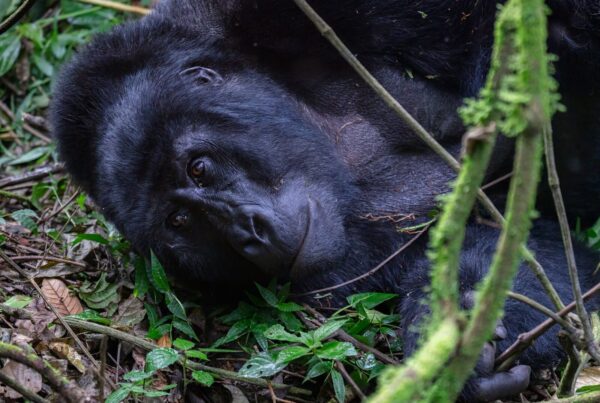
She travelled alone to Uganda at 68 and it changed everything — her sense of what was possible, her relationship with fear, and her understanding of why wild places still matter. This is the story of Margaret, a retired schoolteacher from Glasgow who had never been to Africa, booked a solo gorilla trekking permit on impulse after her grandchildren dared her, and came back a different person.
The Dare That Became a Trip
Margaret had been showing her grandchildren David Attenborough’s gorilla documentaries on a wet Sunday afternoon. Her grandson, twelve years old and possessed of the casual cruelty of children who do not yet understand limitations, said: “Gran, you should go see them.”
“I’m 68,” she said.
“So?”
That “so” lodged in her mind for three weeks before she did anything about it. Then she typed “gorilla trekking Uganda solo woman 68” into a search engine and spent an evening reading everything she could find.
What she found was largely encouraging. Uganda Gorilla Trekking had handled visitors of all ages and fitness levels. Porters were available to help with the physical demands. The guides were experienced and the parks were professionally managed. The permit cost $800, which her pension could manage if she skipped a few things.
She booked it without telling anyone except her daughter, who said “Mum, are you serious?” Margaret said she was. Her daughter said “I suppose I cannot stop you.” This was accurate.
The Preparation
Margaret spent two months preparing. She started walking every day — first around the block, then around the park, then longer routes that gradually built the stamina she would need for the trek. She bought proper hiking boots and broke them in with the methodical determination of a woman who completes tasks she starts.
The Health Questions
Her GP was cautiously supportive. Her blood pressure was fine, her joints were serviceable, and there were no conditions that made Uganda dangerous for her specifically. The vaccinations were standard. The malaria prophylaxis was prescribed without drama.
What She Packed
Margaret packed light and correctly: layers, waterproofs, good socks, a small daypack, and a camera she had borrowed from her son-in-law. She left behind the anxiety her family had tried to give her about travelling alone in Africa.
Arriving in Uganda
She flew via Nairobi, landed at Entebbe in the early morning, and was met by a driver holding a sign with her name on it. “He was so kind,” she told me later. “I had been nervous on the plane but when I saw that sign I thought, alright, this is going to be alright.”
Her lodge was in Buhoma, a small community at the edge of Bwindi Impenetrable National Park. The room was simple and clean, with a veranda overlooking the forest. On the first evening, she heard sounds she could not identify coming from the trees below and thought: something real lives there.
The Morning of the Trek
At the briefing, Margaret was the oldest person in her group. The others were a mix of ages and nationalities — a young couple from Amsterdam, a family from Australia, two American men on a bucket list trip. Nobody remarked on her age. The ranger who gave the briefing addressed all of them equally.
She Hired a Porter
Margaret had already decided to hire a porter and did not waver on this. Her porter, a young man named Emmanuel, adjusted his pace to hers without making her feel slowed. “He was completely professional,” she said. “He told me about the trees as we walked. By the time we found the gorillas, I felt like I had learned more about that forest than I had in all those documentaries.”
The Climb
The terrain was harder than she had expected. There were stretches where she needed Emmanuel’s hand to steady her on the slope, and one section where she simply sat down on a rock and breathed for five minutes before continuing. The guide waited without impatience. The Australian family’s father, a man in his fifties who had been walking ahead, came back and said: “How are you going?” She told him she was going fine.
Finding the Gorillas
The Rushegura family was located in a valley below the ridge where they had been climbing. The trackers led them down a slope through thick vegetation and then, without ceremony, the undergrowth opened slightly and there they were.
What She Saw First
A juvenile gorilla sitting two metres off the path, eating fruit, completely unbothered by the arrival of nine human beings. Margaret said she stood very still and thought: “That is a real thing. That is happening right now, in front of me, and I am 68 years old and I am here.”
The Silverback
Mwirima, the Rushegura silverback, was visible beyond the juvenile — huge, silver-backed, moving through the undergrowth with the unhurried authority of someone who has never had to rush. He looked at the group once and looked away. Margaret described the moment as “like being assessed and found acceptable.”
The Infant
The moment that broke Margaret was the infant. A baby gorilla, small enough to hold in two arms, was riding on its mother’s back as the female moved across the clearing. The infant turned its head, looked at the group of humans with dark curious eyes, and then buried its face in its mother’s back again.
“I thought of my grandchildren,” Margaret told me. “I don’t know why, exactly — they’re not gorillas. But that gesture. Hiding your face in your mother. Something so familiar.”
She cried quietly for several minutes. Emmanuel pretended not to notice, which she said was the kindest thing.
The Hour That Ended Too Soon
When the guide said “time,” Margaret was the last to turn away. She looked at the forest — at the family moving through it, at the light coming through the canopy, at the small visible patches of sky above — and took a photograph that she later admitted did not capture any of it.
“You can’t photograph it,” she said. “It’s not a visual thing. Or not only. It gets into you.”
What Changed
Back in Glasgow, Margaret’s daughter noticed the difference first. “She seems lighter,” she told her husband. “Like something stopped weighing on her.”
Margaret described it more precisely. For years, she said, she had been operating under an assumption she had never examined: that the interesting and challenging parts of her life were behind her. That 68 meant contraction — doing less, taking fewer risks, tending an increasingly small world.
“The gorillas disproved that,” she said. “Not philosophically. Practically. I went somewhere hard and beautiful and completely outside my experience and I was absolutely fine. Better than fine.”
The Dare Repaid
She showed her grandson photographs when she returned. He looked at them for a long time and said: “Gran, that’s amazing.” She agreed that it was. He asked if she would go back.
She is planning to. Next time, she wants to include chimpanzee trekking in Kibale Forest.
Solo Travel at 68 in Uganda: A Practical Note
For anyone who sees themselves in Margaret’s story, the practicalities are straightforward. Uganda is a safe destination for solo travellers, including older women. The gorilla trekking infrastructure is designed to accommodate varying fitness levels. Porters are affordable and make a real difference on the harder sections. The guides are professional and experienced.
The minimum requirement is a willingness to show up and a passport. Age is not a disqualifier. A twelve-year-old’s “so?” is, as it turns out, excellent advice.
Contact Uganda Gorilla Trekking to discuss your specific needs and start planning the trip that changes everything.