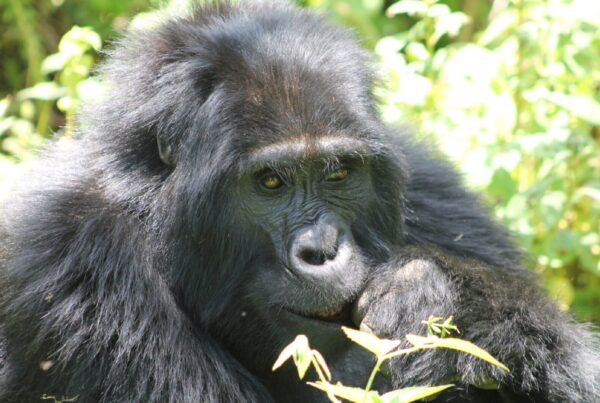
The gorilla that approached our group and sniffed the air was a female from the Habinyanja family, and the footage a trekker in our group captured on a phone camera has since been described by every person who has seen it as “better than any documentary.” It is not technically impressive footage — it is shaky, slightly overexposed, and the sound quality is compromised by wind. What makes it extraordinary is the content: a wild mountain gorilla, in her own forest, approaching to within one metre of a group of eight human tourists, lifting her head, sniffing the air for approximately four seconds with the focused attention of someone identifying a smell they cannot quite place, and then walking away. Four seconds of genuine wild behaviour, captured by a man who had forgotten that professionals exist.
The Context: Morning With the Habinyanja Family
Our group of eight had been assigned to the Habinyanja family, one of the largest habituated gorilla groups at Bwindi’s Buhoma sector. Our guide, Patrick, had been with this family for ten years and knew the individual animals well — their personalities, their habits, the specific dynamics of a family group that had been fully habituated since the mid-1990s.
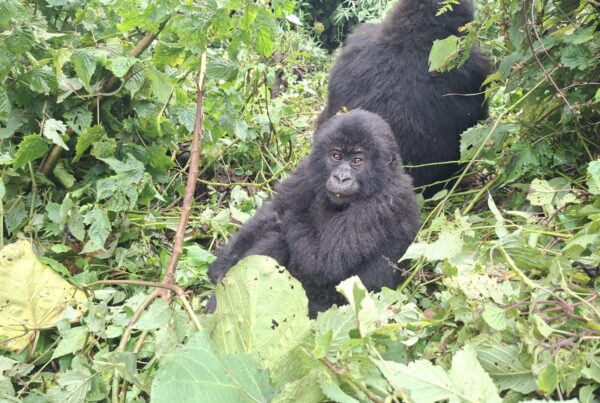
The Habinyanja family was active that morning. Multiple animals were visible from our position at the edge of the clearing — adult females feeding, juveniles playing in the undergrowth, the silverback, Rwigema, visible at the far end of the group, lying on his side and eating with the focused calm of someone who has nowhere to be and all morning to get there.
Patrick had positioned us well — a slight rise in the terrain that gave a clear sightline across the clearing while maintaining appropriate distance from the animals. He was explaining the family’s composition in a low voice when he stopped speaking mid-sentence and went very still.
The Approach
The female had been feeding at the far left edge of the clearing when she changed direction. Patrick saw it before I did — he later said he had noticed her looking toward our group for about thirty seconds before she moved, assessing in the way habituated gorillas sometimes assess visitor groups before deciding whether to engage further.
She moved in the unhurried knuckle-walking gait of an animal that is not alarmed and is not in a hurry — deliberate, smooth, covering the ground with the efficiency of something that has been moving through this terrain for its entire life. Patrick said quietly: “Nobody move. She is curious. Let her come.”
She came. She stopped approximately one metre from the edge of our group — the front of which was the trekker with the phone camera, who had been filming since he noticed her moving toward us.
The Sniffing
She lifted her head. Her nostrils were working with the visible, rhythmic intensity of an animal conducting a serious olfactory investigation. The phone camera caught this clearly: the upward tilt of her face, the mobile nostrils, the expression of concentrated attention.
What she was doing, Patrick explained afterward, was identifying us. Gorillas have an acute sense of smell and use olfactory information heavily in social interactions — they can distinguish individuals by smell, detect emotional states (fear produces different hormonal signals than calm), and identify whether a smell is familiar or novel. She had been smelling us from a distance for thirty seconds and was now, at one metre, completing her assessment.
The assessment took approximately four seconds. Then she lowered her head, looked at the trekker with the phone camera briefly, and walked away — back through the clearing, back to her feeding position, with the same unhurried gait she had used on the approach.
What the Footage Shows
The footage shows all of this in real time. It shows the approach — the trekker with the camera had the presence of mind to hold his phone steady rather than raise it to eye level, which is why the angle is slightly low and why she is visible from head to torso rather than a close-up. It shows her stopping. It shows the nose work. It shows the brief direct look at the camera. It shows her walking away.
It does not show what was happening in the person holding the camera — but the audio does. In the background of those four seconds, you can hear breathing: eight sets of lungs, very quiet, not quite holding their breath but close to it. The specific quality of a group of people who have agreed, without discussion, to be absolutely still.
Why Patrick Let It Happen
After the female had returned to her feeding position, I asked Patrick why he had not moved us back when she began approaching. He explained the distinction between an approach that represents gorilla curiosity and one that represents gorilla agitation: “When they come toward you calmly — walking at their normal pace, no display behaviour, no tension in the body — that is curiosity. She wanted to know what we smelled like. That is normal. We let her come.”
The guides’ ability to make this distinction in real time is the foundation of safe gorilla trekking. The protocol is not “maintain seven metres at all times regardless of what the gorilla is doing” — the protocol is “follow the guide’s instructions, which are based on reading the gorilla’s behaviour.” Patrick’s read was correct. The approach resolved exactly as he anticipated.
The Phone Camera Debate
The footage became, in our group, the subject of a brief but genuine debate about phone cameras at gorilla treks. The photographer — a retired teacher from New Zealand named Graham — said that his guide at a previous wildlife location had told him “never use your phone camera at close-range wildlife, you need a proper lens.” This advice, followed, would have meant the footage did not exist.
Patrick’s view was more nuanced: “Whatever you have, use what you have. If you have a phone, use your phone. If you have a camera, use your camera. The important thing is to not let the camera take you away from the experience. Graham kept his phone down for most of the hour. He raised it when something happened. That is correct.”
This seems right. The footage Graham captured on a phone camera is better than most of the professional wildlife footage I have seen of gorillas, not because of technical quality but because of what it contains. The technical quality is beside the point. The content is everything.
What the Footage Is Being Used For
Graham shared the footage with Uganda Gorilla Trekking after the trip, and with the Mountain Gorilla Conservation Fund. It has since been used in conservation outreach materials and was shown at a fundraising event for the MGVP in New Zealand. It has reached an audience that would not have seen it otherwise, and the response — consistent, across multiple screenings — is the same: people who did not know they cared about mountain gorillas discover that they do.
“That is what these animals do,” Patrick said, when I told him about the fundraiser. “They change people. They do it in person and they do it on screen. It does not matter how the meeting happens. Once you have met them, you are different.”
Planning Your Visit
The approach Graham captured is not unusual at Bwindi — habituated gorillas approach visitors with some regularity when curiosity motivates them. It cannot be planned or predicted, but it cannot happen if you are not there. Uganda gorilla trekking permits are $800 per person. Contact Uganda Gorilla Trekking to book your permit. Bring whatever camera you have. Bring the presence of mind to hold it steady when something comes to meet you.
Frequently Asked Questions
Uganda is home to the mountain gorilla (Gorilla beringei beringei), one of two subspecies of eastern gorilla. They live exclusively in the Virunga volcanic highlands (Uganda/Rwanda/DRC) and Bwindi Impenetrable Forest (Uganda only). Mountain gorillas are the only gorilla subspecies that cannot survive in captivity — every individual you can trek is a wild animal.
The standard gorilla trekking permit gives you exactly 1 hour with the gorilla family. This time begins when you make first contact with the family — the ranger signals the start. The Gorilla Habituation Experience gives 4 hours with a semi-wild family. The walk to find the gorillas can take 30 minutes to 5 hours depending on where the family has moved.
Stay calm, crouch down slowly, avoid direct eye contact, and remain quiet. Do not run — running triggers a chase response. Rangers accompanying your group manage close approaches. Habituated gorillas are accustomed to humans and almost never make contact, but a charging silverback is managed by staying still and following ranger instructions immediately.
A maximum of 8 visitors per habituated gorilla family per day for standard trekking. The Gorilla Habituation Experience has a maximum of 4 visitors per family per day. These limits are set by UWA to minimise stress on the gorilla families and maintain the quality of the experience.
Uganda is home to the mountain gorilla (Gorilla beringei beringei), one of two subspecies of eastern gorilla. They live exclusively in the Virunga volcanic highlands (Uganda/Rwanda/DRC) and Bwindi Impenetrable Forest (Uganda only). Mountain gorillas are the only gorilla subspecies that cannot survive in captivity — every individual you can trek is a wild animal.