Updated
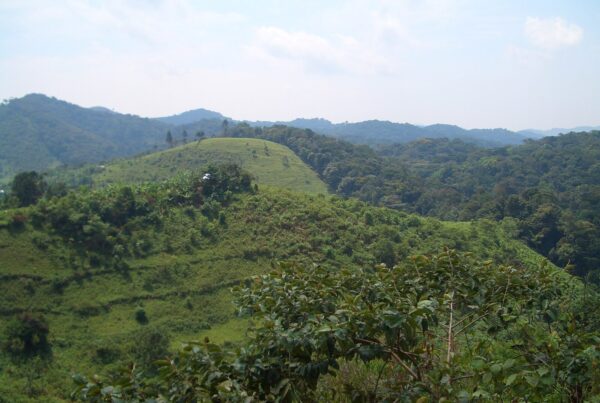
propose girlfriend gorillas Bwindi Uganda proposal story is a subject central to Uganda’s wildlife tourism, where mountain gorilla conservation and responsible visitor experiences go hand in hand. I proposed to my girlfriend in the forest with mountain gorillas watching, and she said yes. This is not the kind of story I would have predicted for myself two years ago. I am not a romantic gestures person. I am an engineer. I plan things with spreadsheets and risk assessments. What happened in Bwindi Impenetrable Forest on a Tuesday morning in September is the most uncharacteristic thing I have ever done, and it was absolutely the right decision.
I Proposed to My Girlfriend in the Forest With Gorillas: She Said Yes
How I Got Here
Emma and I had been together for four years when I started thinking seriously about proposing. The timing felt right. The relationship was everything I wanted. The question was the how — and for someone whose approach to significant events typically involves detailed planning and zero spontaneity, the how was not obvious.
I made a list. I do everything with lists. Restaurant proposals felt generic. Proposing at home felt underdramatic. A holiday proposal was attractive but the risk of something going wrong — weather, other people, bad timing — felt high.
Then Emma mentioned, for the seventh or eighth time in the four years I had known her, that she wanted to see mountain gorillas in Uganda. She had wanted this since watching a documentary at the age of seventeen. It was not a casual wish. It was something she came back to with the regularity of an item that has never been crossed off a list she has been keeping for a long time.
It occurred to me, somewhere around midnight on a Thursday when I could not sleep, that there was an obvious answer to the how question.
The Planning
I will not pretend the planning was not extensive. I contacted Uganda Gorilla Trekking and explained the situation. They were helpful and discreet and had, it turned out, handled proposals before. They advised on which family group and which time of year would offer the best conditions for what I was planning. They suggested a small ring box that could be carried in a secure inner pocket and transferred without awkwardness. They did not laugh at me, for which I remain grateful.
I booked the permits, the lodge, the full two-week itinerary. I bought a ring that I chose with unusual care for someone who typically buys everything online without visiting a shop. I told Emma we were going to Uganda for her birthday. She cried. This was a promising sign.
The Week Before the Trek
Not telling Emma what I was planning for the gorilla trek morning was, by some distance, the hardest seven days of our relationship. She asked several times whether I was okay, because I was quieter than usual. I said I was fine. I was not fine. I was managing a significant secret while simultaneously trying to appear relaxed about a gorilla trek that I was personally very excited about on its own terms.
I had communicated with our guide, Robert, in advance. He knew the plan. He had a suggested moment in mind — when the family group had settled and visibility was good and the silverback was far enough away that the situation was controlled. He said: “Leave the timing to me.” I trusted him.
The Morning of the Trek
Emma was up before the alarm, which she always is when she is excited about something. We ate breakfast with the other trekkers at the lodge, attended the briefing, and set off into the forest. The walk in took about ninety minutes. Emma asked questions the whole way — about the forest, the gorillas, the habits of the family we were visiting. Robert answered all of them with the patience of a man who has met many people who love gorillas and understands how to speak to them.
My internal state during the walk can be described as follows: terrified. Not of the gorillas. Of what I was about to do.
The Gorillas
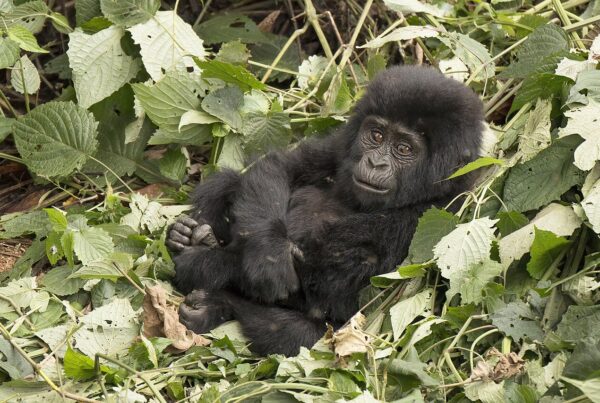
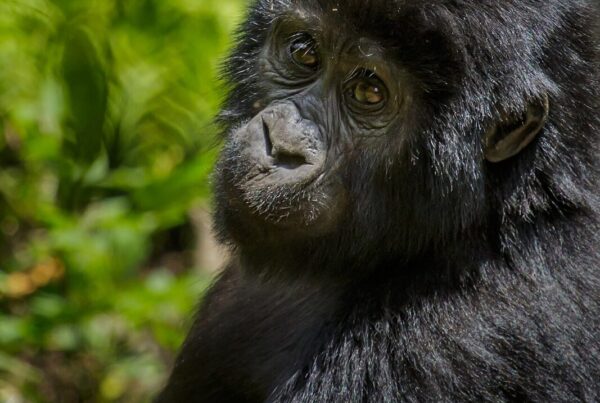
The family was feeding in a clearing when we arrived, and the first sight of them — three adult females, a juvenile, and the silverback visible at the far edge of the clearing — was every bit as extraordinary as I had anticipated. Emma made a sound that I have no word for. She gripped my arm. She looked at the gorillas and looked at me and looked at the gorillas again.
I thought: this is going to be the setting, and I feel completely fine about it.
We watched for about twenty minutes. The family was active and close. An infant was visible nursing. The silverback — Rwigema, Robert had named him — moved through the clearing once with the complete authority of his position and then settled to eat.
Robert looked at me. I looked at him. He gave a very small nod. The family was settled. The light was good. The timing was right.
The Proposal
I did not make a speech. I had prepared a speech and discarded it because in the context of a mountain gorilla family feeding in a Ugandan forest, a prepared speech felt absurd. What I said was direct and real and short, and I do not think I need to share the specific words here. They were for Emma.
She looked at me for a long moment — long enough that I began, briefly, to recalculate my risk assessment. Then she said yes. Actually she said “yes, obviously, yes,” which is the most Emma answer to any question I can imagine.
Robert had his hand over his mouth. Two of the other trekkers had noticed what was happening and one of them was already crying. The gorillas were completely indifferent to the proceedings, which felt correct.
The Rest of the Hour
We spent the remaining thirty minutes with the family in a state that I can only describe as heightened in every possible way. The gorillas were extraordinary. The forest was extraordinary. Emma’s hand in mine was extraordinary. The specific quality of being somewhere completely real, doing something completely real, surrounded by something completely wild — there is no ordinary experience I can compare it to.
The silverback rose and moved before our hour was quite done, taking his family deeper into the forest. We watched them go — the females in his wake, the juvenile tumbling along, the infant visible on its mother’s back until the vegetation closed around them. Then they were gone.
The Lodge Afterward
Robert had, without telling us, arranged with the lodge to have champagne waiting. This was above and beyond what I had asked for, and when we arrived back to find it laid out on the veranda with a view of the forest below, Emma looked at the whole scene and said: “You planned all of this, didn’t you.” I confirmed that I had. She looked at me with an expression that I choose to interpret as affectionate despite its component of disbelief at my capacity for secret-keeping.
For Anyone Considering Something Similar
I am aware this is not the sort of story that generalises as practical advice. But if you are in the category of person who is thinking about a proposal in an extraordinary setting, and Uganda gorilla trekking is on the list of possibilities — it is worth considering seriously. The guides are discreet and experienced. The setting is genuinely extraordinary. And the gorillas’ complete indifference to human romantic proceedings has a quality of perspective that is, in its own way, rather wonderful.
Contact Uganda Gorilla Trekking to arrange permits and discuss your plans. They have handled proposals before. They will handle yours with discretion and care.
Emma and I are getting married in April. We are planning Uganda for the honeymoon.
Frequently Asked Questions
Uganda is home to the mountain gorilla (Gorilla beringei beringei), one of two subspecies of eastern gorilla. They live exclusively in the Virunga volcanic highlands (Uganda/Rwanda/DRC) and Bwindi Impenetrable Forest (Uganda only). Mountain gorillas are the only gorilla subspecies that cannot survive in captivity — every individual you can trek is a wild animal.
The standard gorilla trekking permit gives you exactly 1 hour with the gorilla family. This time begins when you make first contact with the family — the ranger signals the start. The Gorilla Habituation Experience gives 4 hours with a semi-wild family. The walk to find the gorillas can take 30 minutes to 5 hours depending on where the family has moved.
Stay calm, crouch down slowly, avoid direct eye contact, and remain quiet. Do not run — running triggers a chase response. Rangers accompanying your group manage close approaches. Habituated gorillas are accustomed to humans and almost never make contact, but a charging silverback is managed by staying still and following ranger instructions immediately.
A maximum of 8 visitors per habituated gorilla family per day for standard trekking. The Gorilla Habituation Experience has a maximum of 4 visitors per family per day. These limits are set by UWA to minimise stress on the gorilla families and maintain the quality of the experience.
Uganda is home to the mountain gorilla (Gorilla beringei beringei), one of two subspecies of eastern gorilla. They live exclusively in the Virunga volcanic highlands (Uganda/Rwanda/DRC) and Bwindi Impenetrable Forest (Uganda only). Mountain gorillas are the only gorilla subspecies that cannot survive in captivity — every individual you can trek is a wild animal.