Updated
gorilla encounter Bwindi transformative experience Uganda is a subject central to Uganda’s wildlife tourism, where mountain gorilla conservation and responsible visitor experiences go hand in hand. The 10 seconds that changed how I see the natural world forever did not involve a dramatic event. There was no charge, no vocalisation, no physical contact. What happened was this: a juvenile mountain gorilla, about two years old, sat on a branch three metres in front of me, looked at me for ten seconds with an expression of complete and unhurried assessment, and then went back to eating the leaves he had been working on before I became temporarily interesting. That was all. And it was enough to reorganise something fundamental in the way I understand what life is and what my place in it might be.
The 10 Seconds That Changed How I See the Natural World Forever
I Had Not Expected Transformation
I should say clearly that I was not looking for a transformative experience when I booked the gorilla trek. I was looking for an excellent wildlife encounter — something memorable, worth the $800 permit, worth the fifteen-hour journey to Bwindi. I had been on wildlife trips before. I knew what extraordinary looked like. I expected extraordinary. I did not expect to come back different.
The difference between “extraordinary experience” and “fundamental reorganisation of worldview” is a distinction that is easy to miss in advance. They present identically as bullet points in a travel brochure. It is only afterward that you understand which one you were in for.
The Trek to the Bitukura Family
The Bitukura family was located about ninety minutes from the trailhead, on a ridge above a valley where the forest was dense and wet and smelled strongly of living things. Our guide, Jackson, had been with this family for eight years and described them as curious and active — “they will come to look at you,” he said, “especially the younger ones.”
The walk in was harder than I had anticipated. The terrain in Bwindi earns its name in the most direct way. By the time we reached the family, my legs were tired and I was grateful for the porter who had been carrying my camera bag without complaint for ninety minutes.
Finding the Family
The family was feeding in a clearing when we arrived — eight animals visible immediately, spread through the vegetation in the loose configuration of a group at ease. The silverback, Karamuzi, was visible at the far edge of the clearing, lying down and eating bamboo with the focused calm of someone who has nowhere to be and all day to get there.
Jackson positioned us carefully — spread out, low, quiet, at the regulation distance from the nearest animals. We settled in and watched.
The Juveniles
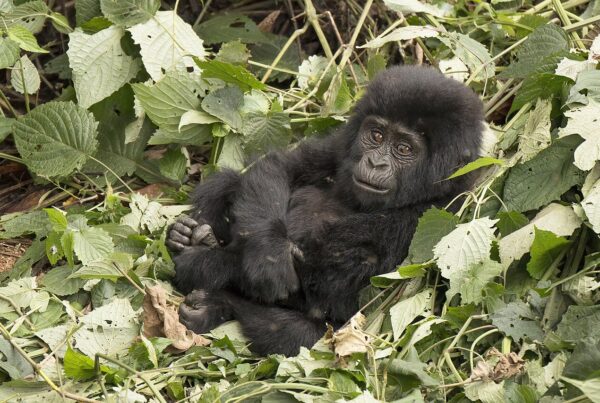
The Bitukura family had three juveniles that morning, and they were, in the specific way of juvenile primates everywhere, entirely uninterested in observing regulations. They moved through the family group with the restless energy of children who have been cooped up too long and are now running at full capacity. They chased each other. They climbed and fell and climbed again. They investigated everything — branches, leaves, each other — with the intense curiosity of creatures for whom the world is still very new.
The Moment: Ten Seconds
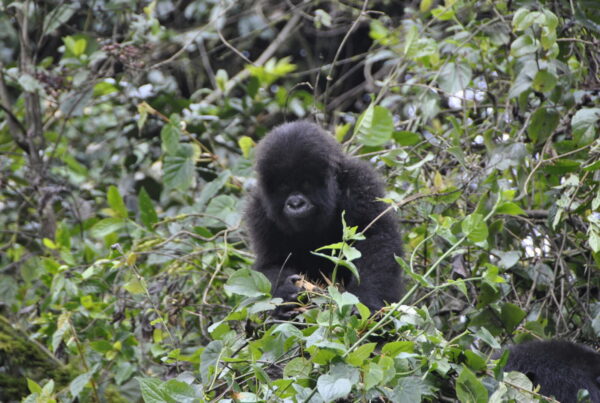
One juvenile had separated slightly from the others and was sitting on a low branch, eating. He was about two years old — still nursing, Jackson would tell us, but increasingly independent. His colouring was not yet the deep black of an adult; he had a brownish tinge and the large, liquid eyes of the very young.
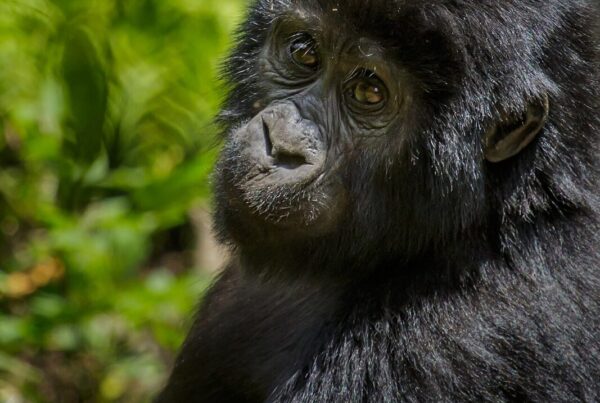
He noticed our group. His eating stopped. He turned his head and looked directly at me — not at the group, at me specifically, in the way that individuals can sometimes single you out in a crowd for no reason you can identify.
Ten seconds. I timed it afterward, counting backward from memory. Ten seconds of a juvenile gorilla looking directly at me with an expression that I can only describe as thinking — not the automatic scanning of a prey animal, not the territorial assessment of a predator, but something that looked, from the outside, like the operation of a mind deciding what to make of something new.
Then he went back to eating.
What Those Ten Seconds Did
I am a biologist by training, though I work now in an unrelated field. I know the science of great ape cognition. I know that gorillas have complex social structures, use tools, demonstrate empathy, show grief, and process information with the kind of flexibility that indicates genuine intelligence. I knew all of this before I arrived in Bwindi.
Knowing it and having a juvenile gorilla look at you for ten seconds are, I discovered, completely different states of knowledge. The science became embodied in those ten seconds in a way it had not been from any paper or documentary or textbook.
The Reclassification
The word I keep returning to is reclassification. Before those ten seconds, my mental categories worked like this: humans here, animals there. Related, certainly — I was not unaware of the evolutionary continuum. But separate categories with a clear boundary.
After those ten seconds, the boundary is harder to locate. Not gone — I am not saying I cannot distinguish between a gorilla and a person. But the category of “mind” has expanded beyond its previous boundaries. Something was thinking behind those eyes. Something was assessing me. The evidence was direct and embodied in a way that no amount of scientific reading could have produced.
What Followed
I stood in that forest for the remaining forty minutes of our hour with the Bitukura family and watched the gorillas with the specific attention of someone who has just been reorganised. Everything I saw — the social interactions, the mothers with infants, the silverback’s authority, the juveniles’ play — carried a different quality of meaning than it had carried in the first twenty minutes. I was not watching animals anymore, exactly. I was watching something that did not have a comfortable category.
The Walk Back
Jackson walked beside me for a stretch on the way back and asked if I had a good sighting. I said I had. He asked if it was my first gorilla trek. It was. He nodded in the way of someone who understands something specific about first times with gorillas.
“Most people,” he said, “come for one time and then need to come back. The gorillas do something.” He did not specify what the something was. I thought I understood.
Why This Matters Beyond Personal Experience
Mountain gorillas are critically endangered. There are just over 1,100 of them on Earth, in two populations — Bwindi Impenetrable National Park in Uganda, and the Virunga massif across Uganda, Rwanda, and the Democratic Republic of Congo. They have recovered from approximately 620 animals in 1989 to their current numbers due to sustained conservation effort funded significantly by tourism.
When I say that ten seconds with a juvenile gorilla changed how I see the natural world, I am also saying something about why these animals must be protected. Not only because they are ecologically important — which they are, as keystone species in one of Africa’s most biodiverse forests. Not only because they share our DNA and our evolutionary history. But because they are minds. Specific, individual, thinking minds. And the loss of each one is not only an ecological loss but a loss of something that looks, unmistakably, like experience.
Going Back
I have booked a return trip. I would like to see a different family — the Nkuringo family in the southern sector of the park, which I have read has a notably active silverback. I would also like to spend more time in Bwindi outside of the trekking context — there are guided walks in the Bwindi forest that do not involve gorilla tracking but give a different relationship to the ecosystem.
Ten seconds reorganised me. I am curious what more time will do.
Contact Uganda Gorilla Trekking to arrange your permit and start planning. Bring everything you know about wildlife and be prepared for it to be rearranged by something that looks at you for ten seconds and then goes back to eating.
Frequently Asked Questions
Uganda is home to the mountain gorilla (Gorilla beringei beringei), one of two subspecies of eastern gorilla. They live exclusively in the Virunga volcanic highlands (Uganda/Rwanda/DRC) and Bwindi Impenetrable Forest (Uganda only). Mountain gorillas are the only gorilla subspecies that cannot survive in captivity — every individual you can trek is a wild animal.
The standard gorilla trekking permit gives you exactly 1 hour with the gorilla family. This time begins when you make first contact with the family — the ranger signals the start. The Gorilla Habituation Experience gives 4 hours with a semi-wild family. The walk to find the gorillas can take 30 minutes to 5 hours depending on where the family has moved.
Stay calm, crouch down slowly, avoid direct eye contact, and remain quiet. Do not run — running triggers a chase response. Rangers accompanying your group manage close approaches. Habituated gorillas are accustomed to humans and almost never make contact, but a charging silverback is managed by staying still and following ranger instructions immediately.
A maximum of 8 visitors per habituated gorilla family per day for standard trekking. The Gorilla Habituation Experience has a maximum of 4 visitors per family per day. These limits are set by UWA to minimise stress on the gorilla families and maintain the quality of the experience.
Uganda is home to the mountain gorilla (Gorilla beringei beringei), one of two subspecies of eastern gorilla. They live exclusively in the Virunga volcanic highlands (Uganda/Rwanda/DRC) and Bwindi Impenetrable Forest (Uganda only). Mountain gorillas are the only gorilla subspecies that cannot survive in captivity — every individual you can trek is a wild animal.