Updated
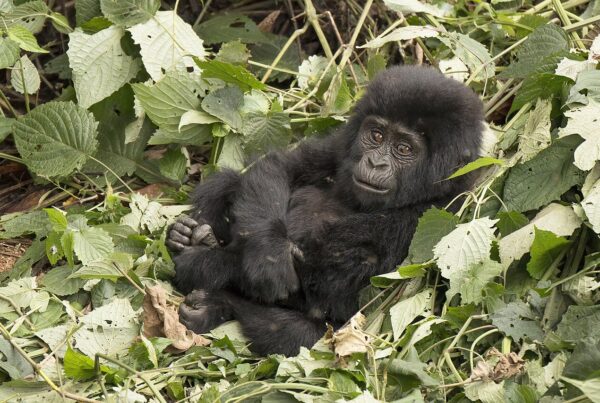
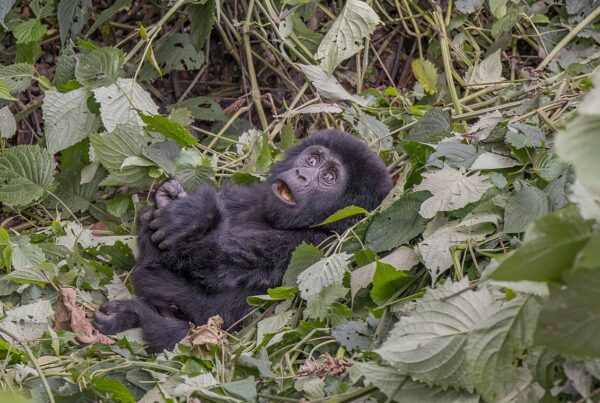
gorilla baby Bwindi same week as daughter story Uganda is a subject central to Uganda’s wildlife tourism, where mountain gorilla conservation and responsible visitor experiences go hand in hand. Our daughter was born the same week this gorilla baby was, and I did not know that when I booked the trek. I found out standing in Bwindi Forest, when our guide, Patrick, mentioned that the infant visible about four metres away had been born in early April. My daughter was born on April 7th. The gorilla baby — a female, still nursing, clinging to her mother with the fierce grip of the newborn — had been born within days of my child. I stood in that forest for a long time after learning this, thinking about what it meant. I am still not sure I have the complete answer, but the thinking has changed things.
Our Daughter Was Born the Same Week This Gorilla Baby Was: A Story
How We Came to Be in Bwindi
My wife Sarah had wanted to see mountain gorillas for years before we finally went. I had always been willing but slow to actually book. Life accumulated, as life does — jobs, mortgage, and then the pregnancy, which shifted everything. We agreed we would go when our daughter was old enough to be left with my parents for two weeks. She turned fourteen months the week we flew to Uganda. My parents came to stay. We boarded the plane.
Neither of us had expected the emotional weight of leaving a fourteen-month-old for two weeks. The night before we flew, Sarah said: “I feel like we’re abandoning her.” We were not abandoning her. We were doing something we had been planning for years, which is what parents are allowed to do. But the feeling was present and real.
What I did not anticipate was how much of the trip would be, obliquely, about her.
Uganda Before Bwindi
We spent four days in Uganda before reaching Bwindi — two nights in Kampala and two nights at Lake Mburo National Park. Both were excellent. Uganda has a quality of welcome that I have not encountered at the same level in many other countries, and the wildlife at Lake Mburo — zebra, impala, hippo, and a remarkable evening boat trip where hippos surfaced beside the boat with a casual indifference to our presence — was an excellent warm-up for what was coming.
The drive to Bwindi from Kampala takes the better part of a day. The landscape changes completely — from the flat, agricultural country around the capital through tea plantation hills to the cool, forested highlands of the southwest, where the park sits on a ridgeline that separates Uganda from the DRC. The forest arrives suddenly and fills the windscreen with green.
The Morning of the Trek
We were assigned to the Habinyanja family. Our guide was Patrick, who had been working with this family for ten years and spoke about them with the specific familiarity of someone who has watched individuals grow from infancy to adulthood.
At the briefing, Patrick mentioned that the family currently had a new infant — female, approximately six weeks old. He said this matter-of-factly, as logistical information. I noted it and moved on to thinking about the walk ahead.
Finding the Family
The trek took ninety minutes. The terrain was demanding — Bwindi’s terrain is always demanding — but manageable. We were both carrying trekking poles and had hired porters, which made the steeper sections considerably less alarming.
The family was feeding when we arrived, spread through a mixed area of forest and bamboo in a valley below the ridge. Patrick positioned us at the edge of the clearing and began quietly identifying animals — this female, that juvenile, the silverback visible through the vegetation to the right.
Then he pointed to a female sitting about four metres away and said: “This is the new mother. The baby was born in early April.”
The Calculation
I do not know exactly what sequence of thoughts led me to say it. Some reflex of new parenthood, perhaps — a constant awareness of dates and developmental stages that you acquire when you have a very young child and that operates below conscious thought.
“April,” I said. “How early in April?”
Patrick said he was not certain of the exact date but the trackers had first observed the infant in the first week of April.
My daughter was born April 7th.
I looked at the mother gorilla. She was looking at me with the mild, assessing calm of a habituated gorilla who has seen many humans and found none of them particularly interesting. Her infant was pressed against her chest, gripping her fur, its small face turned slightly toward the forest light.
What the Coincidence Did
I know it was a coincidence. I am not a superstitious person and I am not proposing mystical significance. But coincidences, when they arrive at the right moment and in the right context, do something to the gap between fact and experience. The fact of primate kinship — 98.3% shared DNA, evolutionary continuity stretching back millions of years — had been in my head before I arrived. The experience of seeing a gorilla mother with a six-week-old infant had been expected to be moving. What I had not anticipated was the specific, unearned intimacy of “the same week as our daughter.”
The infant gorilla had not chosen to be born the same week as my child. The mother had not arranged this. The forest did not know my daughter’s name. But all of it, accumulated in that moment, produced something that I can only call kinship — not metaphorical kinship but the felt sense that this was genuinely, biologically, my family’s extended family.
I cried. Sarah cried. Patrick pretended not to notice, which was the kindest thing.
The Hour With the Habinyanja Family
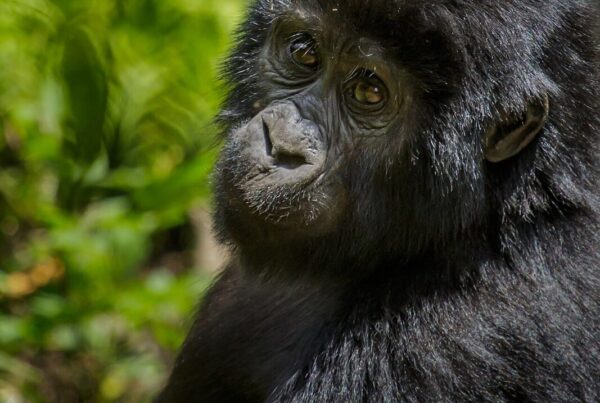
We stayed for the full hour. In that time, the infant shifted and I saw its face clearly — ancient and new, eyes too large for the face, expression registering the world with the uncomplicated attention of something that has not yet learned to be selective about what it finds interesting. It looked at our group briefly. It looked at its mother. It nursed and then slept and then nursed again.
I thought about my daughter doing all of these things fourteen months ago, in a hospital room in Leeds, with the specific completeness of a newborn that has no needs that are not immediately met.
The silverback was present throughout — large, calm, monitoring without apparent effort. He looked at our group once and looked away. The family cohered around him the way families cohere around a stable centre — not consciously, just as a natural property of his presence.
What I Brought Home
My daughter is too young to understand that there is a gorilla in Uganda the same age as her, that they share 98.3% of their DNA, that the gorilla’s mother and her mother were both new mothers in April of the same year, both figuring out the first weeks of infant care in their respective forests.
She will be old enough eventually. I have the photographs. Not of the infant’s face specifically — you cannot capture that face in a way that does justice to it — but of the mother, of the clearing, of the light through the Bwindi canopy. When my daughter is old enough to understand what mountain gorillas are and why they matter, I will show her these photographs and tell her this story. I do not know what she will make of it. I know what I made of it, and I think it is worth passing on.
Planning Your Visit
Uganda gorilla trekking permits are $800 per person. The Habinyanja family at Buhoma is one of the most visited groups in Bwindi, known for being calm and well-habituated. Families with new infants are particularly affecting, but any encounter with the gorillas will give you what you came for.
Contact Uganda Gorilla Trekking to check availability and book. Bring your family stories. The forest has its own, and sometimes they intersect in unexpected ways.
Frequently Asked Questions
Minimum: 3 days (arrive, travel to Bwindi, trek, return — very rushed). Recommended: 5–7 days to include proper travel time and a buffer day. If combining with Kibale chimps or a game park, allow 8–12 days. The 8-hour road journey from Kampala to Bwindi means a 3-day trip involves almost no rest.
A popular 7-day itinerary: Day 1 — Arrive Entebbe, transfer to Kampala or Entebbe hotel. Day 2 — Fly or drive to Bwindi. Days 3–4 — Gorilla trekking (one or two treks), forest walks. Day 5 — Return to Entebbe via Kampala or direct charter. Days 6–7 — Optional Entebbe or Kampala city time before departure.
Yes, but they are in different countries. A combined itinerary typically routes Entebbe (Uganda gorillas) → Nairobi or Kilimanjaro (Tanzania/Kenya safari) with a connecting flight between legs. Allow 10–14 days total. Alternatively, Uganda’s own Queen Elizabeth National Park offers excellent big game alongside the gorilla experience without the international connection.
Near Bwindi: Batwa Cultural Experience (indigenous forest walk with the Batwa community), guided birding walks (350+ species), forest nature walks, waterfall hikes, community village visits. Within 2–3 hours of Bwindi: Lake Bunyonyi (canoeing, island walks), Mgahinga (golden monkey trekking, Virunga volcano hiking).
Uganda is home to the mountain gorilla (Gorilla beringei beringei), one of two subspecies of eastern gorilla. They live exclusively in the Virunga volcanic highlands (Uganda/Rwanda/DRC) and Bwindi Impenetrable Forest (Uganda only). Mountain gorillas are the only gorilla subspecies that cannot survive in captivity — every individual you can trek is a wild animal.