Updated
silverback gorilla close encounter Bwindi 2 metres is a subject central to Uganda’s wildlife tourism, where mountain gorilla conservation and responsible visitor experiences go hand in hand. A silverback gorilla sat two metres from me in Bwindi Forest, and here is what I did: absolutely nothing. Nothing was the correct answer. Nothing was also the only option my body was capable of producing in that moment. Every rational thought, every plan, every rehearsed response from the morning briefing dissolved the instant Nkuringo — the dominant silverback of his family — settled two metres away with the unhurried authority of an entity that has never, in its life, needed to worry about anything.
A Silverback Gorilla Sat 2 Metres From Me: Here Is What I Did
How We Got Two Metres From a Silverback
The Nkuringo family is named for the community adjacent to the southern sector of Bwindi Impenetrable National Park. They are a large, well-habituated group with a history of close interactions with trekking visitors. Our guide, a man named Robert who had been working with this family for seven years, had described the silverback as “confident” — which, as I would discover, was the significant understatement of the morning.
The trek in took about two hours on terrain that earned the park’s name. We crossed streams, scrambled up slopes, pushed through undergrowth that seemed determined to redirect us. By the time Robert raised his hand to stop us, I was sweating freely and had already used both my trekking poles in ways their manufacturer had probably not intended.
The Family Was Feeding
The trackers had located the family in a clearing about the size of a large garden. The gorillas were feeding, spread in a loose configuration through the vegetation. We entered the perimeter of the group as instructed — moving slowly, staying low, keeping noise to zero.
Robert positioned us at the edge of the clearing, crouching behind some undergrowth, and pointed to where the silverback was feeding about fifteen metres away. We settled in and watched.
When Nkuringo Moved
We had been watching for about twenty minutes when Nkuringo rose to his feet and began moving. He was not agitated — his movement was the movement of an animal going from one comfortable position to another, purely because the vegetation at the new location was more interesting.
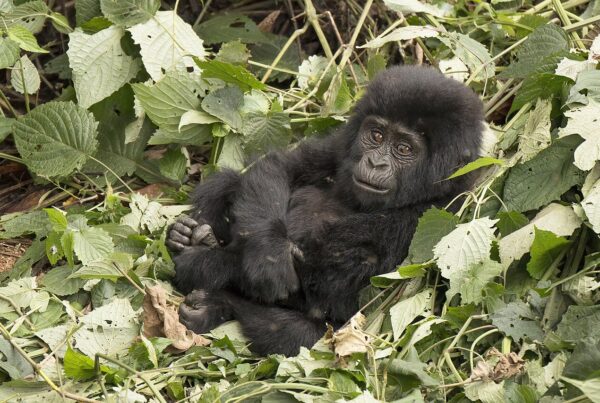
He moved through the family group, past two females who barely registered his passage, past a juvenile who got out of his way with impressive speed, and settled in a patch of vegetation directly in front of our group.
Two metres away. Sitting down. Eating.
What Two Metres Means
The regulations specify a minimum distance of seven metres from gorillas. This regulation is for the gorillas’ protection as much as the visitors’ safety — human respiratory viruses can be transmitted to gorillas, and distance reduces the risk. When a habituated gorilla chooses to close that distance of its own accord, as Nkuringo did, guides allow it. The gorilla is in control. The gorilla always gets to decide the distance.
Two metres is approximately the distance between two people having a conversation. It is well within the range at which you can see individual hairs, can read the expression in eyes, can hear breath. It is the distance at which “large wild primate” stops being a category and becomes a specific individual.
What I Did (Nothing) and Why
I want to be clear about what “nothing” meant in practice, because it was not a passive state. It was the most active stillness I have ever maintained.
I Did Not Move My Camera
I had a camera in my hands. I did not raise it. Not because Robert had told me not to — he had said, in the briefing, that photography was welcome — but because the idea of putting anything between my face and what was two metres in front of me seemed like an act of staggering stupidity. I watched. I just watched.
I Did Not Make a Sound
The urge to whisper to the person next to me — to say “are you seeing this?” or “what do we do?” — was strong and completely suppressible. The quiet was the right response. The quiet was what the situation required.
I Did Not Run
This sounds obvious. It was not. The body’s emergency systems are designed for a world in which a 200-kilogram primate sitting two metres away is a problem to be resolved by fleeing. Overriding those systems required a conscious decision, held steady for a considerable amount of time.
Nkuringo’s Response to My Presence
He glanced at me once. Not a stare — a glance. The kind of glance you give to something that has registered on your peripheral awareness and been assessed as non-threatening in less than a second. Then he returned to eating.
I have thought about that glance a great deal since. In it, I was clearly categorised as something familiar and harmless — a tourist, one of the human shapes that sometimes appear at the edges of his family group and stay quiet and then leave. I was not interesting. I was not a threat. I was furniture with a heartbeat.
There was something both humbling and, in a strange way, deeply reassuring about being so completely not-interesting to a silverback gorilla.
Six Minutes at Two Metres
Robert told me afterward that Nkuringo had stayed at that distance for six minutes before moving back deeper into the vegetation. Six minutes felt like an episode from a different life — a period so saturated with sensory information and emotional response that time stopped operating normally.
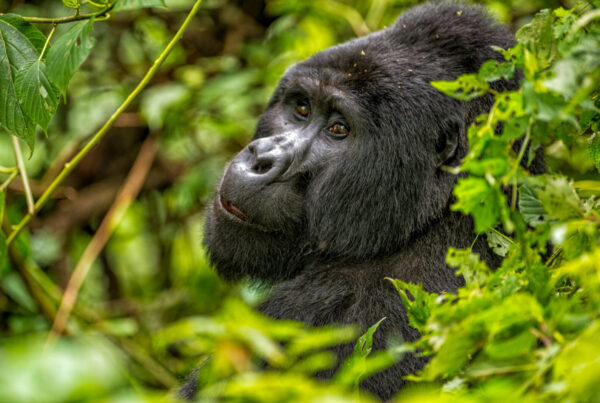
What I registered in those six minutes: the specific grey-silver of his back, broader than a dining table. The sound of his breathing. The smell of the family group — musky, earthy, entirely animal. The sound of plant matter being processed by a jaw that could, if Nkuringo chose, close with a force that no human engineering can replicate. The expression on his face — not threatening, not curious, just present in the complete way of an animal that is entirely at home in its environment.
When he rose and moved away, I exhaled. Robert put his hand on my shoulder briefly, which I understood as a communication in the language of shared extraordinary experience.
What People Ask Afterward
Were You Scared?
Yes and no. The rational part of my brain was not scared — I was following the rules, the animal was habituated, Robert was present and experienced and not scared. But the animal part of my brain was sending signals that I would describe as high alert rather than fear. The body knows when it is in the proximity of something much larger and more powerful than itself, and it communicates this information clearly, regardless of what the rational mind is thinking.
What Did You Think About?
Nothing, for most of it. Conscious thought seemed to require resources that were fully occupied with simply being present. In the last minute or so, as the initial overwhelming quality of the experience settled slightly, I became aware that I was witnessing something extraordinarily rare — a healthy mountain gorilla in its natural habitat, with a population that has recovered from the edge of extinction through decades of dedicated conservation work. That awareness arrived quietly and sat alongside the pure sensory experience without competing with it.
For Anyone Planning to Go
The regulations about distance exist and are important. But habituated gorillas will sometimes close the distance on their own terms. When this happens — and for many trekkers, it does — the correct response is indeed to do nothing. Stay still. Stay quiet. Trust the guide. Trust the process.
You will not regret doing nothing. You may, afterward, find that “nothing” contains more than you would have imagined possible.
Contact Uganda Gorilla Trekking to arrange your permit and plan your visit. Nkuringo is waiting, and he is entirely indifferent to your presence, which is exactly as it should be.
Frequently Asked Questions
A silverback is a mature male mountain gorilla (12+ years old) whose saddle-area back hair has turned silver-grey — a visible sign of adulthood. The silverback leads and protects his family group, decides when and where the group moves, and mediates conflicts. Each habituated gorilla family in Uganda has at least one silverback.
Adult male mountain gorillas weigh 140–200kg and stand 1.5–1.8m tall. Their arm span can reach 2.3 metres. Females are significantly smaller at 70–113kg. Mountain gorillas are the largest living primates. Despite their size, mountain gorillas are generally peaceful and only become aggressive if threatened.
Habituated silverbacks are accustomed to small groups of human visitors and generally ignore the trekking group. You may see the silverback feeding, resting, grooming family members, or moving the group through the forest. Direct eye contact should be avoided. If a silverback charges or bluff-charges, rangers instruct visitors to crouch down, avoid eye contact, and stay still.
A blackback is a sub-adult male gorilla (8–12 years old) whose hair has not yet turned silver. Blackbacks have not reached full maturity and typically live in the family group until they leave to establish their own. A silverback is a fully mature male, larger, dominant, and recognisable by the silver saddle. Both may be present in a single habituated family.
Uganda is home to the mountain gorilla (Gorilla beringei beringei), one of two subspecies of eastern gorilla. They live exclusively in the Virunga volcanic highlands (Uganda/Rwanda/DRC) and Bwindi Impenetrable Forest (Uganda only). Mountain gorillas are the only gorilla subspecies that cannot survive in captivity — every individual you can trek is a wild animal.