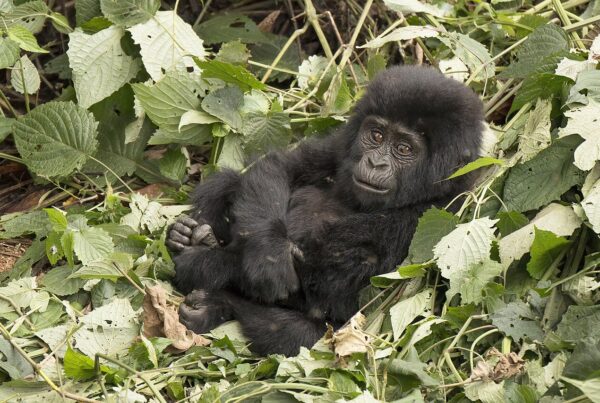
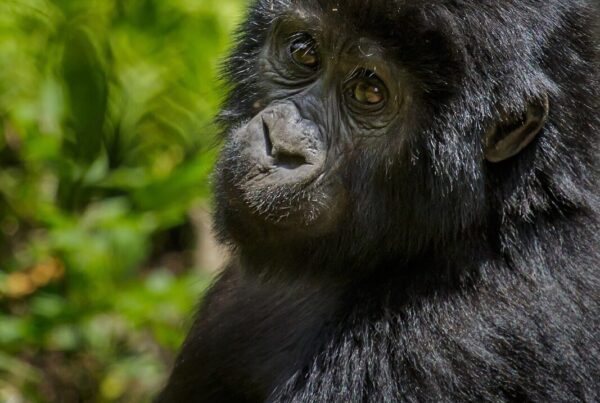
The oldest known mountain gorilla was 43 years old, and her name was Poppy. Born into the Karisoke study area in the Virunga massif in 1976 — making her birth four years before Dian Fossey’s death, which means she would have known the founder of mountain gorilla research personally in the way that habituated gorillas come to know the people who spend time in their presence — Poppy lived a life that was watched, documented, and celebrated by the research community in a way that few wild animals have been. Her death in 2018 was marked by an obituary in scientific journals and notices in the international press. This is the story of her life, and what it tells us about mountain gorilla longevity and the conservation that made it possible.
Poppy’s Early Life
Poppy was born to a female named Effie in the group known as the Pablo group, in the Virunga volcanoes of what is now Rwanda’s Volcanoes National Park. She was part of the original set of gorillas studied by the Karisoke Research Centre, founded by Dian Fossey in 1967. Fossey was killed in 1985; Poppy was nine years old at the time, and the researchers who took over the work at Karisoke knew her as an adolescent who would grow up to become the longest-lived mountain gorilla on record.
Her early years were documented in the standard way of long-term primate research: daily observation by researchers who knew her individually, recorded in the continuous time-series data that makes Karisoke one of the longest-running wildlife monitoring programmes in Africa.
A Full Gorilla Life
Poppy reached sexual maturity at around ten to twelve years — standard for mountain gorillas — and had her first infant at approximately fifteen years. Over her lifetime, she gave birth to four known surviving offspring, contributing directly to the mountain gorilla population at a time when every birth mattered enormously (the population was at its nadir in the late 1980s and early 1990s).
Her social history included periods as a member of the Pablo group and later of the Isabukuru group, reflecting the typical female life history of mountain gorillas, in which females may transfer between groups, following attractive silverbacks or leaving groups where conditions have become unfavourable. Each transfer was documented by the Karisoke researchers, adding to the longitudinal dataset that makes Poppy’s life one of the best-documented in mountain gorilla research.
Longevity and What Determines It
The maximum lifespan of mountain gorillas in the wild is not precisely known. Poppy’s 43 years represents the longest documented case, but there may be older individuals who have not been continuously monitored since birth (making accurate age determination impossible) or who have lived in unhabituated groups outside research ranges. Estimates based on tooth wear and physical condition suggest some individuals may reach their late thirties to mid-forties under good conditions.
What Enables Longevity
The factors that enable mountain gorillas to reach advanced age are illuminating for conservation: consistent food availability in high-quality habitat, absence of significant predation (mountain gorillas have no natural predators to speak of in modern Bwindi or the Virungas), and access to veterinary care that can prevent deaths from treatable conditions. Poppy’s longevity was partly natural and partly a product of the conservation infrastructure that had been built around her population.
Comparison With Captivity
Gorillas in captivity — western lowland gorillas, primarily, as mountain gorillas do not survive in captivity — have reached ages of 50 to 60 years under the consistent nutrition, veterinary care, and absence of natural mortality risks that zoo conditions provide. The gap between 43 years for the longest-lived wild mountain gorilla and 50+ years for captive lowland gorillas reflects the harder conditions of wild life rather than any intrinsic limitation of the mountain gorilla lifespan.
Poppy’s Grandchildren and Great-Grandchildren
By the time of her death in 2018, Poppy had grandchildren and potentially great-grandchildren within the Karisoke study population. The Karisoke database allows researchers to trace family trees across multiple generations — Poppy’s descendants can be identified through genetic analysis and through the continuous photographic and observation records that Karisoke maintains.
This multigenerational documentation is one of the most valuable aspects of long-term primate research. It allows researchers to ask questions about the relationship between early social experience and adult behaviour, about the inheritance of social rank through female lineages, and about the health trends that run through family lines over decades. Poppy’s 43 years of documented life are foundational data for these analyses.
What Poppy’s Story Means for Conservation
Poppy lived from 1976 — when the mountain gorilla population was in steep decline — to 2018, by which time the population had more than tripled from its nadir. She witnessed, from inside, the conservation effort that saved her species. Her life spans the entire arc of modern mountain gorilla conservation, from crisis to recovery.
The fact that it was possible for her to live 43 years — to have four surviving offspring, to see grandchildren, to die of old age rather than poaching or disease or habitat loss — is evidence that the conservation model is working. Not just working in the abstract sense of “population numbers are increasing” but working in the specific, individual sense of: one gorilla had a full, long life.
The Gorillas You Will Meet
The gorillas in Bwindi’s habituated family groups include animals that have been monitored since birth and whose ages are known precisely. Some are young — infants and juveniles. Some are middle-aged adults in their prime. Some may be in their twenties or thirties, approaching the upper range of documented wild gorilla longevity.
None of them knows their age, or knows that they have a known age. They are simply living their lives in the forest, as Poppy lived hers. The fact that those lives can now be long, and documented, and known, is what conservation success looks like from the inside.
Uganda gorilla trekking permits are $800 per person. Contact Uganda Gorilla Trekking to book your permit. The gorillas have stories. Some of them are longer than you might expect.