The Largest Living Primate
Mountain gorillas are the largest non-human primates on Earth — though within the gorilla species, the title of absolute largest belongs to their close relatives, the eastern lowland gorillas of DRC. Mountain gorillas nonetheless represent extraordinary physical scale, and the size difference between males and females is among the most pronounced sexual dimorphism of any primate species. Understanding gorilla size in concrete terms — the actual weights, heights, and physical dimensions of these animals — transforms an abstract knowledge of their existence into something more immediately graspable.
Adult Male Size: The Silverback
Adult male mountain gorillas, designated silverbacks for the distinctive silver-grey saddle of fur that develops across their back as they reach sexual maturity (around 12 to 15 years of age), are truly massive animals. Silverback body mass ranges from approximately 140 to 200 kilograms in the wild, with the average falling around 160 to 170 kilograms. Captive silverbacks, often better nourished and less active than wild individuals, sometimes reach 230 kilograms.
Standing bipedally — a position gorillas adopt briefly, most commonly during threat displays — silverbacks reach 1.5 to 1.8 metres in height. On all fours in their characteristic knuckle-walking stance, their shoulder height is approximately 0.9 to 1.2 metres. The arm span of an adult male mountain gorilla is remarkable: typically 2.3 to 2.6 metres, significantly exceeding their standing height. This long-armed build reflects adaptation for climbing and powerful reach in vegetation, even though mountain gorillas spend the majority of their time on the ground.
Chest Width and Physical Power
The chest width of adult male gorillas is one of their most imposing physical characteristics — broad, barrel-chested, with pronounced muscle development across the pectorals, deltoids, and trapezius. When a silverback performs a chest-beat display, the cupped hands striking this broad chest produce the resonant, low-frequency booming sound audible for distances of up to a kilometre in the forest. The chest beat is not merely dramatic — it is a genuine demonstration of physical quality, advertising the silverback’s size and condition to rivals and group members alike.
Adult Female Size
Female mountain gorillas are substantially smaller than males, reflecting the pronounced sexual dimorphism of the species. Adult females typically weigh 70 to 100 kilograms — roughly half the mass of an adult silverback. Their standing height is approximately 1.3 to 1.5 metres bipedally, and their build, while powerful relative to most animals, lacks the extreme musculature of mature males.
The size difference between male and female gorillas is directly related to their social system. In gorilla society, silverbacks compete with other males for reproductive access and must physically defend their family groups from rival males and threats. Large body size in males has been strongly selected for because it is the primary determinant of fighting ability and competitive success. Females, who do not engage in the same competitive contexts, have not been subject to the same selection pressure for extreme body size.
Blackback Males
Between juvenile status and full silverback maturity, male gorillas pass through a blackback stage — typically from around 8 to 12 years. Blackbacks have developed their adult male body form and are still growing, but have not yet acquired the silver saddle and full muscle development of silverbacks. Blackback males typically weigh 100 to 140 kilograms, making them larger than adult females but not yet the full impressive size of mature silverbacks. In multi-male gorilla groups, blackbacks are present as subordinate males who may eventually inherit group leadership or leave to establish their own groups.
Infant and Juvenile Gorilla Size
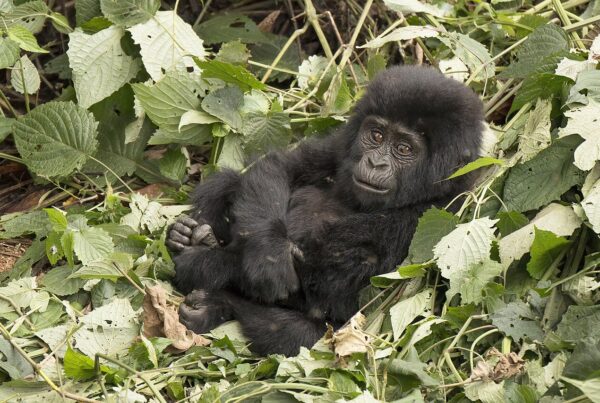
Gorilla infants are born weighing approximately 1.8 to 2.2 kilograms — considerably smaller than human infants relative to maternal body weight. This comparatively small birth weight reflects that gorillas, like most primates, are born relatively undeveloped and undergo much of their physical growth post-birth. Newborn gorillas are entirely dependent, unable to support their own weight initially, though their grasping reflex allows them to cling to maternal fur.
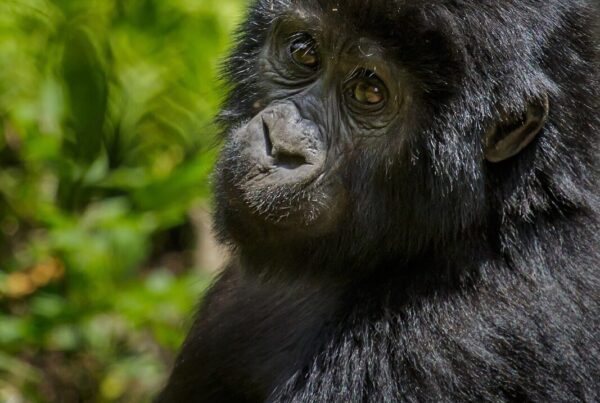
Growth in the first year of life is rapid. By one year, infants typically weigh 8 to 12 kilograms. By five years (juvenile stage), a mountain gorilla weighs approximately 30 to 50 kilograms. The growth trajectory continues through adolescence, with full adult size not reached until 12 to 15 years for males and somewhat earlier for females.
How Size Affects Trekking Encounters
The physical scale of a silverback gorilla is one of the defining elements of the trekking experience. The seven-metre distance maintained during gorilla visits is partly set to minimise disease transmission risk, but it also provides a perspective from which the full physical presence of an adult male is visible in a way that closer proximity would paradoxically obscure. At seven metres, you can see the complete posture, the breadth of the chest, the mass of the animal in its environment. That perspective is part of what makes the encounter so viscerally memorable.
First-time visitors are often surprised by how much larger a silverback appears in person than in photographs. Part of this is the jungle setting — the dense vegetation creates frames and contrasts that amplify scale. Part of it is the animal’s posture, presence, and the unmediated awareness that this is not a captive animal but a wild one, encountered in its own territory on its own terms.
Final Thoughts
A silverback mountain gorilla weighing 170 kilograms with a two-and-a-half-metre arm span is not an abstraction — it is one of the most physically impressive mammals you will encounter anywhere on Earth. The size differential between males and females, the growth trajectory from tiny infant to massive silverback, and the sheer physical scale of an adult male are all biological realities that the trekking encounter makes immediate and undeniable. Scale, in the presence of a silverback, is not a statistic. It is a presence.